
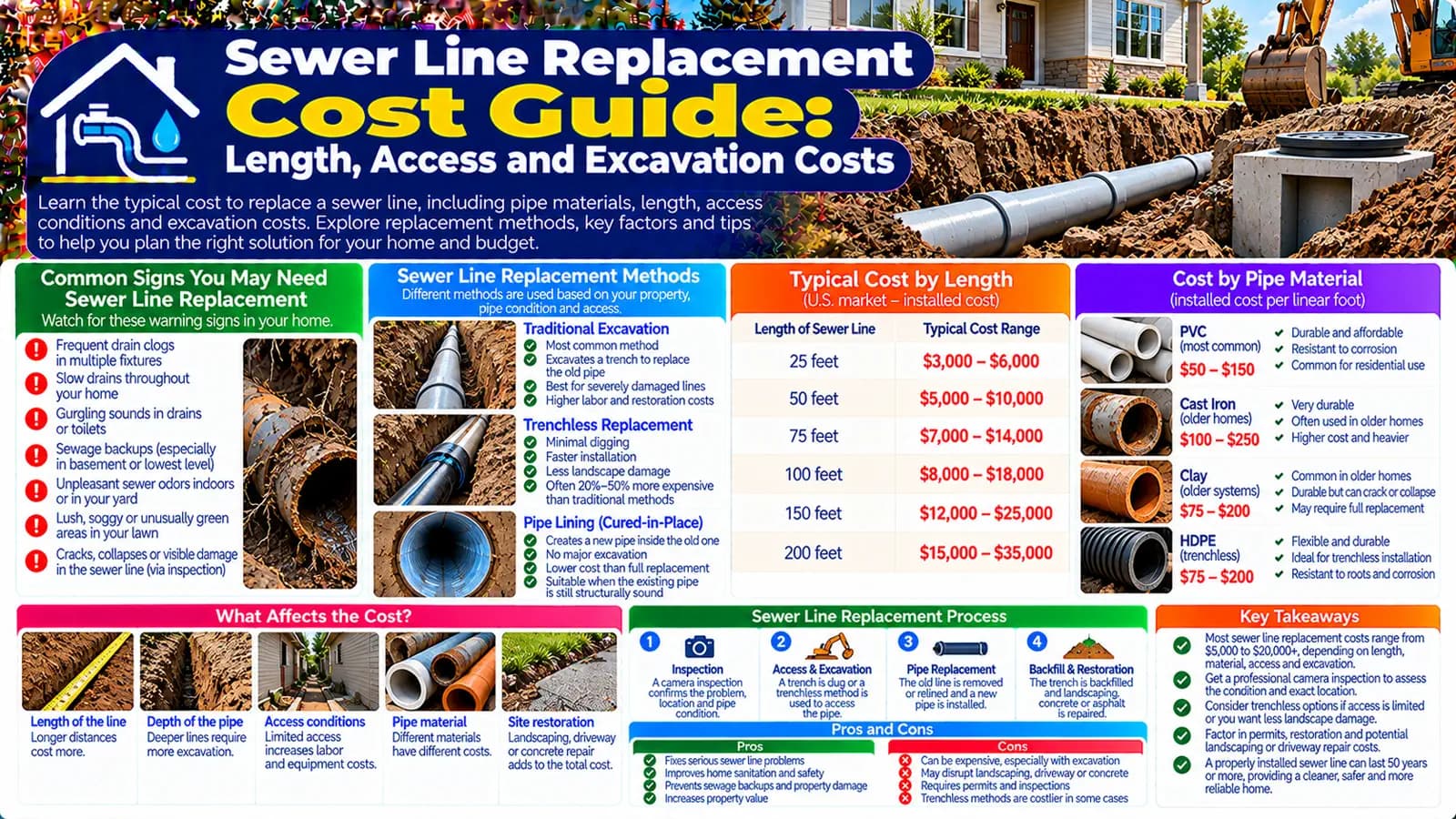
Define the pipe, ownership boundary, and failure before pricing
This guide concerns the private underground wastewater pipe that carries discharge away from a building toward a public sewer connection. It is not internal water-supply repiping, an onsite septic treatment system, a yard stormwater drain, or replacement of a utility-owned sewer main.
Responsibility does not follow one universal property-line rule. Ownership, easements, lateral arrangements, shared connections, utility policy, and jurisdiction matter. Obtain written boundary confirmation from the relevant municipality, utility, sewerage company, landlord, or managing body before accepting a private quote.
What the live Sewer Line Replacement calculator models
| Input | US model | UK model | Budget meaning |
|---|---|---|---|
| Affected length | 5–300 linear ft | 2–100 metres | Multiplies the selected installed method range |
| Method | Traditional excavation, lining, pipe bursting | Excavation and replacement, lining, pipe bursting | Sets the per-unit starting range |
| Depth / access | Easy or shallow, standard, deep or difficult | Easy or shallow, standard, deep or difficult | Percentage adjustment for access complexity |
| Surface | Lawn or soil, paving, under structure | Garden or soil, paved or driveway, under structure | Represents disruption and complexity |
| Condition | Localized, moderate, severe or full replacement | Localised, moderate, severe or replacement | Adjusts the method subtotal |
| Fixed allowances | Camera, permit, cleanout, landscape, concrete | CCTV, setup, manhole, reinstatement, waste | Added only when selected |
Length is the quantity driver, not the entire scope
Measure the affected route used for pricing, not a casual straight-line guess across the yard. Contractors may distinguish the confirmed defective section, connection work, access pits, point repairs, and any route extending toward the public interface.
A short line beneath a structure or driveway can cost more than a longer line through open soil. Ask each bidder to state measured length, pipe endpoints, included connections, depth assumptions, and how a changed route or additional failed segment will be valued.
Method changes labor, equipment, exposure, and restoration
Traditional excavation prices continuous access to the pipe. Lining is a rehabilitation scope; pipe bursting is a trenchless replacement scope. The correct category depends on inspection findings and what the proposed system can accomplish, not on whichever headline rate appears lowest.
Keep diagnostic work separate from production work. A camera or CCTV survey, locating, cleaning needed for inspection, access opening, and post-work verification should each be identified so a low proposal is not simply missing the evidence required to support it.
Depth and access amplify site difficulty
Deeper or difficult access can affect excavation protection, equipment reach, dewatering planning, spoil movement, working room, service crossings, temporary support, and labor. The calculator expresses this through a percentage adjustment, but a site-specific quote must define the actual method and constraints.
- Gate width and equipment route
- Existing buildings, walls, trees, utilities, and easements
- Groundwater or surface-water inflow
- Space for spoil, materials, and safe operations
- Traffic, footpath, road, or public-right-of-way controls
- Service continuity and occupant access
Price opening and restoration as one coordinated scope
Lawn, planting, irrigation, paving, driveway concrete, patios, floors, and structures create different removal and reinstatement work. The live US calculator has separate landscape and concrete allowances; the UK calculator separates surface reinstatement and waste.
Define who removes and replaces each surface, the restoration area and finish, matching limitations, curing or reopening constraints, irrigation or edging repair, compaction, settlement follow-up, and whether disposal is included. A trenchless proposal still needs access-pit and reconnection restoration.
Pipe material and connections belong in the quote even when not calculator inputs
The live estimator does not ask for pipe material, diameter, number of bends, or connection count. Those details may still affect method suitability, fittings, inspection, access, cleanout or manhole work, reconnections, and testing. Treat them as contractor-verified scope rather than inventing a calculator adjustment.
The US cleanout allowance and UK manhole allowance are optional project sums. They are not automatic substitutes for every junction, property connection, public-sewer interface, or access chamber.
Allow for locating, permits, inspection, and public interfaces
The US estimator includes a permit allowance; the UK estimator does not label a separate permit checkbox, so approvals and utility or building-control requirements need confirmation outside the calculated total. Both markets require local responsibility and connection checks.
- Confirm ownership and the exact private/public interface.
- Obtain available records and locate buried services through the applicable utility-locating process.
- Ask which permits, notices, inspections, utility approvals, or right-of-way controls apply.
- Separate public-space traffic management and public-infrastructure work from the private-property quote.
- Record required pre-work and post-work inspection evidence.
Commonly overlooked sewer-line costs
| Cost area | Questions for the written scope |
|---|---|
| Diagnosis | Camera/CCTV, cleaning, locating, report, recording, depth and route |
| Access and safety | Excavation setup, protection, dewatering, utilities, traffic and public areas |
| Pipe work | Method, material, diameter, fittings, connections, cleanout/manhole and testing |
| Continuity | Temporary arrangements, outage window and occupant coordination |
| Ground and waste | Excavated material, contaminated material protocol, haulage and disposal |
| Restoration | Backfill, compaction, settlement, lawn, planting, paving, driveway and interior finishes |
| Administration | Permit, inspection, authority or utility charges, engineering and documentation |
| Exclusions | Sewage cleanup, interior damage, internal plumbing, septic work and utility-owned network work |
Compare complete quotes, not one per-foot or per-metre number
Normalize the same endpoints, method, inspection evidence, connections, surface openings, restoration standard, waste, approvals, testing, warranty, and exclusions. A higher unit rate with complete reinstatement may be more comparable than a low rate that stops at backfill.
Use low, typical, and high outputs as planning scenarios. They are not bids and cannot determine method suitability, responsibility, buried conditions, or the final length discovered after investigation.
Keep sewer, plumbing, septic, and drainage budgets separate
| Project | What it covers | What it does not cover |
|---|---|---|
| Sewer line | Private underground wastewater conveyance toward a public connection | Internal water-supply repiping or utility-owned mains |
| Plumbing replacement | Domestic internal supply-pipe replacement | The underground sewer lateral |
| Septic system | Onsite wastewater collection, treatment, and dispersal | A public-sewer service line |
| Yard drainage | Surface and subsurface stormwater management | Sanitary wastewater conveyance or treatment |
Build a market-specific sewer-line planning range
Enter the affected length, then choose the method category supported by the current evidence, depth or access, surface, and condition. Add only the inspection, permit, access, waste, or restoration allowances that genuinely belong to the scope.
Plan with the right calculator
Enter your project details and select the United States or United Kingdom market for Low, Typical, and High planning estimates.
Frequently asked questions
How much does sewer-line length affect cost?+
Length is the main quantity input in both live market models: linear feet in the US and metres in the UK. The installed method rate scales with affected length, while inspection, permits, cleanouts or manholes, setup, waste, and restoration are separate allowances where supported.
Why can excavation make one sewer quote much higher than another?+
Depth, safe access, soil and groundwater, buried services, structures, traffic or right-of-way constraints, spoil handling, and the surface that must be opened and restored can change labor, equipment, protection, and reinstatement. The calculator represents depth and surface complexity but cannot survey the site.
Is trenchless sewer replacement always cheaper?+
No. It can reduce continuous surface excavation and restoration, but specialist equipment, access pits, inspection, pipe condition, connections, obstructions, alignment, and method suitability can offset those savings. Compare complete scopes rather than method labels.
Does the estimate include driveway or landscaping restoration?+
Only when the relevant allowance is selected. The US model separates yard or landscape and driveway or concrete restoration. The UK model separates surface reinstatement and waste removal. Define the restored area, finish, responsibility, and matching standard in each quote.
Am I responsible for every sewer pipe near my property?+
Not necessarily. Responsibility varies by jurisdiction, ownership, easement, connection, and location. Confirm the private/public boundary with the relevant utility or sewerage authority before authorizing work; the calculator excludes utility-owned network replacement.
Should a camera or CCTV survey be included?+
The calculators offer camera or CCTV work as a separate allowance. A survey may help document route and condition, but the contractor should state access, footage, findings, limitations, locating, and whether post-work verification is included.
Sources & references
- Sanitary Sewer Overflows · U.S. Environmental Protection Agency
- Trenching and Excavation · Occupational Safety and Health Administration
- Before You Dig · Common Ground Alliance
- Public and Private Sewers · Ofwat
- Drainage and Waste Disposal: Approved Document H · GOV.UK
- Sewer Line Replacement or Repair Costs · Angi
- Drain Repair Near Me · Checkatrade