
Start with the defect and required outcome
Do not choose between excavation, lining, and bursting until the affected route, ownership, material, diameter, geometry, connections, condition, and required outcome are sufficiently understood. Lining rehabilitates a host pipe; bursting replaces a pipe along its route; excavation exposes and replaces the required section.
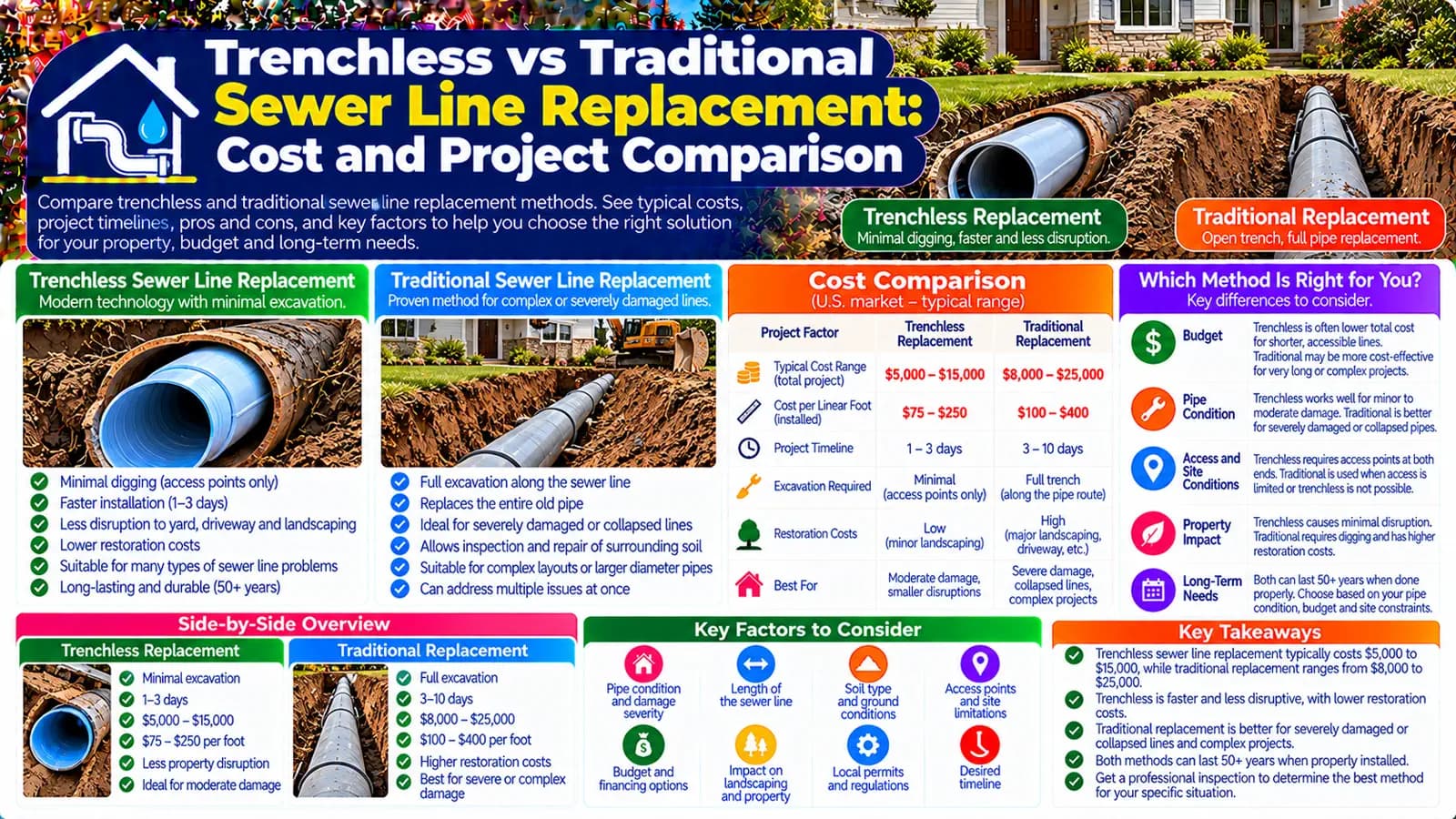
Trenchless versus open excavation at a glance
| Question | Traditional / open excavation | Trenchless lining or bursting |
|---|---|---|
| Pipe access | Exposes the required pipe route directly | Uses the existing route plus access points or pits |
| Existing pipe | Can remove and replace exposed failed pipe | Lining depends on a suitable host; bursting depends on route, material and clearance |
| Surface disruption | Usually a larger continuous opening | Usually smaller openings, but not zero disturbance |
| Connections | Exposed connections can be rebuilt within the open work | Connections may need separate excavation and reconnection |
| Alignment or grade | Direct access may allow route correction within designed scope | Existing route can constrain the result; inspection must establish feasibility |
| Equipment | Excavation, handling and reinstatement plant | Specialist lining or bursting equipment plus access and support work |
| Restoration | Often a major cost center | May be reduced, but pits, point repairs and reconnections remain |
| Best use | Determined by site and defect, not a universal rule | Determined by site and defect, not a universal rule |
What open excavation buys—and what it disrupts
Direct exposure can make an identified failed section, connection, obstruction, route correction, or complete removal accessible. That visibility does not make the project simple: excavation planning, buried services, groundwater, soil stability, nearby structures, waste, compaction, testing, and restoration remain material.
Its cost can be competitive in an open lawn or a short accessible point repair. The same method beneath a driveway, patio, floor, wall, structure, busy access, or public space can shift much more of the budget into opening, protection, logistics, and reinstatement.
Lining is rehabilitation, not a synonym for replacement
A liner uses the existing pipe as a host. Suitability depends on the host condition, shape, continuity, access, connections, preparation, product system, and the defect the proposal is meant to correct. Ask whether the quote is structural rehabilitation, local lining, or another defined scope—and what evidence supports it.
Because the live calculator prices lining as a distinct per-foot or per-metre method, do not present its result as the cost of new excavated pipe. Confirm whether cleaning, CCTV, bypass or service interruption, reconnections, curing, testing, and post-work footage are included.
Pipe bursting is replacement with access requirements
Pipe bursting uses the existing route as a guide while drawing new pipe into place. It may reduce the need for a continuous trench, but commonly requires insertion and receiving access, service reconnections, equipment setup, and inspection. Existing material, diameter, alignment, bends, obstructions, nearby services, ground response, and connection layout can affect feasibility.
Do not assume that a successful municipal main project proves suitability for a private lateral. Scale, access, pipe records, service layout, approval, and risk allocation differ.
Inspection is the gate before method selection
- Confirm private ownership and both endpoints of the proposed work.
- Obtain or create reliable route and depth information and locate other buried services.
- Document pipe material, diameter, connections, geometry, defects, deformation, breaks, roots, obstructions, and accessible sections.
- State the intended outcome: local repair, rehabilitation, full replacement, route correction, capacity change, or reconnection.
- Have the proposing specialist state suitability, limitations, exceptions, and fallback work in writing.
A camera view is important evidence but may not answer every question about exterior ground, exact location, ownership, groundwater, adjacent utilities, or hidden connections.
Compare the same all-in cost boundary
| Category | Traditional quote | Trenchless quote |
|---|---|---|
| Preconstruction | Locating, camera/CCTV, permits, setup | Locating, cleaning, camera/CCTV, design or method verification |
| Production | Excavation, removal, new pipe, bedding/backfill, connections | Liner or new pipe, specialist equipment, pits/access, connections |
| Site controls | Utilities, groundwater, structures, traffic, spoil | Utilities, equipment footprint, pits, point repairs, temporary service |
| Verification | Inspection, testing, final records | Process records, inspection/testing, post-work footage |
| Restoration | Full disturbed route and finishes | Every pit, opening, reconnection, point repair and equipment area |
| Contingency | Unexpected ground, pipe or connection conditions | Failed access, obstruction, unsuitable host/route, conversion to excavation |
Restoration savings depend on what lies above the line
A long run beneath valuable paving, mature landscaping, interior floor, or constrained access may make reduced surface disturbance important. Across open soil, restoration savings may be less decisive. Price the exact affected finishes rather than using ‘minimal disruption’ as an unquantified benefit.
Ask for drawings or marked plans showing every excavation, equipment location, work zone, haul route, and reinstatement area. Trenchless should mean a smaller defined footprint—not an unspecified promise of no digging.
US and UK calculator treatment
The US model prices traditional excavation at $50–$175 per linear foot, lining at $60–$200, and bursting at $75–$250 before depth, surface, condition, and selected fixed allowances. These are live planning bands, not a claim that one method is nationally cheapest.
The UK model prices excavation and replacement at £150–£320 per metre, lining at £80–£180, and bursting at £140–£350 before depth, surface, condition, and selected allowances. UK private-drain responsibility and approvals must be confirmed independently.
Method does not change the responsibility boundary
A contractor’s technical ability to reach a pipe does not prove the homeowner owns it or may alter it. Confirm the private/public transition, easements, shared arrangements, connection consents, and any road or footpath controls before comparing construction approaches.
Questions that expose incomplete comparisons
- What exact defect and pipe segment is each method addressing?
- Is the proposal rehabilitation, replacement, or a combination?
- What evidence confirms material, diameter, route, connections, and condition?
- Which access pits, point excavations, disconnections, or service interruptions are required?
- What surfaces are removed and who restores them to what standard?
- What inspection, testing, records, warranties, exclusions, and fallback work are included?
- What happens to price and responsibility if trenchless work encounters an obstruction or unsuitable pipe?
Model both methods without declaring a winner
Enter the same affected length, depth, surface, and condition for each credible method, then add the same diagnostic and restoration boundary. Use the difference to frame contractor questions—not to replace inspection or method design.
Plan with the right calculator
Enter your project details and select the United States or United Kingdom market for Low, Typical, and High planning estimates.
Frequently asked questions
What is the main difference between open excavation and trenchless work?+
Open excavation exposes the affected pipe along the required route. Trenchless lining or bursting uses the existing route with limited access excavations, but it is not excavation-free and remains dependent on the existing pipe, alignment, connections, access, and site conditions.
Is pipe lining the same as pipe replacement?+
No. Lining rehabilitates an existing pipe by adding a liner, while pipe bursting is a replacement concept that draws new pipe through the existing route as the old pipe is displaced. The live calculator labels them separately.
When might traditional excavation be the clearer option?+
It may be considered where direct exposure is needed to correct a localized failure, route, grade, connection, severe deformation, obstruction, or another condition that the proposed trenchless system cannot address. Method selection requires inspection and contractor or designer review.
Does trenchless work avoid all landscaping and paving damage?+
No. Access pits, service reconnections, equipment areas, locating, point repairs, and material handling can still disturb surfaces. Its restoration footprint may be smaller than a continuous trench, but quotes should identify every opening and reinstatement responsibility.
What inspection should happen before choosing a method?+
The scope may include route and ownership confirmation, cleaning where appropriate, CCTV or camera inspection, locating, measurements, material and diameter identification, connection review, and site-access assessment. The specialist should document whether the evidence is sufficient for the proposed method.
Can a homeowner enter a sewer, manhole, or excavation to inspect it?+
No. Sewers and some excavations can present collapse, hazardous-atmosphere, flooding, biological, and utility hazards. Keep clear and use qualified professionals working under applicable safety controls.
Sources & references
- Trenchless Sewer Rehabilitation · U.S. Environmental Protection Agency
- Sewer Construction Methods · City of Portland Environmental Services
- Pipe Bursting · City of Portland Environmental Services
- Trenching and Excavation · Occupational Safety and Health Administration
- Excavations · Health and Safety Executive
- Safe Work in Confined Spaces · Health and Safety Executive
- Sewer Line Replacement or Repair Costs · Angi