
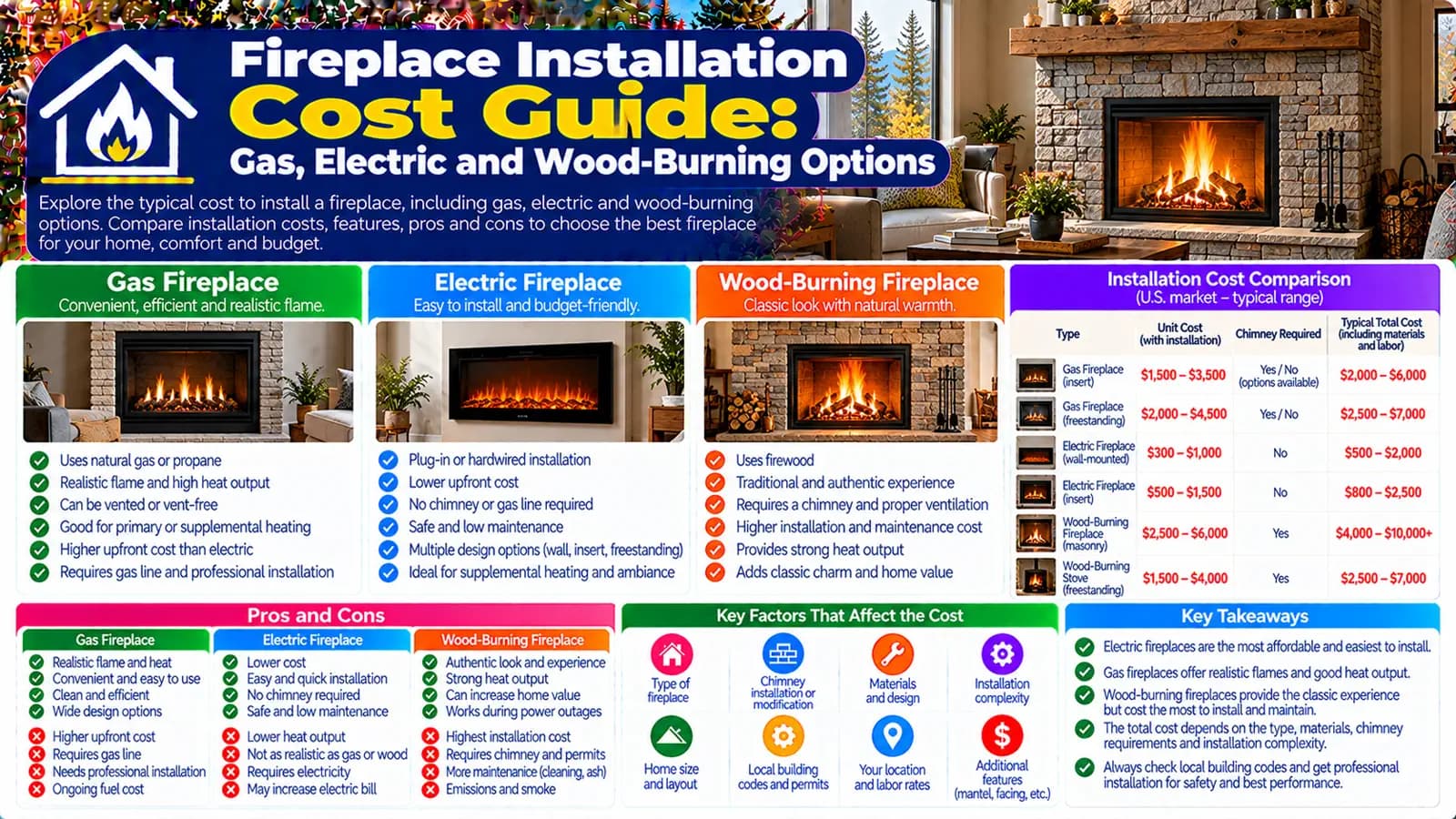
Separate appliance, venting, chimney, and finishes
A complete proposal should identify the appliance, listed or approved installation system, fuel or power, combustion air where relevant, vent or flue, chimney relationship, opening or enclosure, hearth, surround, clearances, structure, controls, utilities, protection, testing, commissioning, certification, cleanup, and warranties.
A vent or flue is not automatically a masonry chimney. An existing chimney is not automatically a suitable flue. Electric fireplaces do not have combustion exhaust, though built-in and heating models can still require electrical, enclosure, clearance, and finish work.
US and UK configurations preserve native categories
USD per fireplace: electric, gas, wood-burning fireplace/stove, or custom masonry; existing, standard-new, or complex installation; existing, new, or complex vent/flue; basic through premium finish; gas line, electrical circuit, hearth/surround, permit, structural/framing, and optional complete new masonry chimney.
GBP per fireplace/fire: electric fire, gas fire, wood-burning stove/fire, or premium/custom fireplace; existing, standard-new, or complex opening; existing suitable flue, new liner/flue, or significant chimney work; basic through premium finish; liner, hearth, surround, gas, electrical, and structural-opening allowances.
How the fireplace estimate is built
Count multiplies the selected installed fireplace or fire type. Installation complexity and vent or flue work scale per unit; finish adjusts the installed subtotal. Utilities, hearth, structure, and other checkboxes remain fixed project allowances.
The US includes a permit allowance and optional complete new masonry chimney. The UK separately exposes a chimney-liner project allowance, hearth, and surround. Avoid double counting when the chosen flue tier or premium finish already includes part of that work.
Fuel and appliance form shape the base scope
| Type | Core installation questions | Common separate scope |
|---|---|---|
| Electric fireplace / electric fire | Plug-in versus dedicated supply, built-in or freestanding form, heater output, enclosure, controls, clearances, and finish | Circuit or electrical work, framing, media wall or surround, making good |
| Gas fireplace / gas fire | Approved appliance, gas type and supply, venting category, air supply, controls, opening, clearances, and commissioning | Gas connection, electrical controls, vent/flue, opening or surround, permits or notification |
| Wood-burning fireplace, stove, or fire | Appliance or open-fire concept, output selection, hearth, clearances, air supply, chimney or engineered flue, terminal, and certification | Liner or flue, opening, hearth, chimney assessment, storage, access, and building work |
| US custom masonry / UK premium-custom | Bespoke structure, firebox or appliance, finish, hearth, surround, support, venting, and approvals | Engineering, complete chimney or significant chimney work, utilities, access, and extended finishing |
An existing opening must be proved suitable
The existing-infrastructure option assumes more than empty space. Dimensions, support, hearth, clearances, combustible materials, ventilation, chimney or vent route, flue condition, damp, services, and the proposed appliance need assessment.
A new or complex installation can involve wall or chimney-breast alteration, framing, structural support, noncombustible construction, penetrations, enclosure ventilation, floor protection, trim, plastering, painting, and coordination with other trades.
Match the exact appliance to its approved exhaust system
Electric fires do not produce combustion gases. Gas products can use different approved venting or flue arrangements. Wood appliances require an appropriate combustion-products route and air-supply context. The appliance instructions and local requirements control—not a generic fuel label.
Existing flue reuse, a new liner, a new vent or engineered flue, significant chimney work, and a complete masonry chimney are materially different scopes. Existing chimney repair remains separate from a new installation allowance.
Gas and electrical work are explicit additions
The calculators expose gas and electrical allowances separately. A gas proposal should define the supply route, capacity, isolation, qualified connection, testing, commissioning, and making good. An electrical proposal should define supply, circuit, controls, isolation, route, certification, and any wider capacity issue.
A gas connection does not belong to the Plumbing Replacement calculator, which covers domestic water-supply repiping. A fireplace circuit does not imply whole-house rewiring; use Electrical Rewiring only when assessment identifies a wider project.
Fire, carbon monoxide, gas, and smoke require authoritative controls
CPSC warns that fuel-burning fireplaces can produce carbon monoxide. USFA recommends professional chimney inspection and cleaning for fireplaces and wood stoves. EPA explains that wood smoke contains fine particles and other pollutants, and that appliance rules can vary by state, local, or tribal jurisdiction.
Approved Document J addresses combustion air, discharge of combustion products, and protection of the building in England. HSE states that domestic gas work in Great Britain must be completed by a Gas Safe registered engineer competent for that work.
Hearth, surround, and finish can be separate projects
The US finish tier and hearth/surround upgrade can overlap; the UK finish tier, hearth allowance, and surround allowance can overlap. Establish whether stone, tile, brick, timber, metal, plaster, cabinetry, a mantel, trim, flooring transition, paint, or a media wall is product, finish, or building-work scope.
Premium appearance does not replace noncombustible, clearance, support, heat, access, or manufacturer requirements. The exact appliance and tested assembly should be selected before permanent finishes are finalized.
Removal, access, and closeout need itemization
Neither calculator has a generic removal checkbox. A replacement quote should therefore state disconnection, safe removal, capping or isolation by qualified trades, appliance disposal, hearth or surround demolition, soot or dust protection, chimney closure or retained use, finish repair, cleanup, and documentation.
Heavy appliances, restricted stairs or doors, upper floors, occupied rooms, bespoke stonework, roof access, and temporary protection can change labour and logistics.
Overlooked fireplace-installation costs
- Survey, heat or room assessment where appropriate, appliance selection, permits, notification, inspection, and certification
- Gas or electrical capacity, routes, controls, isolation, testing, and making good
- Opening, enclosure, framing, structural support, noncombustible construction, hearth, surround, mantel, and finishes
- Venting or flue, liner, terminal, chimney assessment or repair, roof access, and weatherproofing
- Removal, disposal, soot or dust protection, decorating, flooring transitions, delivery, lifting, commissioning, and future service access
Keep chimney repair and whole-home heating separate
This pillar owns new or replacement fireplace installation budgeting. The comparison specialist owns gas versus electric versus wood selection. Chimney Repair owns existing masonry, crowns, stacks, flashing, and repair-versus-rebuild decisions.
A fireplace is not automatically a whole-home heating replacement. Boiler, furnace, heat-pump, and HVAC articles own their respective central or primary system scopes.
Prepare comparable fireplace quotations
- Define the desired fuel, function, appliance form, room, finish, and whether the unit is decorative or intended to contribute heat.
- Assess the opening, structure, hearth, utilities, air supply, vent or flue, chimney, roof interface, and access.
- Separate appliance, installation, venting, liner, chimney, gas, electrical, hearth, surround, structure, and removal scope.
- Confirm permits or notification, qualified trades, testing, commissioning, certification, warranties, exclusions, and maintenance.
- Compare the complete installed system rather than an appliance-only price.
Plan with the right calculator
Enter your project details and select the United States or United Kingdom market for Low, Typical, and High planning estimates.
Frequently asked questions
Which fireplace types are supported?+
Both markets support electric, gas, and wood-burning choices. The US adds a custom masonry fireplace tier; the UK adds a premium or custom fireplace tier. Exact appliance form, such as insert, built-in, stove, or freestanding product, must be defined in the quote.
Does every fireplace need a chimney?+
No. Venting depends on the exact appliance and approved installation system. Electric fires generally have no combustion flue, while gas and wood appliances require product- and jurisdiction-appropriate combustion, air-supply, venting or flue provisions. A new masonry chimney is a separate US allowance.
Are gas and electrical connections included?+
Only when the relevant fixed project allowance is selected. Confirm route, capacity, disconnection, connection, controls, testing, certification, and making good with appropriately qualified trades.
Is an existing fireplace opening automatically reusable?+
No. Dimensions, support, hearth, clearances, construction, condition, chimney or flue, ventilation, services, and the proposed appliance must be assessed. Select new or complex installation when the opening or infrastructure is not suitable.
Does the fireplace calculator repair an existing chimney?+
No. The fireplace calculator can model new or complex vent/flue work and, in the US, optional new masonry chimney construction. Existing chimney masonry, crown, stack, or flashing repairs belong to the Chimney Repair calculator.
Which fireplace is cheapest to run?+
There is no universal answer. Local electricity, gas, and wood prices; appliance performance; usable heat; room demand; operating time; building heat loss; maintenance; service; and fuel availability all affect running cost.
Sources & references
- Keep Warm and Safe This Winter · U.S. Consumer Product Safety Commission
- Frequent Questions about Wood-Burning Appliances · U.S. Environmental Protection Agency
- Fireplace and Wood Stove Safety · U.S. Fire Administration
- Combustion Appliances and Fuel Storage Systems: Approved Document J · GOV.UK
- Domestic Gas: Frequently Asked Questions · Health and Safety Executive
- Fireplace Installation Cost · Angi
- Log Burner Installation Cost · Checkatrade