
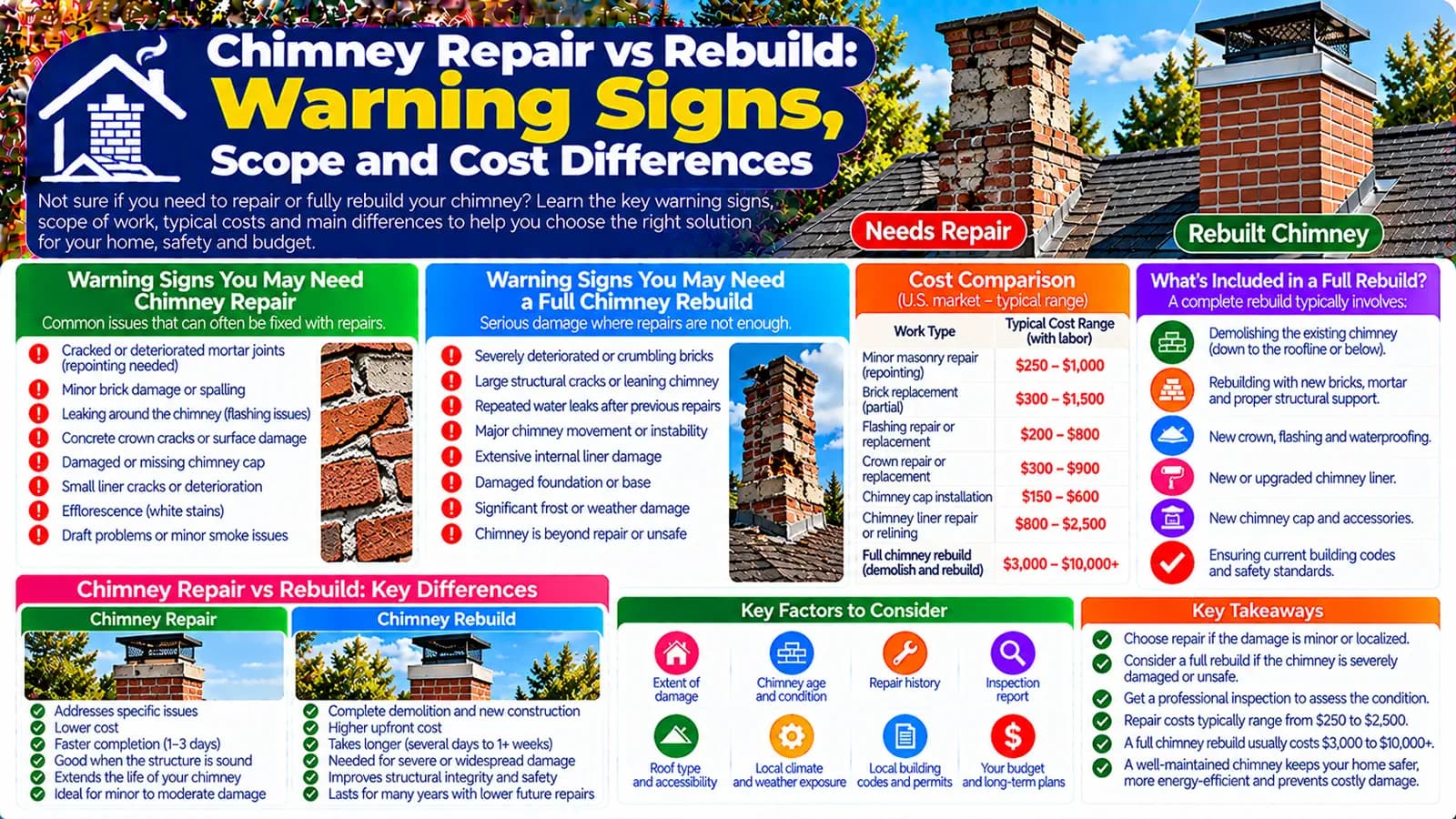
Escalate falling masonry, movement, fire, or combustion concerns
Loose or falling material, apparent movement, severe impact, collapse risk, a carbon-monoxide alarm, smoke or fumes entering occupied space, scorching, fire, or a suspected flue failure requires prompt emergency or qualified professional response. Keep people away from affected areas and follow emergency-service and appliance guidance.
Turn observations into an evaluation brief
| Observation | Possible scope implication | What requires professional evaluation |
|---|---|---|
| Localized open or weathered mortar joints | Defined repointing may be considered if surrounding units and structure remain suitable | Extent and depth, compatible mortar, masonry-unit condition, moisture source, movement, access, and cause |
| Cracked, spalled, loose, or displaced units | Local unit repair, partial rebuilding, or wider work may be considered depending on extent | Pattern, material loss, bond, support, stability, exposure, freeze-thaw or moisture, heat effects, and hidden condition |
| Crown, flaunching, cap, pot, cowl, flashing, or leadwork deterioration | A top-detail or roof-junction repair may be separate from masonry rebuilding | Exact water path, compatible detail, flue terminal, roof condition, adjacent masonry, and overlap between scopes |
| Leaning, separation, bulging, or reported movement | May require urgent stabilization assessment and a substantially larger structural scope | Whether movement is active, geometry, support, ties, foundation or building interface, wind and loading, and safe exclusion zone |
| Recurring damp or repeated repairs | Could indicate an unresolved source, incompatible prior work, concealed damage, or several independent defects | Moisture route, repair history, material compatibility, flue condensation, roof details, internal condition, and repairability |
| Flue or liner concern | May require separate combustion-system restriction, testing, repair, or relining | Appliance and fuel, flue route and condition, liner, connections, clearances, ventilation, termination, and current safe-use status |
What a limited repair proposal should establish
A credible repair proposal identifies the affected area, cause, removal and preparation, compatible units and mortar, crown or top details, flashing or leadwork, protection, curing or weather constraints, access, waste, testing or closeout, and what remains untouched.
Repointing is not a universal remedy for moving or deeply deteriorated construction. Surface waterproofing is not a substitute for identifying water entry or selecting compatible materials.
Partial and more extensive rebuilding are different scopes
The live calculators price a partial rebuild or major-masonry category for one existing chimney, not complete new chimney construction. A partial rebuild may dismantle and reconstruct a defined upper or damaged portion while retaining assessed sound work.
A more extensive rebuild can involve greater dismantling, temporary stability measures, flue or liner coordination, matching materials, roof interfaces, protection, scaffold duration, waste, interior connections, approvals, and making good. It requires project-specific design and pricing beyond a generic multiplier.
Trace water before choosing masonry scope
Water can enter at the chimney top, joints, porous or damaged units, flashing or leadwork, adjacent roof covering, penetrations, or another source. Condensation within a flue can create different evidence. Staining location alone does not prove origin.
A repair can fail economically if it treats a visible symptom while leaving the moisture source or incompatible previous work. The evaluation should connect the proposed detail to the observed path and surrounding condition.
Keep the flue and liner as separate safety scope
Masonry condition and flue integrity overlap physically but are not the same assessment. A sound-looking stack does not confirm a clear, continuous, compatible flue; a liner concern does not automatically determine that exterior masonry must be rebuilt.
Neither market calculator contains a dedicated chimney-liner price. Approved Document J addresses combustion-product discharge, air supply, fireplaces, flues, and chimneys in its England context. Obtain qualified inspection and a separate flue or liner quotation where needed.
Compare full scopes rather than headline totals
| Limited repair | Partial or extensive rebuild |
|---|---|
| Survey, defined repair area, compatible materials, top or flashing detail, protection, access, cleanup, and warranty | Survey and design, dismantling extent, stability plan, reconstruction, flue coordination, roof junctions, access, waste, testing, and approvals |
| Uncertainty in retained masonry and cause of deterioration | Uncertainty in concealed construction, retained lower work, support, interfaces, and matching materials |
| Shorter disruption may be possible, but access setup can still be substantial | Longer scaffold or lift use, weather protection, material handling, and making good may dominate logistics |
Repeated repairs matter when comparing alternatives, but past spending does not prove that rebuilding is required. Review what failed, why, and whether the present scope corrects the cause.
Use the calculator's native repair categories
USD for minor masonry/cracks, repointing/tuckpointing, crown/cap/flashing repair, or partial rebuild/major masonry, with condition, difficult/high-roof access, inspection, water protection, cap, flashing, and scaffold/lift allowances.
GBP for minor masonry, repointing, flashing/leadwork/pot/cowl, or partial chimney-stack rebuild, with condition, access, survey, water protection, pot/cowl, leadwork, and scaffolding allowances.
Model the professionally defined alternative
The calculator cannot decide stability, repairability, or safe use. Use its minor, repointing, top-detail, or partial-rebuild category only after inspection provides a credible scope. A complete new chimney or undefined extensive rebuild needs a project quotation.
Keep chimney repair separate from fireplace installation
The Chimney Repair Cost Guide owns broad repair budgeting; this specialist owns the limited-repair versus partial or larger-rebuild decision. Fireplace Installation owns the appliance, opening, hearth, surround, utility connections, and new vent or flue installation scope.
A fireplace project may reveal chimney work, but a new appliance allowance does not certify or repair existing masonry, crown, flashing, stack, or structural condition. Gutter content is relevant only where roof-water observations help distinguish adjacent sources.
Decide from evidence, not a warning-sign formula
- Address exclusion zones, falling material, movement, fire, carbon-monoxide, or flue concerns first.
- Commission the appropriate masonry, structural, roof-junction, and combustion/flue evaluations.
- Map localized and widespread deterioration, moisture sources, previous repairs, retained construction, and uncertainty.
- Define comparable repair, partial-rebuild, and—if warranted—larger-rebuild scopes.
- Compare access, protection, materials, flue coordination, waste, approvals, disruption, warranties, and remaining risk before choosing.
Plan with the right calculator
Enter your project details and select the United States or United Kingdom market for Low, Typical, and High planning estimates.
Frequently asked questions
Does cracked chimney masonry mean the chimney must be rebuilt?+
No. Crack pattern, material loss, movement, moisture, location, extent, support, flue condition, and cause require professional evaluation. A visible crack cannot establish stability or the correct scope remotely.
Can repointing prevent a rebuild?+
Repointing may be appropriate for defined deteriorated mortar where the masonry units and structure remain suitable. It cannot be assumed to correct displaced, extensively damaged, unstable, or incompatible masonry. The assessment should establish the cause and repairable extent.
Does water damage automatically require rebuilding?+
No. Water can enter through the top detail, cap or cowl, flashing or leadwork, roof, joints, masonry, condensation, or another path. The source, extent, material condition, flue relationship, and structural effects must be identified first.
Is chimney liner work part of the repair-versus-rebuild calculator comparison?+
No dedicated liner price exists in the Chimney Repair calculator. Flue and liner integrity are separate combustion-safety scope and require qualified inspection, testing where appropriate, and a separate quotation.
What should a chimney inspection cover?+
The appropriate scope depends on the chimney and appliance, but may include accessible masonry, movement, roof junctions, top details, moisture, flue or liner, connections, clearances, and the connected appliance. Ask what is and is not included in the inspection.
How does access affect repair versus rebuild cost?+
A larger scope usually means longer access provision, more material handling, protection, waste removal, and weather exposure. Roof position, height, slope, neighbouring property, public areas, and scaffold or lift needs can materially affect both alternatives.
Sources & references
- Carbon Monoxide Fact Sheet · U.S. Consumer Product Safety Commission
- Fireplace and Wood Stove Safety · U.S. Fire Administration
- Combustion Appliances and Fuel Storage Systems: Approved Document J · GOV.UK
- Roof Work · Health and Safety Executive
- Level 2 Inspection of a Masonry Chimney · Chimney Safety Institute of America
- Chimney Repair Cost · Angi
- Chimney Repair Cost · Checkatrade