
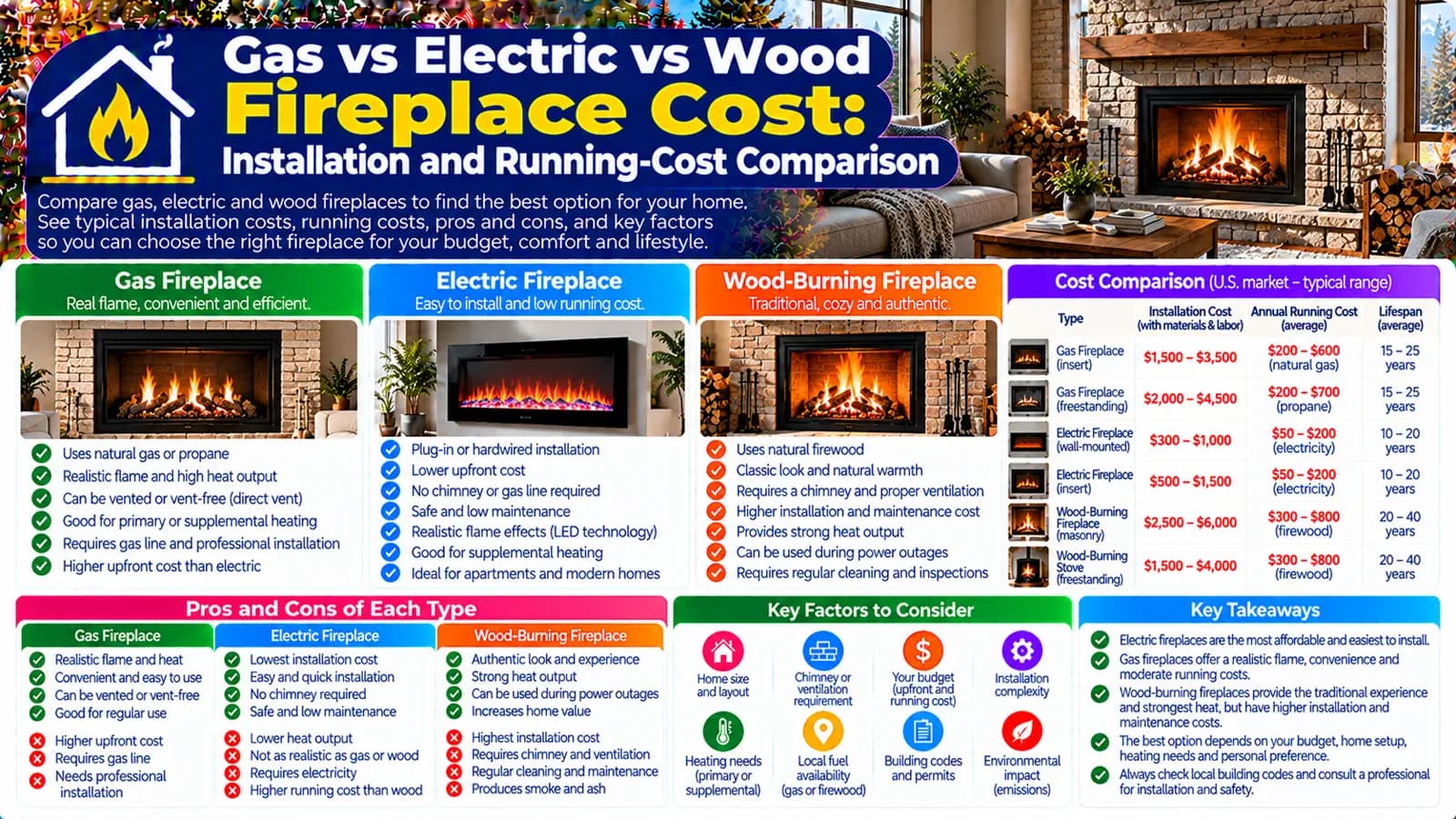
Compare complete systems
| Decision | Gas | Electric | Wood-burning |
|---|---|---|---|
| Equipment | Gas fireplace or fire, controls, burner and approved venting components | Electric fire or fireplace, flame-effect and optional heater components, controls | Wood stove, insert, fireplace, or fire plus approved flue components and hearth context |
| Utility or fuel | Suitable gas supply and often electrical controls | Electrical supply; load and circuit depend on product | Purchased or sourced suitable fuel, dry storage, handling, and local availability |
| Exhaust | Product-specific vent or flue arrangement | No combustion flue | Suitable chimney/liner or engineered flue system and air-supply context |
| Building work | Opening, enclosure, clearances, gas route, vent penetrations, hearth/surround as applicable | Outlet or circuit, enclosure or media wall, clearances, surround and finish | Opening, noncombustible work, hearth, clearances, flue or chimney route, roof interfaces |
| Ongoing scope | Qualified service, venting and control checks per product and rules | Product cleaning and electrical service as needed | Fuel storage, ash, appliance care, flue/chimney inspection and cleaning, local smoke restrictions |
Installation infrastructure can outweigh appliance price
Electric is the lowest named type tier in both calculator datasets; gas and wood have higher installed tiers because their normal systems can include more connection and combustion scope. That ordering is a calculator planning structure, not a guarantee for every quotation.
An elaborate built-in electric feature can exceed a simple product price, while an existing suitable gas or wood opening and flue may reduce building work. Conversely, new utilities, structural openings, complex venting, a liner, or a complete chimney can dominate.
Gas combines controlled combustion with connection scope
Gas fireplaces can offer responsive controls and a consistent supplied fuel where service exists, but the exact product determines air supply, venting, electrical controls, clearances, output, and installation category. Existing gas service does not prove route capacity or appliance compatibility.
Domestic gas work in Great Britain requires a Gas Safe registered engineer competent for that work. US licensing, permitting, fuel-gas, and venting requirements vary by state and locality. No gas piping or burner instructions are provided here.
Electric avoids on-site combustion but not project design
An electric fireplace has no fuel combustion or flue, which can simplify installation. Product form still matters: plug-in, hardwired, inset, built-in, wall-mounted, media-wall, and heater-equipped products can have different supply, enclosure, clearance, ventilation, control, and finish needs.
Electrical resistance at the point of use should not be turned into a guaranteed bill comparison. Electricity price, heater input, run time, thermostat behaviour, room demand, building heat loss, and whether the flame effect runs without heat determine use.
Wood adds combustion, emissions, fuel, and chimney scope
Wood options can include an open fireplace, insert, stove, or UK wood-burning stove/fire. Those are not equivalent in combustion or performance. EPA notes that wood smoke contains fine particles and other pollutants, and US appliance or burn restrictions can vary by jurisdiction.
UK appliance, smoke-control, planning, building, and competent-person requirements depend on location and project. Fuel purchase or sourcing, moisture and storage, handling, ash, inspection, and chimney or flue service belong in ownership planning.
Build running-cost scenarios from explicit variables
| Variable | Why it changes the answer |
|---|---|
| Local electricity, gas, and wood price | Tariffs, standing charges, delivery, quantity, wood species or moisture, and local market vary |
| Appliance input and rated performance | Test methods and boundaries differ; nominal input, delivered room heat, and vent losses are not interchangeable |
| Heat demand and building loss | Climate, room size, insulation, air leakage, adjacent spaces, setpoint, and other heating systems affect demand |
| Hours and control pattern | Decorative use, supplementary heat, thermostatic use, intermittent fires, and user behaviour differ |
| Maintenance and service | Gas service, electrical repair, chimney/flue inspection and cleaning, fuel storage, and consumables change ownership cost |
Efficiency labels need common boundaries
Electric resistance equipment converts purchased electricity to heat at the appliance, but that statement does not include electricity generation, tariff, or building demand. Gas and wood ratings depend on defined tests, fuel-energy conventions, appliance category, and exhaust losses. Open fires, stoves, inserts, and closed gas appliances should not be compared by one unlabeled percentage.
Use product documentation and applicable standardized ratings, then compare usable function and the whole installed system. This article promises no bill saving, ROI, payback, or lower lifetime cost.
An existing chimney changes questions, not the answer
A suitable existing chimney and flue may reduce some installation work for a compatible gas or wood appliance, but condition, dimensions, route, liner, terminal, air supply, clearances, and appliance instructions require assessment. Electric installation does not validate, repair, or require continued use of an old chimney.
Masonry cracks, crowns, stacks, and flashing remain Chimney Repair scope. Liner or new-flue work attached to the appliance remains fireplace installation scope when defined in the quote.
Fuel labels do not erase US and UK differences
The live USD model includes electric, gas, wood-burning fireplace/stove, and custom masonry types; new or complex vent/flue work; gas line, circuit, hearth/surround, permit, framing, and complete new masonry chimney allowances.
The live GBP model includes electric fire, gas fire, wood-burning stove/fire, and premium/custom types; existing, new liner/flue, or significant chimney work; separate liner, hearth, surround, gas, electrical, and structural-opening allowances.
Keep safety and competence outside the cost shortcut
Fuel-burning appliances can create fire and carbon-monoxide hazards if systems are unsuitable, damaged, or improperly installed or maintained. Wood smoke also has air-quality implications. Electric products avoid combustion but still involve electrical supply, heat, clearances, and product safety.
Choose for the property and intended use
- Define whether the goal is atmosphere, occasional supplementary heat, or a designed heating contribution.
- Assess utilities, opening, structure, hearth, vent or flue, chimney, air supply, clearances, and access.
- Compare complete installed gas, electric, and wood quotations.
- Model running costs with local prices, stated use, product data, heat demand, maintenance, and sensitivity ranges.
- Compare convenience, control, emissions context, fuel storage, service, cleaning, aesthetics, noise, resilience, and warranties without declaring a universal winner.
Plan with the right calculator
Enter your project details and select the United States or United Kingdom market for Low, Typical, and High planning estimates.
Frequently asked questions
Is an electric fireplace always cheapest overall?+
Electric units are the lowest installed type tier in both live calculators, but lifetime cost also depends on electrical work, product, use, local tariff, heat demand, maintenance, replacement, and whether the appliance is decorative or used for heating.
Can a gas fireplace use an existing chimney?+
Only when the proposed appliance, flue or vent, chimney condition, dimensions, air supply, route, terminal, and local requirements are compatible. Existing does not mean suitable.
Does a wood-burning stove always need a masonry chimney?+
No. The approved venting solution depends on the product and building; some projects use a suitable existing chimney and liner, while others use an engineered flue system. This guide does not design or install either.
Can nominal efficiency ratings be compared directly?+
Only with care. Test standards, boundaries, fuel energy conventions, vent losses, room effects, and whether an electric flame-effect product is providing heat can differ. A rating alone does not predict household running cost.
Which type needs the least maintenance?+
Electric appliances avoid combustion-system service, but still have product and electrical requirements. Gas appliances need qualified service appropriate to the product; wood systems add fuel storage, ash, appliance, flue, and chimney inspection or cleaning. Exact maintenance follows the manufacturer and jurisdiction.
Sources & references
- Keep Warm and Safe This Winter · U.S. Consumer Product Safety Commission
- Frequent Questions about Wood-Burning Appliances · U.S. Environmental Protection Agency
- Fireplace and Wood Stove Safety · U.S. Fire Administration
- Combustion Appliances and Fuel Storage Systems: Approved Document J · GOV.UK
- Domestic Gas: Frequently Asked Questions · Health and Safety Executive
- Fireplace Installation Cost · Angi
- Log Burner Installation Cost · Checkatrade