
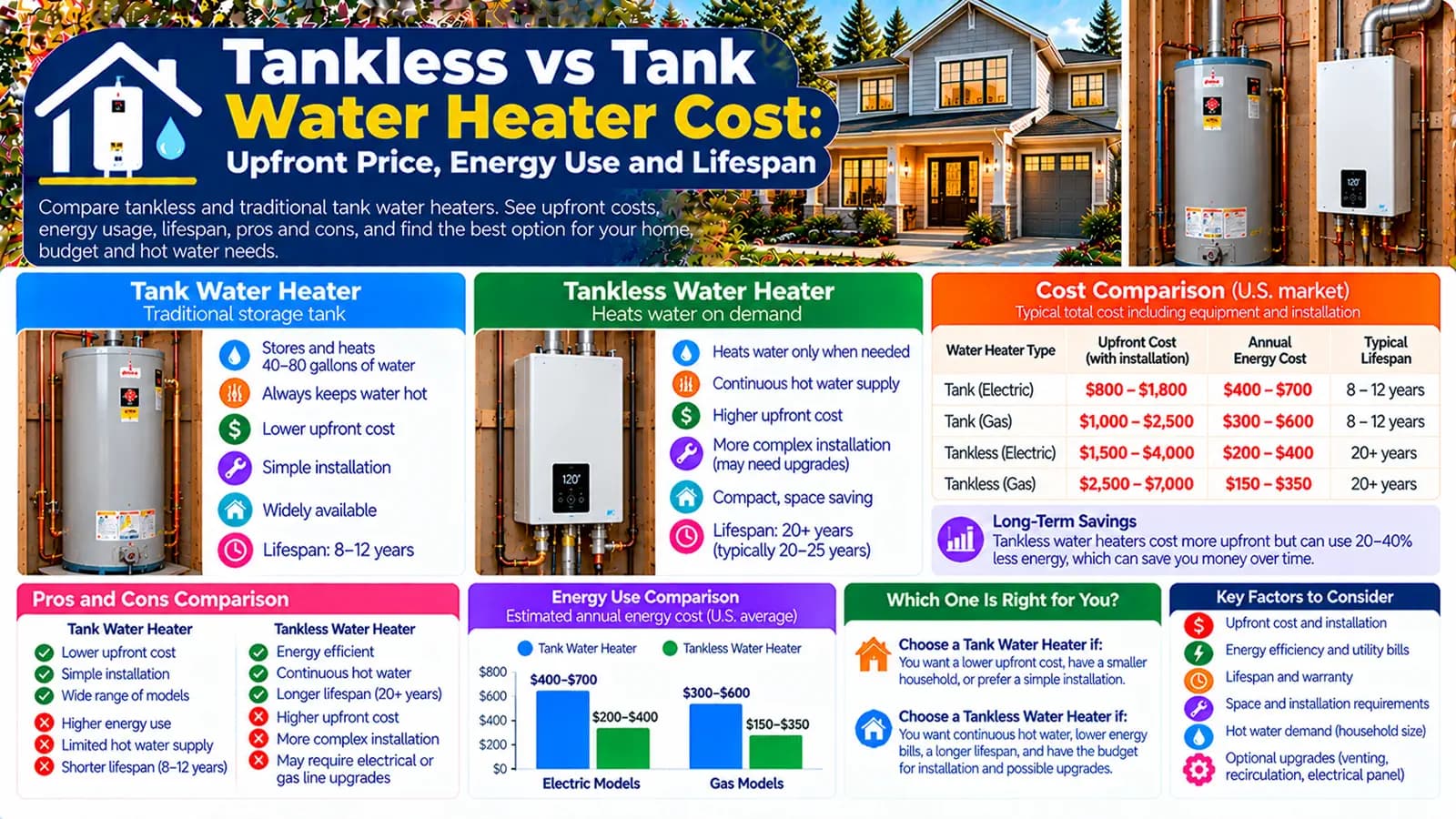
Tankless versus stored-water decision matrix
| Decision factor | Tankless / instantaneous | Tank / cylinder |
|---|---|---|
| Upfront project | Equipment plus flow sizing and potentially substantial conversion infrastructure | Like-for-like storage replacement may reuse more existing infrastructure |
| Delivery concept | Heats during draw, limited by flow and temperature-rise capacity | Stores volume, then depends on available hot water and recovery |
| Peak demand | Must serve simultaneous flow at design conditions | Tank/cylinder volume and recovery must serve the draw pattern |
| Space | Compact equipment can reduce storage footprint but still needs compliant access and services | Requires storage space plus safe access and associated system components |
| Energy | Avoids full-volume storage but actual use and cost remain household-specific | Has storage characteristics; efficiency and heat loss depend on the product and system |
| Maintenance/service | Water quality, scale, heat exchanger, controls, and combustion/venting may matter | Tank/cylinder, heating components, corrosion protection, pressure/safety, and heat source may matter |
Upfront cost depends on whether the home is being converted
An existing tankless replacement and a first tank-to-tankless conversion are different projects. Conversion may require electrical-service, gas, venting, plumbing, condensate, location, and finish work. A like-for-like storage replacement may be simpler, but changed fuel, capacity, location, or system architecture can also expand its cost.
Use the Tankless Cost Guide to itemize instantaneous installation and the Water Heater Replacement Cost Guide for US storage tanks or UK unvented cylinders.
“Endless” hot water still has a capacity limit
An instantaneous unit does not deplete a stored tank, but it has a maximum output under a given temperature rise. Simultaneous showers, taps, and appliances can exceed that capacity. A stored system can deliver from its available volume, then needs recovery.
Compare actual peak demand, incoming-water conditions, recovery, and distribution. Neither “gallons,” “litres,” nor “GPM” alone describes household performance.
Energy savings are conditional, not promised
Actual energy cost depends on hot-water volume, draw timing, fuel or electricity rates, rated efficiency, storage and distribution losses, installation, maintenance, behaviour, climate and incoming-water conditions, and the system displaced.
DOE guidance recognizes reduced storage-related consumption as a potential tankless benefit while also identifying capacity, infrastructure, climate, water conditions, and maintenance considerations. Model local costs rather than repeating a generic percentage or guaranteed payback.
Ownership cost is more than annual energy
Add equipment, installation, financing, maintenance, service calls, consumables, repairs, utilities, and eventual replacement. A tankless system with a difficult conversion can start with a larger investment; a stored system can involve storage losses and vessel-related risk. Product warranty and local service support matter for both.
Do not compare a premium tankless conversion with the equipment-only price of a basic tank—or vice versa.
Lifespan evidence is conditional
DOE technical guidance describes longer potential service for tankless equipment than traditional storage equipment, but a published category comparison is not a warranty for a property. Water quality, scale, demand, maintenance, installation, component availability, environment, and repair economics can shorten or extend service.
Do not collapse US tanks and UK cylinders
Compare tankless flow and temperature-rise capacity with a storage tank's gallons, recovery, fuel, venting, electrical, and installation requirements.
Compare instantaneous electric or gas equipment with the actual alternative—often a direct or indirect unvented cylinder and its heat source—not an assumed US-style gas storage tank.
Both choices retain safety-critical work
Gas and combustion systems need qualified gas, ventilation, venting, and commissioning work. Electric equipment can require substantial qualified electrical work. Stored hot-water systems add pressure, temperature, expansion, and discharge-safety context; instantaneous equipment has its own pressure, flow, combustion or electrical protections.
Compare two complete calculator scenarios
Use the Tankless calculator for instantaneous scope and the Water Heater Replacement calculator for the supported conventional storage alternative. Keep household demand and market constant, then document infrastructure and exclusions separately.
Choose around household and property constraints
- Model peak and typical hot-water demand.
- Confirm the real storage and instantaneous alternatives available in the market.
- Assess electrical, gas, venting, plumbing, water, space, and access constraints.
- Compare complete installed costs and product-specific maintenance.
- Model energy use with local rates and realistic behaviour.
- Compare warranty, service support, uncertainty, and ownership horizon without assuming a universal winner.
Plan with the right calculator
Enter your project details and select the United States or United Kingdom market for Low, Typical, and High planning estimates.
Frequently asked questions
Is tankless always cheaper to own?+
No. Higher or lower ownership cost depends on installed price, conversions, energy use, rates, demand, maintenance, repairs, financing, and how long the system remains in service.
Does tankless provide unlimited hot water?+
It heats without a storage-tank depletion cycle, but delivery remains limited by the unit's capacity, temperature rise, energy supply, distribution, and simultaneous demand.
Which system is better for high simultaneous demand?+
Neither label answers that alone. A professional should compare the household demand profile with tank recovery and storage performance or instantaneous flow and temperature-rise capacity.
Does tankless last longer than tank equipment?+
Some authoritative technical guidance describes longer potential tankless service, but actual service depends on water quality, maintenance, components, installation, demand, and repair support. It is not a guaranteed lifespan.
Can a cylinder-based UK system be compared directly with a US tank?+
No. UK cylinders, heat sources, controls, and instantaneous systems can have different architectures and market practices. Compare the actual systems available for the property.
Sources & references
- Measure Guideline: Transitioning to a Tankless Water Heater · U.S. Department of Energy
- Water Heater Key Product Criteria · ENERGY STAR
- Carbon Monoxide Fact Sheet · U.S. Consumer Product Safety Commission
- Domestic Gas: Frequently Asked Questions · Health and Safety Executive
- Tankless Water Heater Cost · Angi
- Tankless Water Heater Installation Cost Guide · Checkatrade