
Safety takes priority over the financial comparison
A suspected gas leak, combustion concern, carbon-monoxide alarm, smoke, scorching, electrical hazard, uncontrolled hot-water discharge, or serious leak is not a budgeting exercise. Leave the area and contact emergency or utility services when appropriate, then use a qualified professional. CPSC advises leaving immediately when a CO alarm sounds and not re-entering until responders permit it.
Observation, significance, and the evaluation to request
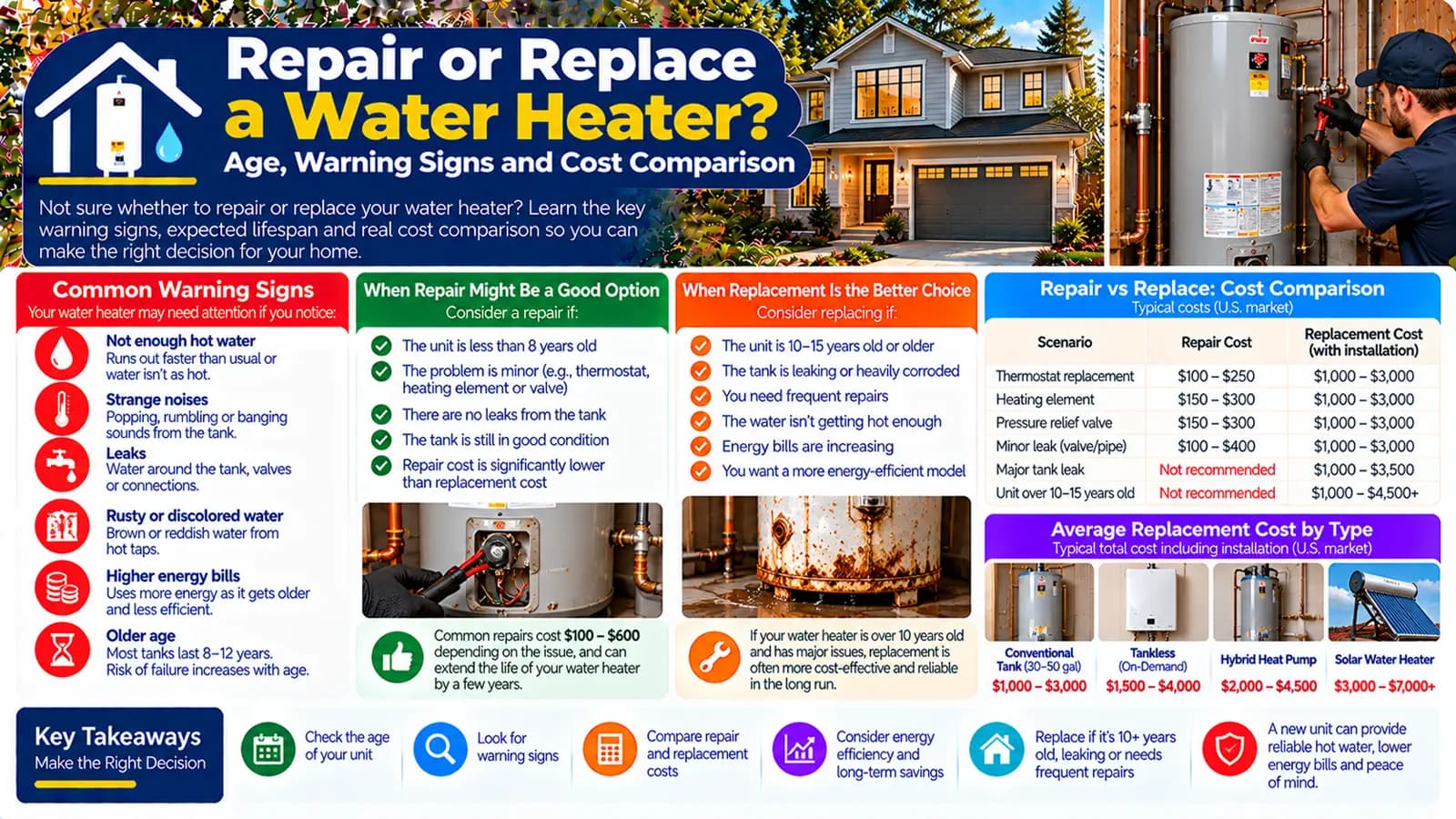
| Observation | Why it matters | What to have evaluated |
|---|---|---|
| Water around the equipment | The source may range from an external connection to the storage vessel or another nearby system | Source, active damage, pressure and safety condition, repairability, and water-damage scope |
| Less hot water, slow recovery, or unstable temperature | Demand, controls, heating components, scale, supply, or system sizing may contribute | Equipment operation, demand profile, controls, capacity, and safe performance |
| Visible corrosion or staining | It may reflect leakage, condensate, environment, or deterioration | Exact source, extent, affected components, and whether the storage or pressure boundary is involved |
| Repeated shutdowns or service calls | Recurring faults can increase cost and disruption without proving one cause | Service history, diagnosis, repair warranty, parts availability, and expected next risks |
| Higher energy use | Rates, demand, settings, other loads, efficiency, and equipment condition can all affect bills | Rated efficiency, measured operation where appropriate, usage, tariffs, and replacement options |
Age is context, not an automatic replacement date
Age can affect warranty, parts availability, corrosion exposure, accumulated repairs, and the value of another repair. It cannot show whether the current fault is minor, whether the vessel or cylinder is sound, or how long a repair will last.
Ask the professional to document condition and the diagnosed work. A newer appliance with an unsafe or uneconomic fault can still require replacement; an older appliance may have a defined repair that remains reasonable.
Compare two complete written scopes
A repair proposal should state the diagnosis, labour, parts, access, warranty, follow-up work, and whether it restores normal safe service. A replacement proposal should include equipment, capacity, installation, removal, access, permits or notification, plumbing, electrical, gas or venting work, controls, commissioning, and restoration.
Do not apply a universal percentage rule. Compare the repair cost and uncertainty with the complete replacement investment, disruption, system suitability, and warranty.
US tank and UK cylinder decisions differ
The replacement calculator covers electric, natural-gas, propane, high-efficiency, and hybrid heat-pump storage tanks in gallons. Repair and replacement professionals must match the fuel, venting, electrical, plumbing, pressure, and permit context.
The calculator covers direct and indirect unvented hot-water cylinders in litres. Cylinder safety, heat source, immersion elements, controls, discharge arrangements, pipework, Building Regulations, and installer competence shape the decision.
Efficiency is one decision input, not promised savings
ENERGY STAR uses Uniform Energy Factor and product-category criteria to compare eligible water heaters, but a rating alone does not predict one home's bill. Demand, fuel or electricity prices, distribution, settings, climate or incoming-water conditions, maintenance, and behaviour influence operating cost.
Request an operating-cost comparison based on local rates and realistic use. Include any conversion upgrades in the upfront cost rather than assuming efficiency will repay them.
Treat tankless as a separate system choice
If replacement is justified, tankless may be evaluated alongside a conventional system. It is not merely a different box: flow and temperature rise, gas or electrical capacity, venting, water conditions, location, maintenance, and conversion work can change the project.
Use the Tankless Cost Guide for installation budgeting and Tankless vs Tank for the ownership decision. The existing Water Heater Replacement Cost Guide remains the detailed conventional replacement resource.
Use the calculator after replacement is a real scenario
The calculator does not diagnose the appliance or estimate a repair. It models the installed replacement once the market, conventional system, capacity, type, installation complexity, access, and supported upgrades are known.
A disciplined decision sequence
- Address urgent safety and water-damage concerns.
- Obtain a professional diagnosis rather than inferring the fault from symptoms.
- Review warranty, service history, parts support, condition, and system suitability.
- Compare a complete repair scope with a complete installed replacement scope.
- Model realistic operating cost without promised savings or lifespan.
- Choose based on safety, reliability, suitability, uncertainty, disruption, and total cost.
Plan with the right calculator
Enter your project details and select the United States or United Kingdom market for Low, Typical, and High planning estimates.
Frequently asked questions
Does an older water heater automatically need replacement?+
No. Age is one planning factor. Condition, safety, system suitability, failure history, repair scope, parts, warranty, water damage risk, and professional findings should guide the decision.
Does a leak always mean the whole heater must be replaced?+
No. The source and extent must be professionally identified. A connection or nearby pipe is different from a compromised storage vessel or unsafe pressurized component, and serious leaking requires prompt attention.
How should repair cost be compared with replacement?+
Compare a written repair diagnosis and warranty with the complete installed replacement scope, including removal, permits, access, utility or pipework changes, and expected suitability. A percentage rule cannot replace those facts.
Will a replacement definitely lower energy bills?+
No. Operating cost depends on hot-water demand, fuel or electricity rates, equipment efficiency, system design, installation, setpoints, maintenance, and use. Compare rated equipment and project-specific estimates without assuming guaranteed savings.
Should tankless be considered whenever a tank fails?+
It may be one option, but it is a different installation decision. Demand, electrical or gas capacity, venting, water conditions, location, and conversion costs must be assessed through the Tankless guide and calculator.
Sources & references
- Water Heater Key Product Criteria · ENERGY STAR
- Carbon Monoxide Fact Sheet · U.S. Consumer Product Safety Commission
- Sanitation, Hot Water Safety and Water Efficiency: Approved Document G · GOV.UK
- Domestic Gas: Frequently Asked Questions · Health and Safety Executive
- Cost to Repair a Hot Water Heater · Angi
- Water Heater Replacement Cost · Angi