
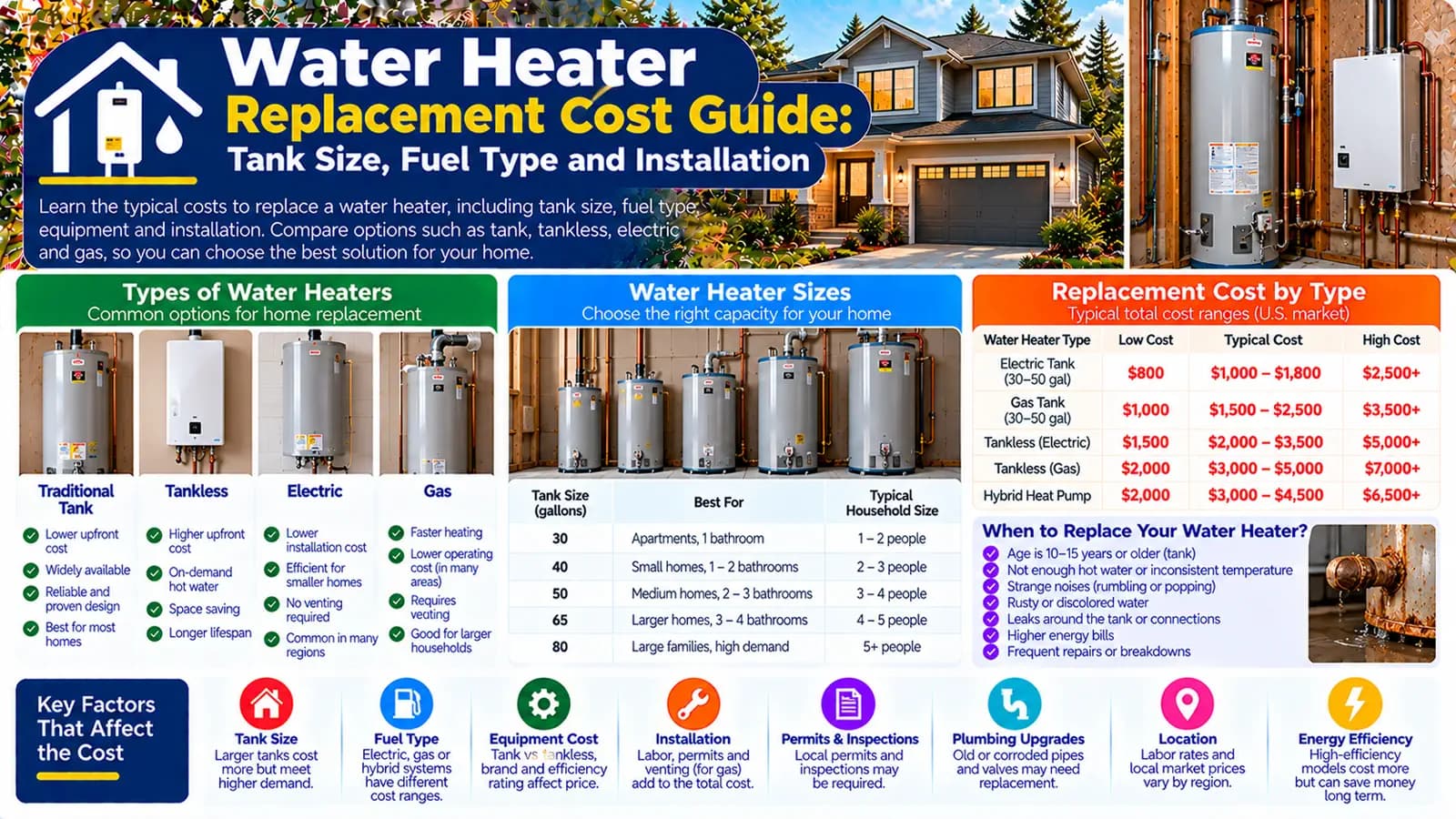
First identify the market-specific project
The calculator models installed residential storage-tank equipment in gallons: electric, natural gas, propane, high-efficiency tank, and hybrid heat-pump water heaters. Fuel, venting, electrical, gas-line, permit, access, and removal choices are explicit.
The calculator models installed unvented hot-water cylinders in litres: indirect cylinders heated through another heat source and direct cylinders using electric immersion elements. Pipework changes, access, relocation, controls, and system-change complexity are explicit.
The UK profile is not a pound-denominated version of a US gas tank. It does not include a new boiler, radiators, or a complete combi-to-system-boiler conversion in its like-for-like baseline.
How the replacement calculator builds the range
Capacity scales the installed equipment baseline. The US profile then applies the selected tank type and adds only the chosen installation complexity, access, permit, power-vent, electrical-upgrade, gas-line, and old-unit-removal allowances. Normal installation labour is already represented in the baseline.
The UK profile scales an installed unvented-cylinder range by litres and direct or indirect type. Like-for-like, moderate pipework changes, or a complex system/cylinder installation establishes the installation scope; access, relocation, additional pipework, and controls remain separate allowances.
Capacity is not the same as usable performance
Tank gallons or cylinder litres influence equipment and installation cost, but capacity alone does not guarantee that a household's demand will be met. Draw pattern, recovery rate, heat source, first-hour performance where applicable, setpoints, and simultaneous use matter.
ENERGY STAR advises using applicable sizing requirements and manufacturer guidance for heat-pump water heaters, whose tank-sizing strategy may differ from standard resistance or fossil-fuel equipment. UK cylinder sizing must be coordinated with household demand and the direct or indirect heat source by the appropriate professional.
Like-for-like replacement versus changed scope
| Scope item | Normal replacement question | Potential added project |
|---|---|---|
| Location and access | Can the old and new unit move safely through the route? | Joinery, doors, stairs, platforms, lifting, protection, or relocation |
| Water connections | Do existing connections suit the replacement design? | Additional pipework, valves, drainage, expansion, or system changes |
| Electrical | Does existing supply suit the specified equipment? | New circuit, disconnect, capacity, controls, or other qualified electrical work |
| Gas and combustion | Does a US gas replacement retain a compatible approved arrangement? | Gas-line modification, combustion air, venting, power vent, condensate, or permit work |
| UK cylinder system | Is it a direct-for-direct or indirect-for-indirect replacement? | Relocation, heat-source/controls changes, or a wider heating-system project |
| Removal | Who disconnects, drains, carries out, and disposes of the old unit? | Difficult handling, access alteration, recycling, or hazardous-condition response |
Fuel and equipment type change the surrounding work
A US electric-tank replacement may require confirmation of circuit and disconnect suitability. Gas or propane equipment introduces qualified gas, combustion, ventilation, and venting scope. High-efficiency or power-vented equipment may change electrical, vent, or condensate needs. A hybrid heat-pump water heater adds space, air, sound, drainage, electrical, and operating-condition considerations.
Direct and indirect UK cylinders
A direct unvented cylinder heats stored water using electric immersion elements. An indirect cylinder receives heat through a primary circuit from a separate heat source and may also include immersion backup. The calculator compares these cylinder types within an unvented-cylinder model; it does not price the boiler or a whole heating conversion.
Approved Document G addresses hot-water safety and unvented storage systems in England, including safety devices and discharge arrangements. The exact installer competence, notification, and rules must be confirmed for the UK nation and project.
Compare efficiency without reducing it to fuel labels
Equipment efficiency, fuel or electricity price, household demand, recovery, controls, location losses, and maintenance all affect operation. DOE distinguishes storage, instantaneous, and heat-pump consumer water-heater categories, while ENERGY STAR criteria apply to qualifying product categories.
A higher-efficiency equipment choice can also require a different installation scope. Compare rated product performance and projected use with the added electrical, ventilation, venting, condensate, controls, or space work; do not infer guaranteed savings from the article.
Safety, permits, inspection, and professional qualifications
US permit and inspection requirements vary by jurisdiction and by fuel or equipment change. The estimate includes a separate permit allowance but cannot determine local requirements. Gas, electrical, plumbing, venting, pressure-relief, expansion, seismic, drainage, and location requirements belong in the professional specification.
In Great Britain, HSE states that gas-appliance work must be carried out by a Gas Safe registered engineer competent for that work. Unvented-cylinder work has its own Building Regulations and competence context. Confirm what certificates, notifications, commissioning records, and manufacturer documentation will be supplied.
Overlooked replacement costs
- Delivery route, protection, lifting, platforms, and difficult access
- Old-unit removal, recycling, and disposal
- Pipework, valves, controls, drainage, expansion, and reconnection scope
- Electrical capacity, circuit, disconnect, or control work
- Gas line, vent or flue, combustion-air, power-vent, or condensate work
- Permit, inspection, notification, commissioning, and documentation
- Water damage, flooring, joinery, wall finishes, or other separate remediation
Keep repair and tankless decisions in their own lanes
This guide assumes a conventional replacement project is being budgeted. It does not decide whether a specific existing heater should be repaired or replaced; that future specialist intent requires condition, safety, reliability, warranty, and repair-cost assessment.
It also does not price tankless installation or decide tank versus tankless. Tankless equipment can create distinct flow, gas, venting, electrical, water-quality, and upgrade requirements. The related Tankless Water Heater calculator provides early planning without turning this pillar into the future tankless cost and comparison guides.
Request a complete replacement quotation
- Record the existing system, capacity, fuel or heat source, location, access, and available documentation.
- Have the professional determine required capacity and compatible equipment.
- Identify like-for-like work versus relocation, utility, venting, electrical, pipework, controls, or system changes.
- State removal, disposal, protection, permits, inspection, notification, commissioning, and certificates.
- Separate building repair and water-damage remediation from the equipment installation.
- Compare total installed scope and operating assumptions rather than equipment price alone.
Plan with the right calculator
Enter your project details and select the United States or United Kingdom market for Low, Typical, and High planning estimates.
Frequently asked questions
How should tank or cylinder size be selected?+
Capacity should reflect household demand, recovery or heat-source performance, available space, and the complete system. The calculator scales by gallons in the US and litres in the UK, but final sizing should follow professional and manufacturer guidance.
Does changing fuel type cost more than like-for-like replacement?+
It can. Electrical capacity, gas service, venting, condensate, pipework, controls, and permits may change. The US calculator separates moderate or complex modifications and utility upgrades from a normal replacement.
Is removal of the old unit included?+
The US calculator provides a separate old-unit removal allowance. The UK model is based on installed cylinder replacement pricing, but every quote should still state removal and disposal explicitly.
Does the UK calculator estimate a boiler replacement?+
No. It estimates direct or indirect unvented hot-water-cylinder replacement. A boiler, radiators, and a complete heating-system conversion are excluded.
Does this guide cover tankless water heaters?+
No. Tankless equipment has different sizing, utility, venting, and installation questions. Use the Tankless Water Heater calculator for early planning and the future dedicated tankless guides for that project intent.
Can a homeowner make gas, venting, electrical, or pressure-safety changes?+
This guide does not provide DIY instructions. Gas, combustion, high-voltage electrical, unvented-cylinder, temperature, pressure, and discharge-safety work requires appropriately qualified professionals and compliance with applicable rules.
Sources & references
- Water Heater Key Product Criteria · ENERGY STAR
- Heat Pump Water Heater Design Considerations · ENERGY STAR
- Sanitation, Hot Water Safety and Water Efficiency: Approved Document G · GOV.UK
- Domestic Gas: Frequently Asked Questions · Health and Safety Executive
- Water Heater Replacement Cost · Angi
- Unvented Hot Water Cylinder Cost · Checkatrade