
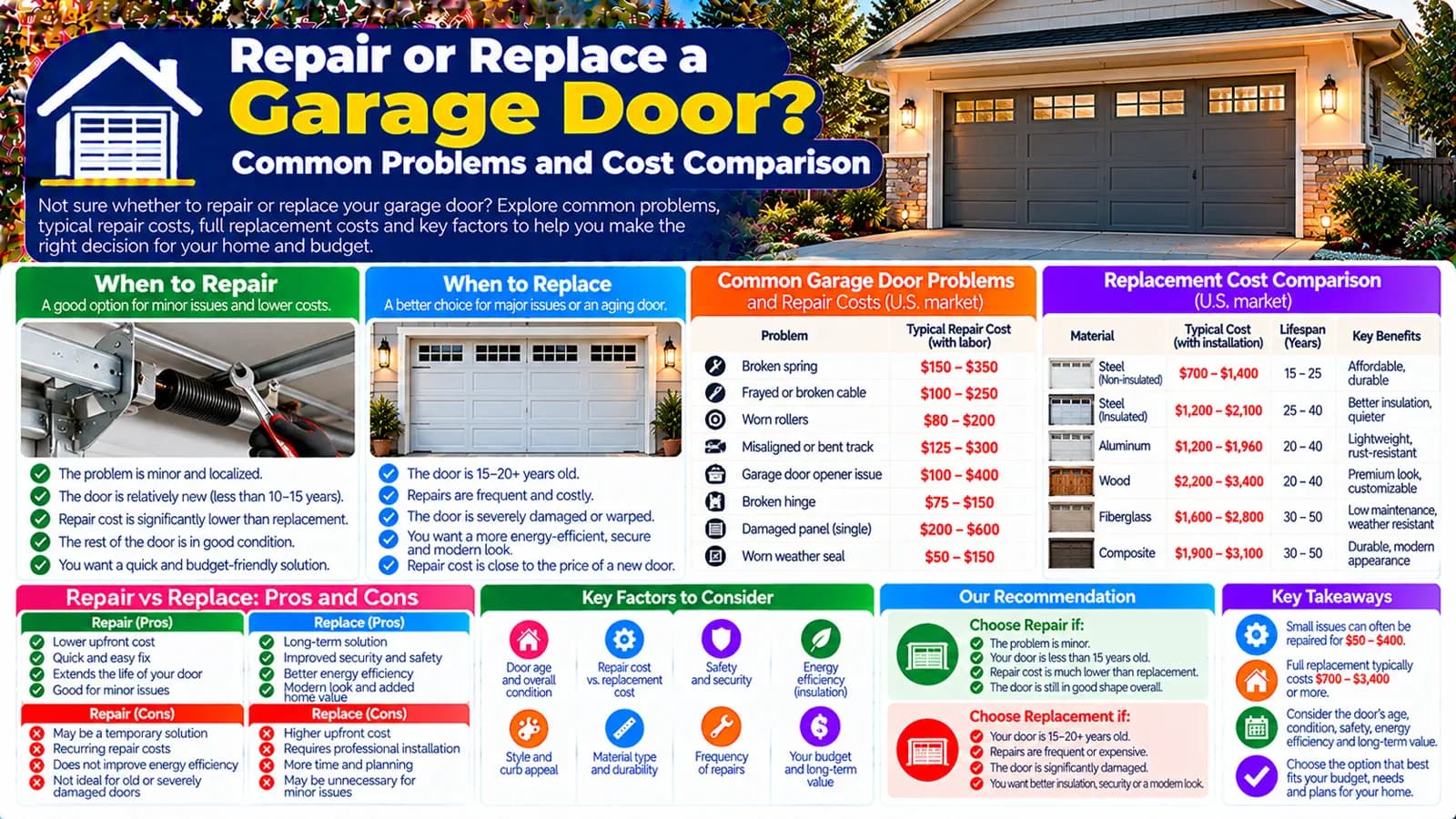
Treat unsafe movement or damaged tension components as a safety issue
A door that is falling, hanging unevenly, jammed, severely impact-damaged, off its guides or tracks, or associated with visibly damaged springs, cables, brackets, or supports needs prompt professional attention. Keep people, pets, and vehicles away and follow manufacturer or emergency guidance.
Translate observations into a professional evaluation
| Observation | Why it matters | What a qualified professional should evaluate |
|---|---|---|
| Dented, cracked, warped, or separated panel | Local damage may affect fit, movement, weathering, appearance, wind performance, or adjacent components | Damage extent, door construction, model and panel match, tracks, hardware, finish, opening, and repair compatibility |
| Jerky, heavy, uneven, noisy, or unreliable movement | Counterbalance, cables, rollers, tracks, guides, fixings, obstruction, opener, or door damage may contribute | Secure condition, complete movement system, alignment, counterbalance, powered operation, and root cause |
| Bent track, loose hardware, or impact event | Visible displacement may be only part of the system damage | Tracks or guides, anchors, framing, panels, rollers, counterbalance, clearances, and safe operation |
| Rust, rot, delamination, or broad deterioration | Material loss can affect appearance, seals, fixings, panels, and serviceability | Extent, moisture source, structural and hardware condition, product repair options, and wider opening |
| Drafts, failed seals, condensation, or insulation concern | Perimeter seals, panel construction, fit, air leakage, exposure, and garage use all matter | Complete door, seals, opening, drainage, ventilation, conditioning, and product ratings |
| Remote, sensor, motor, or control problem | The powered opener can fail while the door itself remains repairable—or door resistance can burden the opener | Electrical supply, controls and safety devices, opener, door movement, balance, compatibility, and commissioning |
Panel repair depends on product compatibility
A contained panel repair or replacement may preserve a serviceable system, but the exact section, profile, thickness, reinforcement, hinge layout, finish, glazing, and manufacturer support matter. Colour or weathering differences may remain even when a technical match exists.
Several damaged sections, a distorted door, unavailable matching components, damage to tracks or counterbalance, or required performance upgrades can widen the replacement comparison. None of these facts alone creates an automatic rule.
Repeated repairs change the comparison, not the diagnosis
Document callouts, parts, labour, downtime, temporary security, previous impact, recurring symptoms, warranties, and recommendations. Repetition can reveal an unresolved root cause, a system-wide condition, or simply separate repairable events; a professional should distinguish them.
Past spending is sunk cost. Compare the current repair proposal and remaining uncertainty with a complete replacement proposal rather than trying to recover earlier expenditure.
Compare complete repair and replacement scopes
| Repair proposal | Replacement proposal |
|---|---|
| Identified fault, root cause, affected components, parts compatibility, labour, testing, warranty, and safe current condition | Door type and size, material or mechanism, insulation or operation, specification, tracks or guides, counterbalance, hardware, seals, and commissioning |
| Condition of panels, opening, tracks, guides, cables, springs, fixings, opener, and electrical controls | Opener or automation compatibility, electrical supply, frame or structural work, removal, disposal, access, making good, and approvals |
| Expected result, exclusions, likely follow-up, downtime, and remaining uncertainty | Lead time, disruption, retained components, product and labour warranties, exclusions, and service support |
Do not confuse opener replacement with door replacement
A powered opener controls movement but does not replace the door, tracks, counterbalance, cables, or structural opening. Conversely, a strained or failed opener does not prove that the motor is the root cause; door resistance or balance can be relevant and requires trained assessment.
Compare opener-only repair or replacement separately where credible. A new door quote should state whether the existing operator is compatible and retained, recommissioned, or replaced.
Appearance, insulation, and weather seals are ownership goals
A homeowner may reasonably compare replacement for updated appearance, glazing, finish, quieter operation, security features, wind or impact performance where relevant, or insulation. These are specification goals, not diagnoses.
No guaranteed energy saving follows from an insulated panel. Whole-door performance, seals, opening, installation, garage conditioning, adjacent rooms, climate, and the wider envelope affect outcomes.
Use the actual US or UK replacement alternative
Price a single, double, or custom/oversized door with material, insulation, specification, opener, removal, track/hardware, structural-opening, and electrical choices in USD.
Price an up-and-over, sectional, roller, or side-hinged/premium door with single/double size, manual/electric operation, removal, frame, automation, electrical, and structural choices in GBP.
Repair quotations should use local parts, labour, regulation, product, and access conditions. Do not translate a US replacement ratio into a UK decision rule.
Use the calculator only for the full-replacement side
The calculator does not estimate a spring, cable, opener, track, panel, seal, or control repair and cannot decide whether the system is safe. Use it after an on-site evaluation defines a credible replacement specification.
Protect adjacent article intent
The Garage Door Replacement Guide owns complete replacement budgeting. This specialist owns the repair-versus-replacement decision. Garage Building covers the whole vehicle-storage structure; Door Replacement covers ordinary residential doors. Neither adjacent guide should be used to price a spring, cable, opener-only, or panel-only repair.
Make a documented, non-formulaic decision
- Restrict access if movement, support, impact damage, or high-tension components appear unsafe.
- Obtain a qualified evaluation of the complete door, counterbalance, tracks or guides, opener, opening, and electrical controls.
- Define the repair result, compatible parts, warranty, follow-up, downtime, and uncertainty.
- Define the complete replacement product, installation, removal, electrical, opening, access, and making-good scope.
- Compare safety, function, appearance, performance goals, service support, disruption, and ownership plans—without a universal percentage rule.
Plan with the right calculator
Enter your project details and select the United States or United Kingdom market for Low, Typical, and High planning estimates.
Frequently asked questions
Does one damaged panel mean the whole garage door must be replaced?+
No. A professional should identify the door model, panel availability and match, damage extent, alignment, hardware and track condition, wind or impact requirements, finish, and whether repair restores safe operation.
Can a garage-door opener problem be mistaken for a door problem?+
Yes. The opener, controls, sensors, electrical supply, door balance, tracks, rollers, cables, springs, and panels interact. Do not infer the failed component remotely; have the complete system evaluated.
Should I test or adjust the springs and cables myself?+
This guide provides no adjustment, winding, removal, replacement, or release instructions. Springs, cables, bottom brackets, and related counterbalance parts can be under high tension. Keep clear of suspected damage and use a trained door-systems professional.
Does recurring trouble automatically justify replacement?+
No. Repair history changes the financial comparison, but the current fault, root cause, parts, safety, system condition, warranty, and complete replacement scope still need documented evaluation.
Will a new insulated door definitely lower energy bills?+
No. Product performance, installation, air leakage, garage conditioning, climate, adjacent spaces, the wider envelope, and household use all matter. Compare whole-door ratings and do not rely on panel insulation alone.
Sources & references
- Automatic Residential Garage Door Operators · U.S. Consumer Product Safety Commission
- Garage Door Safety Tips · Door & Access Systems Manufacturers Association
- DASMA Standards · Door & Access Systems Manufacturers Association
- Technical Data Sheets · Door & Access Systems Manufacturers Association
- Garage Door Replacement Cost · Angi
- Garage Door Replacement Cost · Checkatrade