
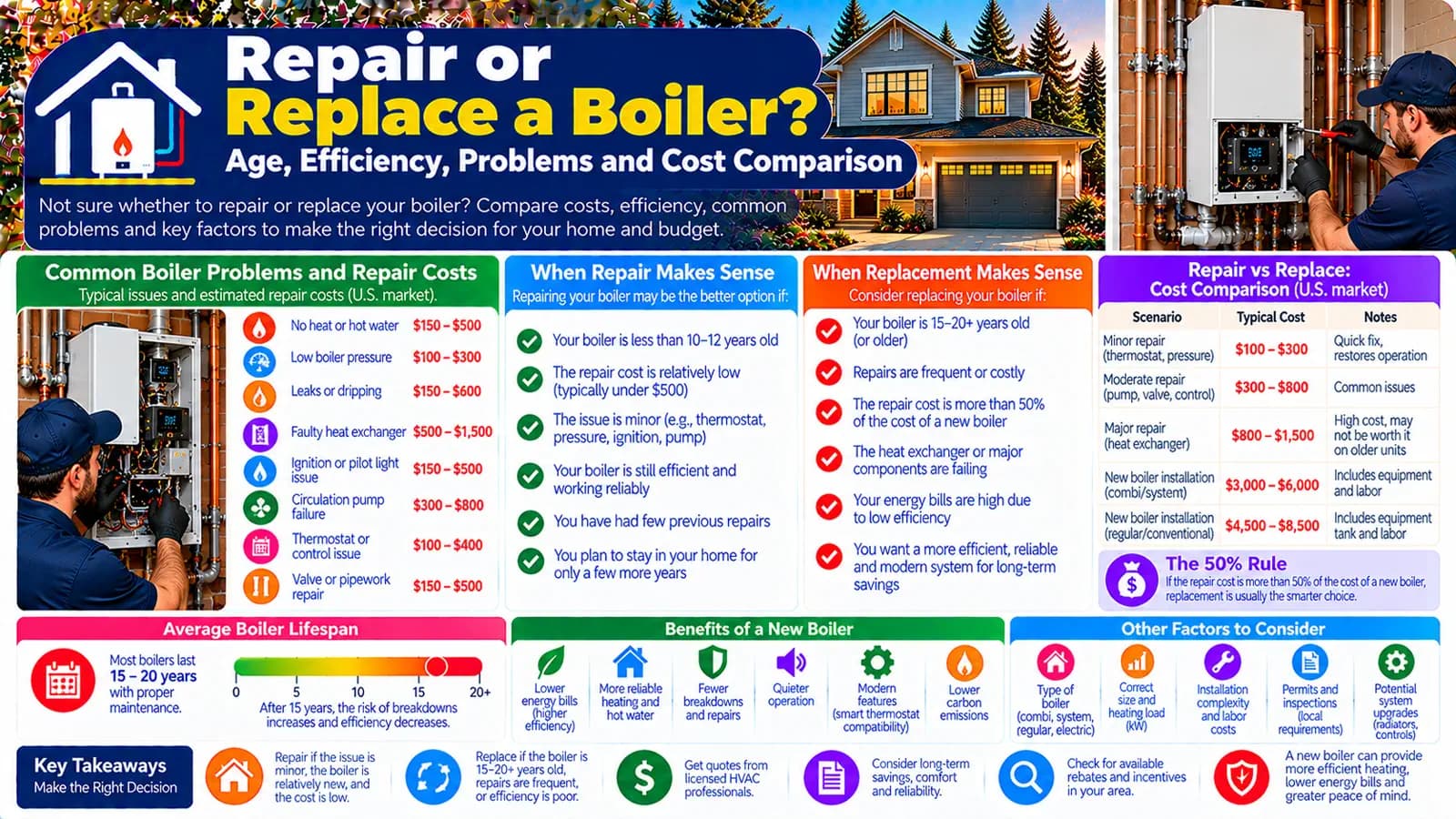
Put safety before the cost comparison
A carbon-monoxide alarm, suspected gas or oil leak, smoke, scorching, combustion or flue concern, abnormal pressure or discharge, serious leakage, or unsafe electrical condition requires prompt emergency or qualified professional response. Follow emergency-service, fuel-supplier, manufacturer, and jurisdictional instructions.
Turn observations into an evaluation scope
| Observation or situation | Why it matters | What should be evaluated |
|---|---|---|
| No heat, poor heat, or intermittent operation | Controls, supply, boiler, pumps, valves, distribution, load, or safety controls may contribute | Safe operation, fault diagnosis, controls, circulation, emitters, load, and system condition |
| Hot-water complaint where the boiler serves it | Demand, cylinder or combi arrangement, controls, flow, scale, equipment, or other components may interact | Hot-water architecture, demand, controls, water-side condition, and diagnosed fault |
| Noise, odour, staining, flame, soot, or flue concern | Some observations can involve combustion or exhaust safety | Stop use if advised; obtain qualified combustion, flue, fuel, and equipment assessment |
| Pressure change, discharge, or significant leak | Sealed-system, expansion, safety, vessel, pipework, or connection issues require competent evaluation | Immediate safety, source, pressure controls, system condition, water damage, and repair scope |
| Repeated breakdowns | Recurring cost and downtime can change the ownership decision without predicting the next failure | Root cause, service history, parts, warranty, system condition, and likelihood of further work |
| Rising energy use | Weather, rates, heat loss, controls, distribution, hot water, maintenance, settings, and equipment can affect bills | Normalized use, load, rated efficiency, controls, distribution, and boiler performance |
Age is one factor among many
Age can affect parts availability, warranty, compatibility, efficiency options, corrosion or wear exposure, and whether a major repair feels proportionate. It cannot reveal the condition of a heat exchanger, vessel, burner, pump, controls, valves, flue, electrical components, or distribution system.
ENERGY STAR presents age as one reason to consider professional replacement evaluation, not an automatic threshold. Ask the professional to document actual findings and uncertainties.
Use the full repair and service record
A defined repair with available parts, an appropriate warranty, and otherwise serviceable equipment can differ from recurring failures, discontinued controls, unresolved performance problems, or several aging components. Record diagnostic charges, parts, labour, emergency premiums, prior repairs, downtime, temporary heating, and recommended follow-up.
Money already spent is not proof that another repair is justified or that replacement is required. Focus on the present alternatives and evidence.
Compare written repair and replacement proposals
| Repair proposal | Replacement proposal |
|---|---|
| Diagnosis, affected component, root cause, parts, labour, warranty, and current safety status | Heat-loss and hot-water assessment where relevant, equipment, fuel/type, specification, and installation |
| Known follow-up, other observed condition, service support, parts availability, and downtime | Distribution, pumps, expansion, controls, cylinder, pipework, fuel/electrical, flue, condensate, access, removal, approvals, commissioning, and making good |
| Expected result and remaining uncertainty | Warranty, service support, retained components, exclusions, and project disruption |
A simple repair-to-appliance-price ratio omits installation and system scope. Compare complete costs, reliability uncertainty, household disruption, serviceability, and intended ownership horizon.
Efficiency evidence needs the whole system
US fuel-fired boilers may use AFUE; UK and European boiler metrics follow their applicable standards. A higher rated efficiency does not guarantee a bill reduction because building heat loss, weather, rates, distribution temperatures, emitters, controls, hot-water demand, cycling, installation, maintenance, and settings affect results.
Controls or distribution improvements may form part of a proposal, but they should be itemized instead of attributed automatically to appliance replacement. No savings percentage, payback, or ROI is promised.
Compatibility and parts can widen the decision
A boiler operates with fuel or electrical supply, flue or venting where applicable, controls, pumps, expansion provisions, pipework, emitters, and sometimes a cylinder. A repair can be technically possible while other components still need assessment; replacement can require changes to form a compatible commissioned system.
Parts availability and technician support are legitimate planning considerations only when confirmed for the actual model and market. Do not infer obsolescence from age alone.
US hydronic and UK boiler decisions differ
Assess a natural-gas, propane, oil, or electric hydronic boiler with its efficiency tier, piping, pumps, expansion, controls, vent/flue, removal, permit, and heat-loss context.
Assess the actual gas combi, system, conventional/heat-only, electric, or oil arrangement, including hot-water architecture, cylinder or tanks, controls, filter, flushing, radiators, pipework, flue, condensate, relocation, and Gas Safe or oil competence.
Keep adjacent heating decisions separate
The Boiler Replacement Cost Guide owns the full replacement, conversion, relocation, and upgrade budget. This specialist owns the repair-versus-replacement decision.
A US forced-air furnace is not a boiler. The Furnace calculator's UK mode remains the normal boiler-replacement model, while the dedicated Boiler calculator covers broader UK installation and upgrade work. Heat Pump and HVAC content concern different technologies or combined system scope and are not added here as generic links.
Price replacement after assessment defines it
The calculator does not diagnose a fault or estimate repair cost. Use it after professional assessment establishes a credible US hydronic replacement or UK boiler installation, conversion, relocation, or upgrade scenario.
Make the decision with documented evidence
- Resolve urgent gas, combustion, carbon-monoxide, oil, electrical, pressure, or leakage concerns.
- Obtain a qualified diagnosis and current safety status.
- Review age alongside condition, repair history, parts, warranty, and service support.
- Compare complete repair and replacement proposals.
- Assess controls, distribution, hot water, compatibility, and efficiency without promised savings.
- Weigh downtime, disruption, reliability uncertainty, ownership horizon, and professional recommendations.
Plan with the right calculator
Enter your project details and select the United States or United Kingdom market for Low, Typical, and High planning estimates.
Frequently asked questions
Does boiler age automatically mean it should be replaced?+
No. Age is context for warranty, parts, condition, efficiency options, and repair exposure, but it does not diagnose the boiler or establish remaining service. Qualified findings and the complete system should guide the decision.
How should recurring boiler repairs affect the decision?+
Review the root causes, frequency, total cost, warranties, downtime, parts availability, and whether earlier work corrected the underlying problem. There is no universal repair count that mandates replacement.
Will a higher-efficiency boiler definitely reduce bills?+
No. Rated efficiency is only one variable. Building heat loss, weather, fuel or electricity rates, controls, distribution temperatures, emitters, hot-water use, installation, maintenance, and household settings affect actual cost.
What boiler observations require urgent professional attention?+
A carbon-monoxide alarm, suspected gas or oil leak, smoke, scorching, combustion or flue concern, unusual pressure or discharge, serious water leakage, or unsafe electrical condition requires prompt emergency or qualified professional response.
What should a replacement comparison include?+
Include heat-loss and hot-water assessment where relevant, equipment, fuel or electrical work, distribution, controls, pumps, expansion, cylinder work, flue or venting, condensate, access, removal, approvals, commissioning, and making good.
Is the dedicated UK Boiler calculator the same as the UK Furnace calculator?+
No. The Furnace route's UK mode handles normal boiler replacement. The dedicated Boiler route covers broader installation, boiler-type conversion, relocation, and heating-system upgrades.
Sources & references
- When Is It Time to Replace? · ENERGY STAR
- Boilers · ENERGY STAR
- Purchasing Energy-Efficient Boilers · U.S. Department of Energy
- Carbon Monoxide Fact Sheet · U.S. Consumer Product Safety Commission
- Combustion Appliances and Fuel Storage Systems: Approved Document J · GOV.UK
- Domestic Gas: Frequently Asked Questions · Health and Safety Executive
- Boiler Repair Costs · Checkatrade