
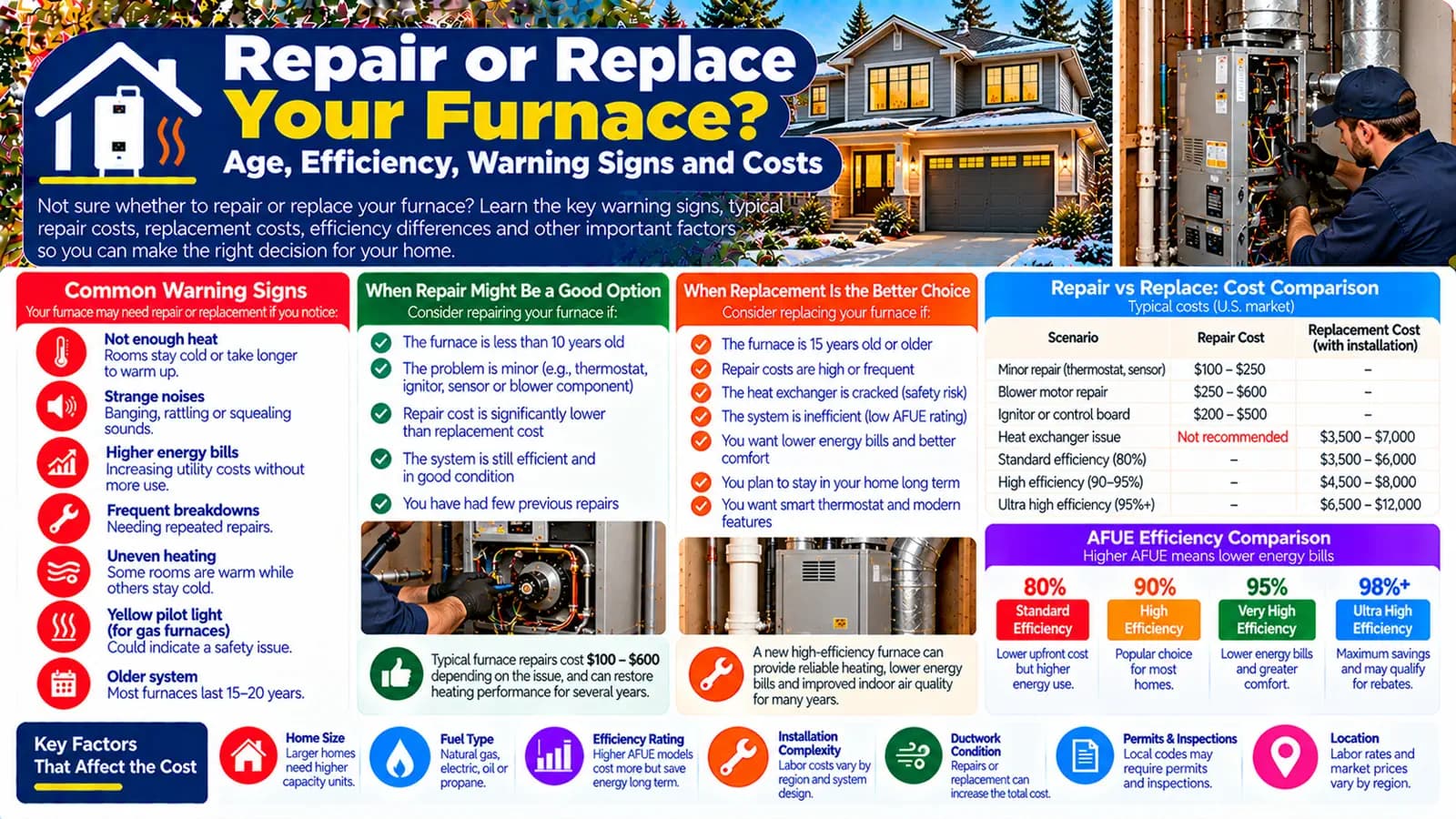
Escalate safety concerns before comparing costs
A carbon-monoxide alarm, suspected gas or oil leak, smoke, scorching, flame or combustion concern, damaged vent or flue, or other unsafe condition requires emergency or qualified professional response. Leave the building and call emergency or fuel-supplier services when directed for the situation.
A decision framework without remote diagnosis
| Observation | Why evaluation matters | Scope to investigate |
|---|---|---|
| No heat, intermittent heat, or repeated shutdown | Controls, supply, appliance, safety devices, distribution, or other causes may contribute | Qualified diagnosis, immediate safety, repair options, and wider system condition |
| Uneven comfort or long run times | Load, ducts or radiators, airflow or water flow, controls, envelope, and equipment may interact | Building load, distribution, controls, maintenance, capacity, and operation |
| Unusual sound, smell, soot, staining, or vent condition | Some observations can involve combustion or exhaust safety | Stop use if advised and obtain qualified combustion, flue, and equipment assessment |
| Increasing repair frequency | Recurring faults can add cost and downtime without proving the next failure | Service history, root cause, parts, warranty, and probability of further work |
| Rising fuel or electricity use | Weather, rates, settings, building changes, distribution, maintenance, and equipment can affect bills | Normalized usage, rated efficiency, building load, and system condition |
Age and remaining service are uncertain
Age can affect parts availability, warranty, efficiency options, corrosion or wear exposure, and the value of a major repair. It cannot establish the condition of a heat exchanger, burner, controls, blower, boiler vessel, pump, or flue from a calendar alone.
ENERGY STAR lists age among reasons to consider professional replacement evaluation, not as an automatic rule. Ask the professional to document the actual findings and uncertainty.
Use the full repair history, not only today's invoice
One defined repair with available parts and a useful warranty may be reasonable. Repeated callouts, multiple aging components, discontinued controls, long outages, or repairs that do not correct the underlying performance problem can shift the planning balance.
Record diagnostic charges, parts, labour, emergency premiums, prior warranties, downtime, temporary heat, and recommended follow-up. Do not assume money already spent should determine the next decision.
Compare repair with the full replacement project
The repair option should state the diagnosed work, parts, labour, warranty, safety status, expected result, and known follow-up. Replacement should include equipment, professional sizing, installation modifications, removal, permits or notification, distribution, controls, fuel/electrical, venting or flue, condensate, commissioning, and restoration.
A simple repair-to-equipment-price ratio omits too much. Compare complete installed scopes, reliability uncertainty, household disruption, and service support.
Efficiency and comfort need separate evidence
A newer rated efficiency does not guarantee lower bills or better comfort by itself. Climate, load, ducts or hydronic distribution, controls, installation, maintenance, fuel or electricity rates, and the building envelope affect outcomes.
Comfort problems do not prove the heating appliance is undersized or failing. Correcting ducts, radiators, controls, airflow, insulation, or air leakage may be part of the professional recommendation, but those scopes remain distinct from appliance replacement.
US furnace decision versus UK boiler decision
Evaluate a forced-air furnace, its fuel, BTU capacity, AFUE, blower and controls, duct relationship, electrical/gas/oil/propane services, venting, removal, and permit context.
The live calculator evaluates a gas combi, system, conventional/heat-only, electric, or oil boiler—not a US-style furnace. Boiler type, property context, pipework/radiators, hot-water architecture, controls, filter, flushing, flue, relocation, and Gas Safe or oil competence matter.
HVAC and heat-pump decisions remain separate
Replacing a furnace is not automatically the same as replacing an air conditioner, all HVAC equipment, or ducts. Choosing a heat pump is also a broader system-design decision involving load, climate, distribution, electrical capacity, comfort, and backup strategy where relevant.
Use the Furnace Cost Guide once appliance replacement is being priced. Use HVAC Replacement for combined conventional-system scope and Heat Pump content for heat-pump installation or technology comparison.
Price replacement only after assessment supports it
The calculator does not diagnose faults or estimate repair. It models a US furnace or UK boiler replacement after the market, capacity or property context, equipment type, efficiency where offered, installation path, and supported upgrades are defined.
Make the decision with documented evidence
- Resolve urgent gas, combustion, carbon-monoxide, electrical, or fuel safety concerns.
- Obtain qualified diagnosis and the current safety status.
- Review age as context alongside condition, repair history, warranty, and parts support.
- Compare complete repair and replacement scopes.
- Assess load, distribution, controls, compatibility, and rated efficiency without promised savings.
- Consider reliability, downtime, ownership horizon, and uncertainty before choosing.
Plan with the right calculator
Enter your project details and select the United States or United Kingdom market for Low, Typical, and High planning estimates.
Frequently asked questions
Does furnace age automatically determine replacement?+
No. Age adds context but does not diagnose condition or remaining service. Safety, reliability, repair history, parts, efficiency, compatibility, and professional findings all matter.
How many repairs are too many?+
There is no universal count. Compare the frequency, cost, warranty, downtime, fault pattern, parts availability, and likelihood of further work with a complete installed replacement proposal.
Do uneven temperatures prove the furnace is failing?+
No. Comfort problems can involve equipment, controls, ducts, airflow, insulation, building load, or other causes. Professional assessment should identify the scope before choosing repair or replacement.
Can a heat-exchanger problem be diagnosed from symptoms?+
No. Combustion and heat-exchanger concerns require qualified inspection and testing. Do not open equipment, alter burners or vents, or rely on a visual checklist as a diagnosis.
Should replacement switch to a heat pump?+
That is a separate system-selection question involving climate, load, distribution, electrical capacity, fuel, comfort, and project scope. Use the Heat Pump and HVAC comparison content rather than assuming a universal answer.
Sources & references
- When Is It Time to Replace? · ENERGY STAR
- Carbon Monoxide Fact Sheet · U.S. Consumer Product Safety Commission
- Combustion Appliances and Fuel Storage Systems: Approved Document J · GOV.UK
- Domestic Gas: Frequently Asked Questions · Health and Safety Executive
- Average Furnace Repair Cost · Angi
- Boiler Repair Costs · Checkatrade