
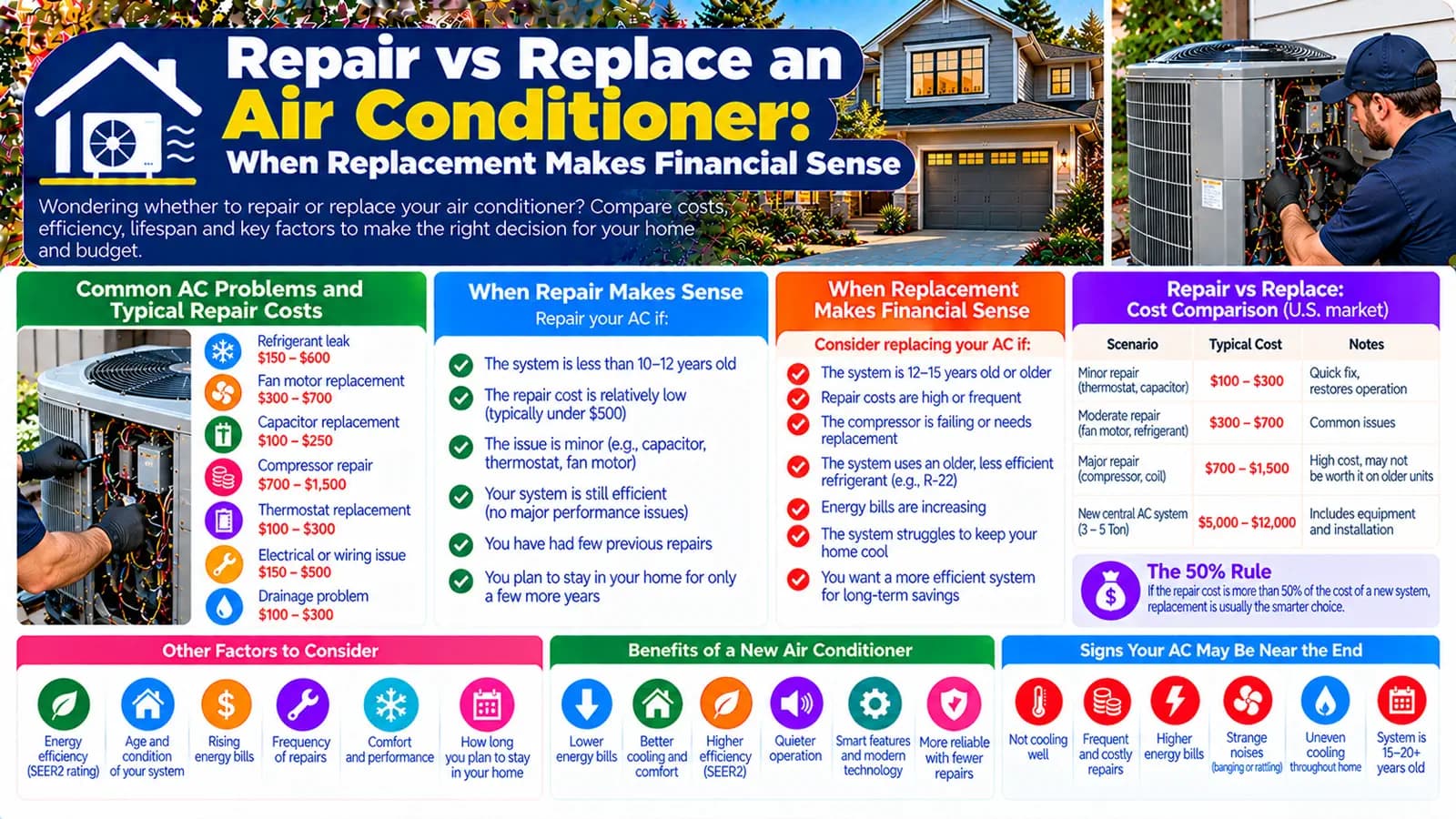
Resolve safety and damage risks first
Electrical overheating, smoke, scorching, damaged conductors, a repeatedly tripping protective device, significant condensate leakage, or another unsafe condition requires prompt qualified attention. Stop using equipment when instructed by emergency services, the utility, the manufacturer, or a professional.
Translate observations into professional questions
| Observation or situation | Why it matters | What should be evaluated |
|---|---|---|
| Weak, uneven, or intermittent cooling | Load, controls, airflow, ducts, equipment, or maintenance may contribute | Cooling load, temperatures, airflow, ducts, controls, maintenance, and equipment performance |
| Unusual noise, vibration, odour, or cycling | Mechanical, electrical, mounting, airflow, control, or other causes are possible | Safe operation, root cause, repair scope, and wider system condition |
| Water or condensate problem | Drainage, humidity, coil condition, installation, or building damage may be involved | Source, immediate damage control, drain and equipment condition, and repair consequences |
| Repeated service calls | Recurring cost and downtime can change the ownership decision without proving the next failure | Service history, root cause, parts, warranties, and likelihood of further work |
| High electricity use | Weather, rates, load, ducts, settings, faults, and behaviour can alter bills | Normalized use, rated efficiency, load, controls, ducts, maintenance, and equipment condition |
Age is context, not a verdict
Age can affect warranty, parts support, compatibility, expected wear, refrigerant service context, and the value placed on a major repair. It cannot establish the remaining service of the compressor, coils, motors, controls, ducts, or electrical components.
ENERGY STAR includes equipment age among reasons to consider professional evaluation. Treat that as a prompt to gather evidence, not a rule that overrides diagnosis.
Read the repair history as a pattern
A single well-defined repair with available parts and a useful warranty can be different from recurring faults across several components. Review diagnostic charges, labour, parts, emergency premiums, prior repairs, warranty coverage, downtime, temporary cooling, and whether earlier work resolved the underlying complaint.
Compatibility can make the decision system-wide
Central AC operates as a combination of indoor and outdoor refrigeration components, airflow equipment, ducts, electrical supply, controls, condensate provisions, and refrigerant piping. A failed component does not mean every part must be replaced, but a new component must form an approved, suitable system.
Refrigerant type can affect parts, service practices, line compatibility, recovery, and replacement scope. EPA guidance requires qualified refrigerant handling; refrigerant identity alone is not a remote replacement decision.
Compare two documented scopes
| Repair proposal | Replacement proposal |
|---|---|
| Diagnosis, failed component, root cause, parts, labour, warranty, and current safety status | Load assessment, matched equipment, efficiency rating, installation, and commissioning |
| Known follow-up work, other observed condition, parts availability, and downtime | Duct, electrical, controls, refrigerant-line, condensate, access, removal, approval, and restoration scope |
| Expected result and what remains uncertain | Warranty, service support, exclusions, and what existing equipment remains |
A repair-price percentage or estimated remaining-life number cannot replace this evidence. Compare complete costs, reliability uncertainty, disruption, ownership horizon, and service support.
Efficiency is not a guaranteed financial return
SEER2 or another applicable rating describes standardized equipment performance. Actual consumption and cost depend on climate, load, electricity tariffs, ducts, controls, sizing, installation, maintenance, and use. Do not turn the difference between two labels into promised savings, payback, or ROI.
The decision occurs in different market contexts
Commonly a split central AC tied to ducts and an indoor coil or air handler, with capacity, SEER2/EER2, matched equipment, electrical, refrigerant, removal, permit, and duct implications.
Ducted or whole-home residential cooling is less typical; distribution, ceiling or service space, outdoor-unit placement, access, condensate, controls, building approval, planning, and refrigerant qualifications may shape the option.
System changes are separate design decisions
A mini split can be a relevant ductless alternative, and a heat pump can add heating capability, but neither should be treated as an automatic substitute for central AC. Combined furnace-and-AC replacement belongs to the broader HVAC decision.
Use the Central AC Cost Guide when replacement scope is being developed; use the Mini-Split comparison when choosing between ductless zones and central distribution.
Use the calculator only for the replacement alternative
The calculator does not diagnose or price a repair. Once qualified assessment establishes a credible replacement scenario, it can model the market, system size, specification, installation complexity, and supported project additions.
Make the financial decision without a universal rule
- Resolve electrical, refrigerant, leakage, or other immediate risks.
- Obtain a written professional diagnosis.
- Review age alongside condition, repair history, parts, warranty, and compatibility.
- Define complete repair and replacement scopes.
- Evaluate comfort and energy evidence without assuming the equipment is the only cause.
- Compare cost, downtime, uncertainty, ownership horizon, and service support.
Plan with the right calculator
Enter your project details and select the United States or United Kingdom market for Low, Typical, and High planning estimates.
Frequently asked questions
Does an older air conditioner automatically need replacement?+
No. Age is one factor alongside diagnosis, safety, repair history, condition, parts, warranty, compatibility, efficiency, comfort, and complete replacement scope.
Does poor cooling prove the AC needs replacement?+
No. Equipment, controls, airflow, ducts, filters, load, insulation, solar gain, and other conditions can affect comfort. A qualified evaluation should identify the cause and options.
How should repair cost be compared with replacement?+
Compare a written diagnosis, repair scope, warranty, and known follow-up with a complete installed replacement proposal. Include equipment matching, ducts, electrical work, refrigerant-line work, controls, removal, approvals, and restoration.
Does an older refrigerant automatically require a new system?+
No. Refrigerant type can affect service options, parts, compatibility, and cost, but it does not remotely diagnose the equipment or dictate one financial answer. Have a qualified technician assess the actual system.
Will replacement definitely reduce cooling bills?+
No. Rated efficiency is only one variable. Weather, cooling load, electricity rates, installation, ducts, controls, maintenance, and household use determine actual energy cost.
Sources & references
- When Is It Time to Replace? · ENERGY STAR
- Heating and Cooling Maintenance Checklist · ENERGY STAR
- Homeowners and Consumers: Refrigerant Frequently Asked Questions · U.S. Environmental Protection Agency
- Energy Saver 101: Home Cooling · U.S. Department of Energy
- AC Replacement Cost · Angi
- Air Conditioning Installation Cost · Checkatrade