
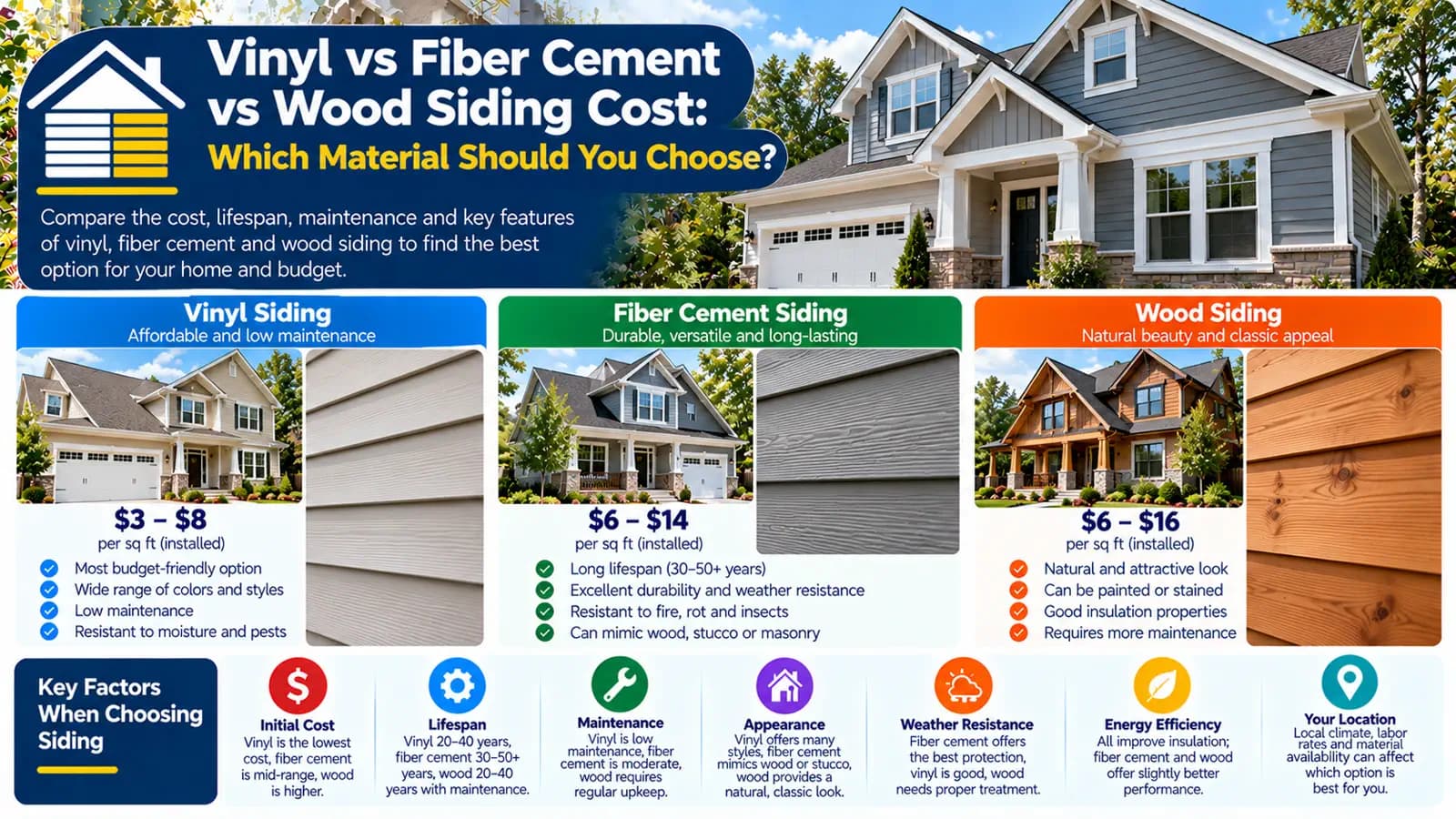
Compare installed systems, not material labels
| Priority | Vinyl / uPVC | Fibre cement | Wood / timber |
|---|---|---|---|
| Initial calculator position | US and UK baseline categories | Premium over the baseline | Engineered wood or UK larch/cedar premiums |
| Installation focus | Movement, fastening, accessories | Weight, cutting, fastening, finish details | Species/product, moisture, finish, joints |
| Appearance | Manufactured profiles and colours | Manufactured boards/panels and finishes | Natural grain or coated timber expression |
| Maintenance planning | Inspect, clean, repair components | Inspect joints, finish, edges, and damage | Inspect finish, moisture paths, joints, and exposed areas |
| Repair question | Can matching profiles and colours be sourced? | Can boards be safely removed and matched? | Can the profile, species, and finish be matched? |
How HomeCostNest represents material cost
In the US calculator, installed vinyl is the $3 to $10 per-square-foot baseline. Engineered wood adds $2 to $7 per square foot, and fibre cement adds $3 to $10. Those are planning adjustments within the current model, not retail material prices. Removal, stories, complex detailing, and preparation are added separately.
The UK calculator uses uPVC at £60 to £100 per square metre as its baseline. Fibre cement adds £10 to £30; larch adds £40 to £70; cedar adds £90 to £130. UK options also include aluminium and zinc. The material menu reflects a different market, so a US vinyl result should not be converted into a UK cladding estimate.
Vinyl or uPVC: product-system simplicity still needs detail
Vinyl siding is common US terminology; the UK calculator uses uPVC house cladding. Profiles, trims, fastening slots, movement clearances, substrate flatness, flashing, and penetrations remain part of the system. Installation instructions matter because overtight fastening or poor clearances can restrict movement.
For budgeting, confirm the panel or plank profile, colour, accessories, backing or subframe assumptions, removal, and repair approach. A low material baseline does not eliminate labour around openings and transitions.
Fibre cement: account for handling and installation
Fibre cement is heavier and handled differently from vinyl. Product-specific cutting, dust control, storage, edge treatment, clearances, fastening, joints, and finishing can influence labour and equipment. Ask the installer to identify the exact product and current manufacturer instructions rather than pricing a generic board name.
Wood and timber: define product and finish
Wood siding can mean solid timber, engineered wood, different species, profiles, and factory- or site-applied finishes. Exposure, moisture movement, end grain, fasteners, ventilation, detailing, and finish selection affect performance and maintenance. USDA guidance on exterior wood reinforces that wood choice, design, construction, and finish must be considered together.
Installation complexity, labour, and preparation
Material choice changes cutting, handling, fastening, accessories, and sequencing, but existing-building conditions can overwhelm that difference. Removal, substrate flatness, damaged sheathing, flashings, openings, corners, heights, and access should be priced consistently across every material option.
Moisture and climate are detailing questions
No cladding material makes water management optional. Roof and opening flashings, clearances, joints, penetrations, drainage paths, ventilation where required, fastener suitability, and the condition behind the finish all matter. Coastal, high-wind, freeze-thaw, strong-sun, or wet exposures require locally appropriate products and specifications rather than a universal material ranking.
Maintenance, finish flexibility, and repairability
Compare the maintenance instructions for the exact product. Some systems rely on integral colour, some on factory finishes, and some require periodic finish care. Ask how cleaning, local damage, replacement pieces, colour matching, recoating, sealants, joints, and spare material will be handled. Do not substitute an unsupported universal lifespan for a product- and exposure-specific maintenance plan.
Compare ownership cost without inventing certainty
- Use the calculator to establish the installed planning range for each supported material.
- Add the same removal, access, and preparation scenario to every comparison.
- Obtain product-specific allowances for trim, membranes, finish, repairs, and accessories.
- Choose a common ownership period and list expected inspection, cleaning, repair, and refinishing events.
- Test uncertainty instead of relying on one precise lifespan or resale claim.
Material relevance differs between the US and UK
Vinyl, engineered wood, and fibre cement are explicit calculator choices, alongside aluminium and a masonry premium. Compare them in USD per square foot with US installation context.
House cladding terminology and material availability differ. Use the GBP per-square-metre choices for uPVC, fibre cement, larch, cedar, aluminium, or zinc rather than assuming US vinyl conventions apply.
Choose by project priority
| If your priority is… | Ask… |
|---|---|
| Lower initial range | What complete system and preparation are included at that price? |
| Natural appearance | Which wood, profile, finish, and maintenance plan suit the exposure? |
| Robust manufactured finish | What handling, joint, edge, and repair requirements apply? |
| Low disruption | How do removal, access, weather protection, and sequencing differ? |
| Future repair | Will matching components and approved installers remain accessible? |
Read the Siding Replacement Cost Guide for the full project budget. If the existing exterior is sound and the decision is actually whether to repaint or replace it, use the paint-versus-siding comparison first.
Plan with the right calculator
Enter your project details and select the United States or United Kingdom market for Low, Typical, and High planning estimates.
Frequently asked questions
Which siding material is cheapest?+
In the current US calculator, vinyl is the baseline and aluminium can model below it, while engineered wood and fibre cement add to it. A real quote also depends on removal, preparation, access, details, and the selected product system.
Is fibre cement the same as wood siding?+
No. Fibre cement is a manufactured cladding product with different weight, cutting, fastening, finishing, and handling requirements. Wood products have their own species, profile, finish, and moisture-management needs.
Does wood siding always need more maintenance?+
Maintenance depends on the wood, finish, exposure, detailing, and manufacturer guidance. Treat upkeep as a property- and product-specific plan rather than relying on one universal interval.
Which material is best for wet or coastal climates?+
There is no universal winner. Exposure, wind, salt, drainage, fastening, ventilation, substrate condition, and product approvals all matter, so local specification and installation quality should drive the decision.
Why are the UK choices different from the US comparison?+
The UK calculator uses house-cladding choices such as uPVC, fibre cement, larch, cedar, aluminium, and zinc. Vinyl siding does not have identical market relevance or pricing in both countries.
Sources & references
- Vinyl Siding Installation Manual · Vinyl Siding Institute
- Exterior Wood in the South: Selection, Applications, and Finishes · USDA Forest Products Laboratory
- Cost to Replace or Install Siding · Angi
- House Cladding Cost Guide · Checkatrade