
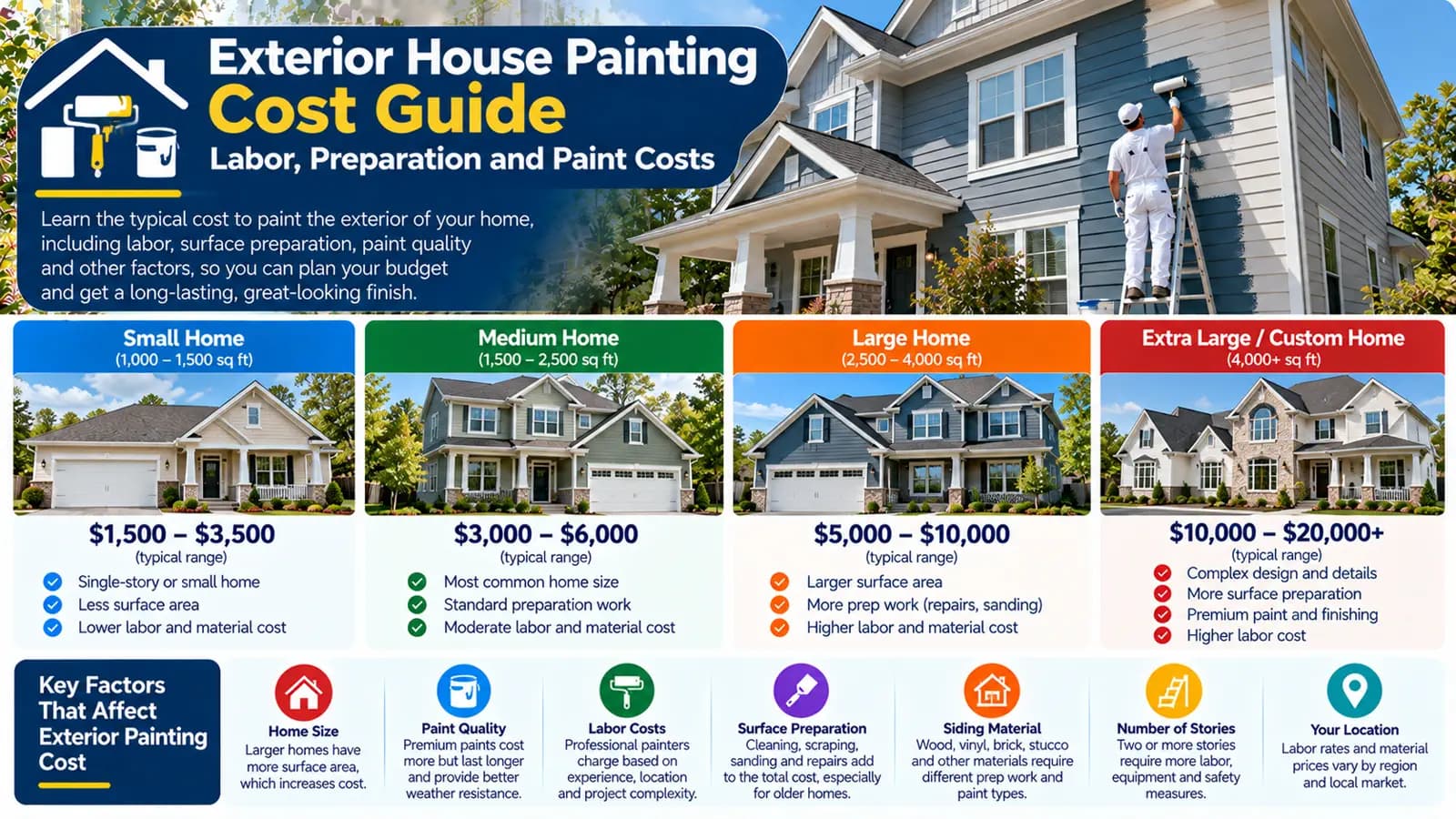
What determines exterior house painting cost?
HomeCostNest models four core questions: how much exterior wall area is paintable, what the surface is or what market model applies, how difficult access is, and how much preparation is required. Extensive stripping is kept separate because it is not part of every repaint.
| Cost component | What to establish |
|---|---|
| Paintable area | Elevations and surfaces included |
| Substrate | Wood, compatible metal/vinyl, stucco, masonry, or UK finish |
| Preparation | Good, moderate, extensive, or major stripping |
| Access | Storeys, terrain, obstructions, scaffold or lift needs |
| Details | Trim, doors, soffits, fascia, and other separately scoped work |
Measure paintable exterior wall area
Measure each included elevation by width and height, then account for gables and substantial openings. Do not substitute interior floor area: a two-storey house and a single-storey house can have similar floor area but very different wall area. Record excluded brick, stone, glazing, roofs, and attached structures so every quote uses the same boundary.
Surface type and coating requirements
The US calculator uses a compatible vinyl or aluminium surface as its baseline and provides area-based additions for wood, stucco, and brick or masonry. That does not mean one universal paint system suits every substrate. Existing coatings, adhesion, porosity, movement, moisture, and product instructions can change cleaning, primer, and finish requirements.
The UK calculator does not apply a surface selector; it models a native exterior-painting baseline, condition, access, scaffolding, and stripping. Material-specific or specialist coatings remain outside a generic planning range and belong in the written specification.
Cleaning, scraping, sanding, repairs, and primer
Preparation should create a sound surface for the specified coating. Depending on condition, that may include cleaning, removing loose material, sanding edges, treating defects, filling, and priming bare or repaired areas. Major timber decay, failed render, persistent moisture, or structural movement is repair work—not merely extra paint preparation.
Labour, storeys, access, and scaffolding
Higher elevations can require more setup and controlled access, while narrow side passages, sloping ground, conservatories, planting, and overhead services can constrain equipment. The US model scales single-, two-, and three-storey or difficult access with area. The UK model scales access with area and offers scaffolding as a separate fixed allowance.
A low bid is not necessarily like-for-like if it omits scaffold, lift hire, masking, protection, removal of loose coating, or cleanup. Ask for access equipment and protection to be named rather than assumed.
Paint, primer, coats, and labour scope
Product quantity and labour depend on coverage, surface texture, condition, colour change, application method, and the manufacturer-specified system. The calculator deliberately uses an installed planning range rather than pretending materials and labour can be split accurately for an unseen property. Quotes should identify the preparation standard, primer, finish product, coat system, and areas included.
Trim, details, and workable weather
Windows, doors, fascia, soffits, shutters, railings, and fine trim may be slow relative to their area. Define whether they are included. Exterior coating work also needs suitable conditions for preparation, application, and curing according to the product instructions; scheduling risk is different from adding an unsupported universal weather surcharge.
How the HomeCostNest estimate is assembled
The US profile starts at $1.50 to $3.50 per square foot of paintable exterior wall, then applies surface, access, and condition adjustments per square foot. Major stripping adds a fixed $800 to $6,500 planning allowance. The UK profile starts at £20 to £40 per square metre, then adds access and condition per square metre; scaffolding and stripping are fixed allowances.
US and UK project differences
Use square feet, USD, the supported surface selector, and the storey/access choice. Lead-safe work and permits require project-specific assessment.
Use square metres, GBP, the property-access and condition choices, and add scaffolding only when required. Specialist coatings and listed-building constraints are excluded.
DIY and professional boundaries
Ground-level, sound surfaces can be very different from high elevations, aggressive preparation, or suspect old coatings. Working at height, access equipment, hazardous dust, concealed defects, and coating compatibility can justify professional assessment. If preparation may disturb lead-containing paint, follow the applicable EPA or HSE controls.
Compare quotes on the same scope
- Confirm measured area and every included elevation.
- Name the substrate, preparation level, repair boundary, primer, finish, and coat system.
- List trim, doors, fascia, soffits, protection, access equipment, and cleanup.
- Separate provisional repair allowances from firm painting scope.
- Use the paint-versus-siding guide if the surface may no longer be a repainting project.
Plan with the right calculator
Enter your project details and select the United States or United Kingdom market for Low, Typical, and High planning estimates.
Frequently asked questions
Should exterior painting be estimated from floor area?+
No. Use paintable exterior wall area. A building footprint does not account for storeys, gables, openings, or elevations that are not being painted.
Why does the number of storeys affect painting cost?+
Height can add access equipment, setup, movement, and safety requirements. HomeCostNest models access separately from the surface and preparation choices.
Is scraping or stripping automatically included?+
Routine preparation belongs in the selected condition level, while extensive stripping or major preparation is a separate calculator allowance. The actual boundary should be defined in contractor quotes.
Does exterior surface type matter?+
Yes. The US calculator distinguishes compatible vinyl or aluminium surfaces, wood, stucco, and masonry because preparation and coating requirements can differ. The UK model focuses on area, access, condition, scaffolding, and stripping.
When should I use the siding calculator instead?+
Use it when the project is replacement rather than a sound, paintable-surface refresh—for example, when deterioration or a desired material change makes new siding or cladding the relevant scope.
Sources & references
- Exterior Wood in the South: Selection, Applications, and Finishes · USDA Forest Products Laboratory
- Steps to Lead Safe Renovation, Repair and Painting · U.S. Environmental Protection Agency
- Construction Hazardous Substances: Lead · Health and Safety Executive
- Cost to Paint a House Exterior · Angi
- Cost to Paint the Exterior of a House · Checkatrade