
Identify whether water is below, on, or being sent across the surface
Observe the problem during and after rainfall without entering flooded excavations or unsafe areas. Surface sheets from paving, concentrated roof discharge, a local low point, broad saturation, an uphill source, high groundwater, and a leaking supply or wastewater line can look similar after the fact but require different investigation.
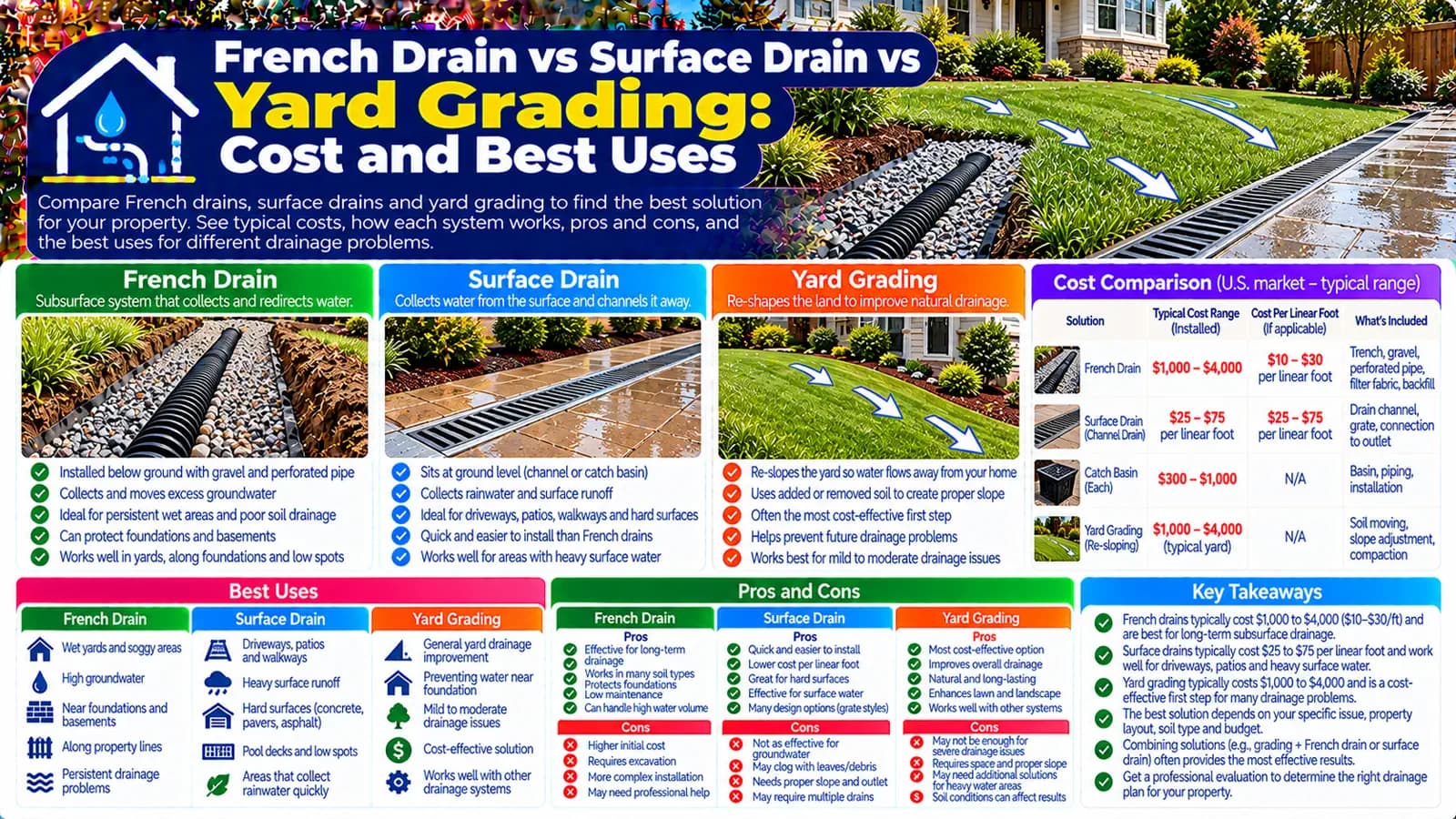
Solution-selection matrix
| Criterion | French / land drain | Surface / channel / catch drain | Yard grading |
|---|---|---|---|
| Primary role | Intercept or convey certain subsurface water | Collect concentrated surface runoff | Shape the surface path of runoff |
| Typical evidence | Persistent saturation or subsurface flow pattern | Runoff visible at paving, entrance, edge or low point | Surface flow follows an unfavorable landform |
| Main quantity | Length-based in both calculators | Length-based; US catch-basin system also length-based | Area/earthwork—outside live selector |
| Excavation | Continuous subsurface route | Channel, inlet and underground route as designed | Cut/fill and finish replacement over an area |
| Outlet dependency | Required | Required | Required receiving area or collection feature |
| Surface impact | Route and equipment disturbance | Often interacts with hardscape and crossings | Broader landscape disturbance |
| Maintenance | Access and performance monitoring; cleaning as designed | Clear inlets/channels and maintain downstream route | Preserve intended levels and prevent erosion/settlement |
| Combination role | May feed solid conveyance or storage | May receive runoff after grading | May direct runoff to a collector or infiltration feature |
French drains target a subsurface pathway
A French or land drain is a high-level concept involving an excavated route with drainage media and usually pipe. The exact cross-section, depth, fall, materials, and outlet are design decisions this article intentionally does not provide.
Cost is driven by length, excavation, ground, access, disposal, aggregate and pipe specification, crossings, outlet, and restoration. Poor-draining clay can make both construction and infiltration assumptions more difficult; it does not prove that adding more French drain will solve the site.
Surface drains collect runoff where it concentrates
Channel drains collect along a line, often near hardscape; catch basins collect at specific points and connect to an underground route. Their value depends on water actually reaching the inlet and the downstream system accepting it.
Budget sawcutting or surface removal where relevant, channel or basin components, underground conveyance, chambers and fittings, crossings, outlet or connection, traffic-rated specification where applicable, waste, and finish reinstatement. A grate without a complete route is not a complete cost.
Grading changes landform and flow direction
Regrading can spread, slow, or redirect surface flow toward an appropriate collection, infiltration, or receiving area. It requires enough physical space and must account for buildings, boundaries, paths, walls, planting, soil, erosion, and finished use.
Its cost structure is different from a drain: survey or design, cut and fill, imported or exported material, machinery, compaction, soil improvement, turf or planting, irrigation changes, and restoration may be area- or volume-driven. The HomeCostNest drainage calculator does not directly price grading.
Every option is constrained by destination
The selection cannot be separated from outlet feasibility. Infiltration depends on ground and environmental conditions; an approved connection depends on ownership, levels, capacity, and consent; surface release must not transfer harm or create erosion, icing, flooding, or pollution.
In England, national SuDS standards and Approved Document H provide relevant frameworks for surface-water planning, while local and devolved requirements still need checking. In the US, stormwater rules and acceptable discharge arrangements vary by municipality, watershed, and property context.
Compare cost structures instead of headline totals
| Cost component | French drain | Surface drain | Grading |
|---|---|---|---|
| Investigation | Subsurface source, route, soil and outlet | Runoff path, inlet locations, levels and outlet | Topography, boundaries, structures and receiving area |
| Materials | Drainage media, pipe and access components | Channels/basins, pipe, chambers and connections | Soil, erosion control and finish materials |
| Labor/equipment | Trenching, handling, backfill and disposal | Hardscape work, inlets, trenching and connections | Earthmoving, shaping, compaction and finish work |
| Restoration | Linear disturbed route | Hardscape and route-specific | Often broad landscape area |
| Separate scope | Pump/storage/connection if required | Downstream pipe/storage/connection | Collectors, drains, walls or outlet structures if required |
Let site conditions eliminate unsuitable options
- No feasible or approved outlet
- Soil or groundwater incompatible with the proposed infiltration concept
- Insufficient space or levels for grading
- Route obstructed by structures, utilities, roots, boundaries, or access
- Runoff volume or consequence requiring professional hydraulic assessment
- Signs of sanitary sewage, a utility leak, foundation movement, or retaining-wall distress
- Public road, watercourse, flood-risk, protected-site, or neighbour impacts requiring authority involvement
Combination systems need one coordinated scope
A practical plan might regrade a small area so runoff reaches a channel, carry it through a solid pipe, and use approved storage or infiltration. Another might intercept subsurface water separately from roof runoff. Combining measures is valid only when each has a defined function and the whole route is checked.
One coordinated drawing and schedule helps prevent duplicate excavation, incompatible levels, inaccessible maintenance points, and the same restoration being priced three times.
Compare maintenance access before choosing
Surface inlets are visible but can collect leaves, sediment, and debris. Subsurface systems can be less visible, so access, inspection evidence, and upstream sediment control matter. Graded surfaces can settle, erode, rut, or be altered by later landscaping.
Ask what routine observations and maintenance the owner is expected to perform, which components are accessible, what failure symptoms look like, and who is responsible for downstream infrastructure. Follow the system designer’s and authority’s requirements rather than generic cleaning intervals.
US and UK terminology is not one-to-one
The US calculator includes French drain, surface/channel drain, catch basin plus underground drainage, dry well, and foundation/perimeter drainage. It uses linear feet and USD; grading requires a separate scope.
The UK calculator includes French drain, channel/surface drainage, and fixed rubble or crate soakaway options. It uses metres and GBP; land drain, surface-water drainage, regrading and SuDS may appear in quotes, but site and regulatory meaning must be confirmed.
Price the options that survive site screening
Use the calculator for supported French, channel, catch-basin, dry-well, soakaway, or perimeter-drainage scenarios. Keep the same length and site assumptions when comparing, and obtain a separate grading quote rather than disguising earthwork as drain length.
Plan with the right calculator
Enter your project details and select the United States or United Kingdom market for Low, Typical, and High planning estimates.
Frequently asked questions
Which is cheaper: a French drain, surface drain, or grading?+
There is no dependable universal ranking. Length or area, excavation, soil, access, hardscape, disposal, outlet work, restoration, and whether several measures are required determine complete cost. The live calculator prices supported drainage systems, not grading as an automatic substitute.
What water problem does a French drain target?+
It is generally considered for subsurface or persistently saturated-ground conditions where an appropriate route and outlet are available. It does not automatically solve every puddle, roof-water problem, high groundwater condition, or failed sanitary line.
Where are channel drains or catch basins commonly considered?+
They are often evaluated where surface runoff concentrates at a hardscape edge, entrance, paved route, or low point. Collection is only part of the system; the underground route and lawful destination remain essential.
Can grading replace drains?+
Sometimes shaping the surface can be part of the solution, but only where space, levels, soil, boundaries, structures, and an acceptable receiving area allow it. Other sites need collection or subsurface measures as well.
Does a soakaway equal a US dry well?+
They are related infiltration concepts but should not be treated as automatically identical specifications or regulatory categories. The UK calculator distinguishes rubble and crate soakaways; the US calculator has a dry-well project allowance. Each requires market- and site-specific evaluation.
Who should select the drainage solution?+
A suitable drainage, landscape, civil, or building professional should diagnose the water source and assess soil, levels, structures, utilities, outlet, permissions, and maintenance. More complex or consequential sites may require engineering or authority review.
Sources & references
- Types of Green Infrastructure · U.S. Environmental Protection Agency
- Urbanization and Stormwater Runoff · U.S. Environmental Protection Agency
- National Standards for Sustainable Drainage Systems · GOV.UK
- Drainage and Waste Disposal: Approved Document H · GOV.UK
- Yard Drainage Cost · Angi
- Garden Drainage System Cost · Checkatrade