
Observation is not diagnosis
Visible crack width, direction, location, staining, displacement, and change over time are useful observations. They still need context: foundation material, building age, connected damage, loads, drainage, soil, previous repairs, and whether movement is active. HUD's inspection guidance discusses correlating multiple observations and monitoring movement; IStructE guidance places diagnosis within a structured appraisal. Neither supports choosing a major repair from one photograph.
Observations that can change the planning path
| Observation | Why it matters | Possible next planning step |
|---|---|---|
| A visible crack with no history | One visit may not reveal when it formed or whether it is changing | Record location and context; arrange appropriate inspection before selecting a treatment |
| Recurring or changing crack | Change can affect the assessment and may show that a previous cosmetic repair did not address the cause | Provide dated records and request professional evaluation |
| Edges no longer align or wall appears displaced | Displacement adds information beyond surface width | Treat as a reason for prompt structural assessment, not a DIY repair choice |
| Wall bowing or wider building movement | The affected system and load path may extend beyond one crack | Restrict unsafe access if advised and obtain qualified assessment |
| Water entry or staining | Moisture can damage finishes and may involve joints, drainage, waterproofing, plumbing, or cracks | Investigate water and structural questions separately, then coordinate scopes |
| Sticking openings, unevenness, or cracks in connected elements | A pattern across the building may inform an investigation | Document the pattern and include it in the on-site review |
These are planning prompts, not guaranteed diagnoses or repair instructions.
What a localized crack scope may contain
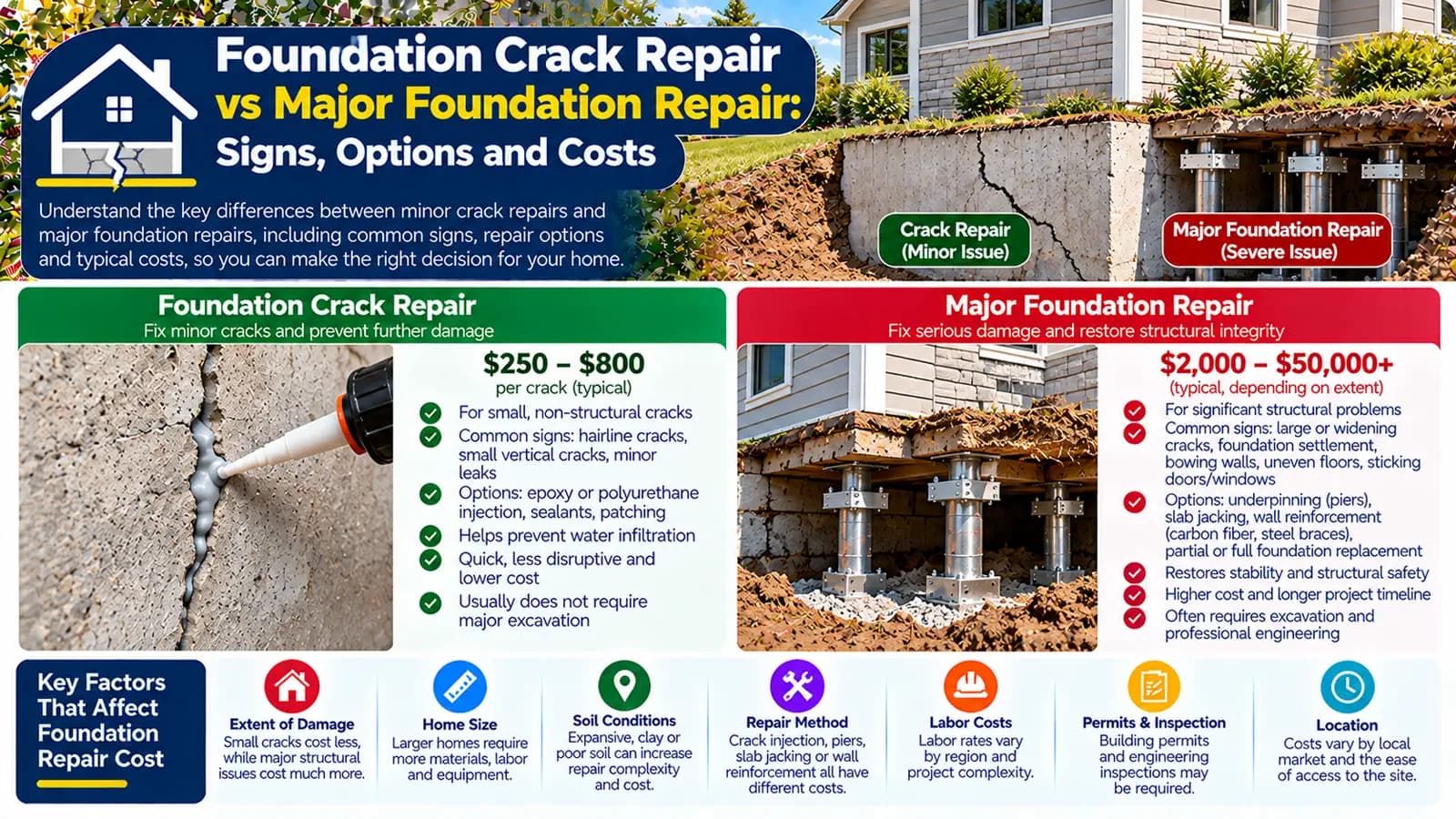
Where an appropriate assessment defines the issue as localized, a quotation may cover preparation, removal of unsound material, a specified sealant, grout, patch, or crack-repair system, leak control where applicable, and local finishes. The purpose matters: managing water, restoring a surface, and creating a structural bond are different objectives and products are not interchangeable.
A limited scope should state why it is limited, what movement conditions it assumes, how moisture is handled, and what is excluded. Repainting a recurring crack without understanding the cause is not the same as a documented repair plan.
What turns the budget into a major structural project
Major scope can involve an affected wall or building zone rather than a crack line. It may include engineering, geotechnical investigation, temporary support, excavation, wall reinforcement, designed anchors, stabilization points, piers or underpinning, inspections, and staged reinstatement. The method and quantity follow the assessed cause, loads, foundation, ground, and access—not a generic symptom checklist.
This is why cost can rise nonlinearly: a deeper or wider investigation can reveal several work packages, while constrained access and occupied-space protection can dominate labour even when the visible crack is short.
Monitoring can add evidence, but it is not a safety clearance
Consistent photographs, fixed reference measurements, and professionally selected movement indicators can help establish change over time. Record dates, weather or water events, nearby work, and any new symptoms. The appropriate duration and method depend on the question being investigated.
Monitoring is not a reason to postpone help when there is rapid change, significant displacement, instability, damaged utilities, post-disaster concerns, or professional advice to act. If there is an immediate safety concern, keep people away from the affected area and contact the appropriate local professional or emergency authority.
Water and drainage can be related without being the diagnosis
Water entry deserves action because it can damage materials and occupied space, but it does not identify the structural cause. A drainage or waterproofing investigation may sit beside structural assessment. Any solution needs a safe, lawful destination for water and must avoid transferring runoff toward the building, neighbours, or an unsuitable system.
How the two cost profiles diverge
| Cost component | Localized scope | Major structural scope |
|---|---|---|
| Investigation | Focused inspection and defined repair specification | Structural and potentially geotechnical investigation, design, and staged review |
| Quantity | Crack length or small local area | Affected area or wall length plus designed support or reinforcement points |
| Access | Local surface access | Excavation, equipment routes, internal access, protection, and temporary works |
| Work | Preparation and specified local treatment | Stabilization, wall repair, piering or underpinning where designed |
| Aftercare | Local finish and observation | Inspection, monitoring, landscaping and interior or exterior reinstatement |
Model an assessed scenario—not a visual guess
In the US calculator, choose crack repair, stabilization, or underpinning only as a documented planning scenario; the affected area, severity, foundation type, engineer, soil report, and permit inputs then alter the range. In the UK calculator, affected metres and the selected local, structural, mass-concrete underpinning, or complex underpinning scope drive the result.
A practical handoff to a professional
- Share dated photographs and a plan marking every observation.
- Note change over time, water entry, recent excavation, tree or drainage changes, and previous repairs.
- Ask what further inspection or testing is needed before a method is selected.
- Request the repair objective, quantities, access, temporary works, approvals, and reinstatement in writing.
- Use the Foundation Repair Cost Guide to check for overlooked budget items.
Plan with the right calculator
Enter your project details and select the United States or United Kingdom market for Low, Typical, and High planning estimates.
Frequently asked questions
Can a crack's direction diagnose the problem?+
No. Shape and direction are observations that may help an in-person investigation, but they do not establish cause, structural significance, or the correct repair by themselves.
What information is useful before an inspection?+
Dated photographs, measurements taken consistently, records of water entry, recent site work, drainage changes, sticking openings, and where movement appears elsewhere can provide useful context.
Is sealing a crack the same as structural repair?+
Not necessarily. A localized seal may address a defined crack or water path, while stabilization or underpinning addresses a different diagnosed condition. The required scope must be assessed.
Does recurring water prove the foundation is moving?+
No. Water entry is important evidence but does not prove a structural cause. Drainage, waterproofing, plumbing, grading, joints, and structural conditions may need separate evaluation.
Should homeowners monitor a crack?+
Documenting change can support professional evaluation when it is safe to do so, but monitoring should not delay urgent assessment where there is displacement, active movement, instability, or another safety concern.
Sources & references
- The Rehab Guide, Volume 1: Foundations · U.S. Department of Housing and Urban Development
- Residential Rehabilitation Inspection Guide · U.S. Department of Housing and Urban Development
- Subsidence · Institution of Structural Engineers
- Structure: Approved Document A · GOV.UK
- How Much Does Foundation Repair Cost? · Checkatrade
- Who to Call to Repair Foundation Issues · Angi