
Start with the household priority
| Priority | Option to investigate | What must still be checked |
|---|---|---|
| Lower upfront product budget | Often a standard steel configuration | Gauge/construction, finish, core, frame, hardware, glazing, exposure, dent/corrosion repair, and installed scope |
| Lower routine finish work | Often fiberglass or a factory-finished steel system | Coating, colour, sun and moisture exposure, scratches or dents, seals, warranty, and product instructions |
| Traditional natural appearance | Wood | Species or engineered construction, finish schedule, exposure, moisture details, glazing, frame, movement, and upkeep |
| Custom shape, profile, or joinery | Often wood, with premium fiberglass or metal options also possible | Lead time, fabrication, size, weight, frame, structural opening, finish, and warranty |
| Thermal-performance priority | Compare rated complete doorsets across all materials | Whole-product U-factor/U-value, glazing, frame, threshold, seals, fit, climate, and installation |
| Security priority | Compare tested complete doorsets | Leaf, core, frame, hinges, locks, glazing, fixings, installation, and surrounding wall—not material alone |
Compare installed doorsets, not bare slabs
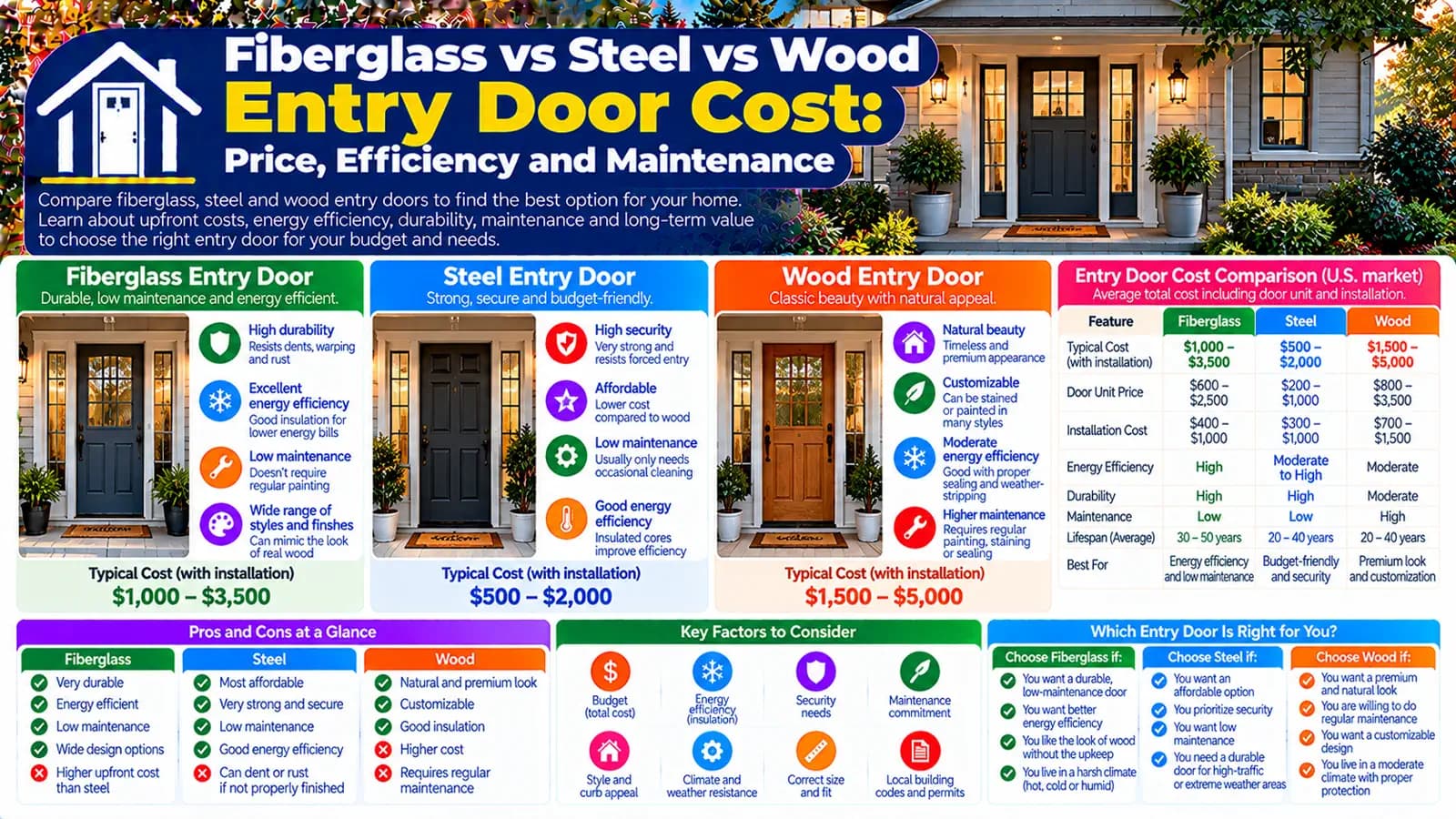
The US calculator uses steel as the standard tier, fiberglass as the mid-range tier, and wood/custom as the premium tier. These are planning relationships, not national retail promises for every product.
Installation can change with size, complete frame replacement, product weight and handling, nonstandard openings, glazing, sidelights or transoms, hardware, thresholds, weatherproofing, disposal, finishing, and structural work. Use the broad Door Cost Guide to assemble the whole project.
Fiberglass planning profile
Fiberglass doors can use moulded skins, insulated cores, painted or wood-look finishes, and varied glazing and panel designs. Product construction and finish quality vary, so compare the exact doorset rather than assigning every fiberglass door the same durability, appearance, or thermal result.
Inspect exposure, surface damage repair, colour and refinishing options, edges, frame material, warranty exclusions, hardware reinforcement, and service availability.
Steel planning profile
Steel doors can serve price-sensitive and higher-specification projects, often with an insulated core and factory coating. Steel thickness, internal construction, edge treatment, finish, frame, and hardware vary.
Dents, scratches, exposed metal, corrosion environment, repainting, coastal or de-icing-salt exposure, and repairability deserve product-specific review. Greater weight or a metal skin does not establish security without the rest of the doorset.
Wood planning profile
Wood can provide natural grain, traditional detailing, refinishing options, and extensive customization. Species, solid versus engineered construction, joinery, veneers, panel design, glazing, finish, exposure, and manufacturer requirements affect cost and care.
Moisture, sun, sheltered versus exposed location, movement, edge sealing, finish condition, frame and threshold detailing, and timely repair can matter. Do not attach an unsupported universal lifespan or maintenance interval.
Material is not the thermal rating
ENERGY STAR door criteria use certified whole-product ratings and account for glazing level. A U-factor or U-value describes heat transfer under the applicable test framework; glazing can introduce additional solar and insulating considerations.
Compare labels for the exact size and configuration where available. Core, glazing, frame, threshold, seals, installation, air leakage, orientation, climate, and household use prevent a material-only bill prediction. No savings or payback is promised.
Security belongs to the complete installed system
A secure entry depends on door-leaf construction, frame, hinges, lock and strike system, glazing, sidelights, fixings, wall opening, and installation. Approved Document Q illustrates the complete-doorset approach in its applicable English regulatory context.
Translate the comparison carefully for the UK
Fiberglass, steel, and wood are explicit calculator specification tiers for entry-door cost planning.
The calculator uses external/front and composite/higher-spec door types with standard, mid-range, or premium specification. Common comparison terms include composite, uPVC, timber, and aluminium; fiberglass is not treated as a direct synonym for composite.
A UK composite doorset can combine different skins, cores, frames, glazing, and hardware. Its construction and certified performance must be evaluated directly rather than inferred from a North American fiberglass label.
Compare ownership work and repairability
Ask how surface damage, dents, scratches, edge damage, moisture, coating failure, glazing, hardware, seals, threshold, and frame problems would be repaired. Confirm approved finishes, spare parts, colour matching, warranty conditions, maintenance access, and whether a damaged leaf can be replaced without the entire frame.
Choose the complete entry system
- Set the installed budget and architectural goals.
- Describe climate, exposure, shelter, moisture, traffic, and maintenance willingness.
- Compare exact doorsets, glazing, frames, thresholds, seals, hardware, and finishes.
- Review certified thermal and security performance where applicable.
- Define frame, opening, structural, making-good, removal, and finishing scope.
- Compare warranty, repairability, service support, and ownership priorities without declaring a universal winner.
Plan with the right calculator
Enter your project details and select the United States or United Kingdom market for Low, Typical, and High planning estimates.
Frequently asked questions
Is fiberglass always the best entry-door material?+
No. Budget, appearance, exposure, maintenance preference, finish, customization, glazing, complete-product ratings, frame, hardware, and installation can lead to different choices.
Is steel always the most secure door?+
No. Security depends on the tested complete doorset, including leaf construction, frame, hinges, locks, glazing, fixings, installation, and surrounding opening. Material alone cannot establish resistance to forced entry.
Are wood doors always inefficient?+
No. Thermal performance is a whole-product property. Door construction, thickness, core, glazing, frame, seals, threshold, fit, and installation matter, so compare certified U-factor or U-value data where available.
What is the closest UK comparison to fiberglass?+
The UK calculator uses composite or higher-spec front door terminology rather than treating fiberglass as a direct equivalent. Composite doors can contain multiple materials and constructions, so compare the actual complete doorset specification.
Which material needs the least maintenance?+
Maintenance depends on the product, finish, exposure, damage, hardware, seals, and manufacturer instructions. Factory-finished steel or fiberglass may require different care from painted or stained timber, but no material is maintenance-free.
Sources & references
- Residential Windows, Doors and Skylights · ENERGY STAR
- Windows, Doors and Skylights Key Product Criteria · ENERGY STAR
- Conservation of Fuel and Power: Approved Document L · GOV.UK
- Security in Dwellings: Approved Document Q · GOV.UK
- Door Installation Cost · Angi
- Door Installation Costs · Checkatrade