
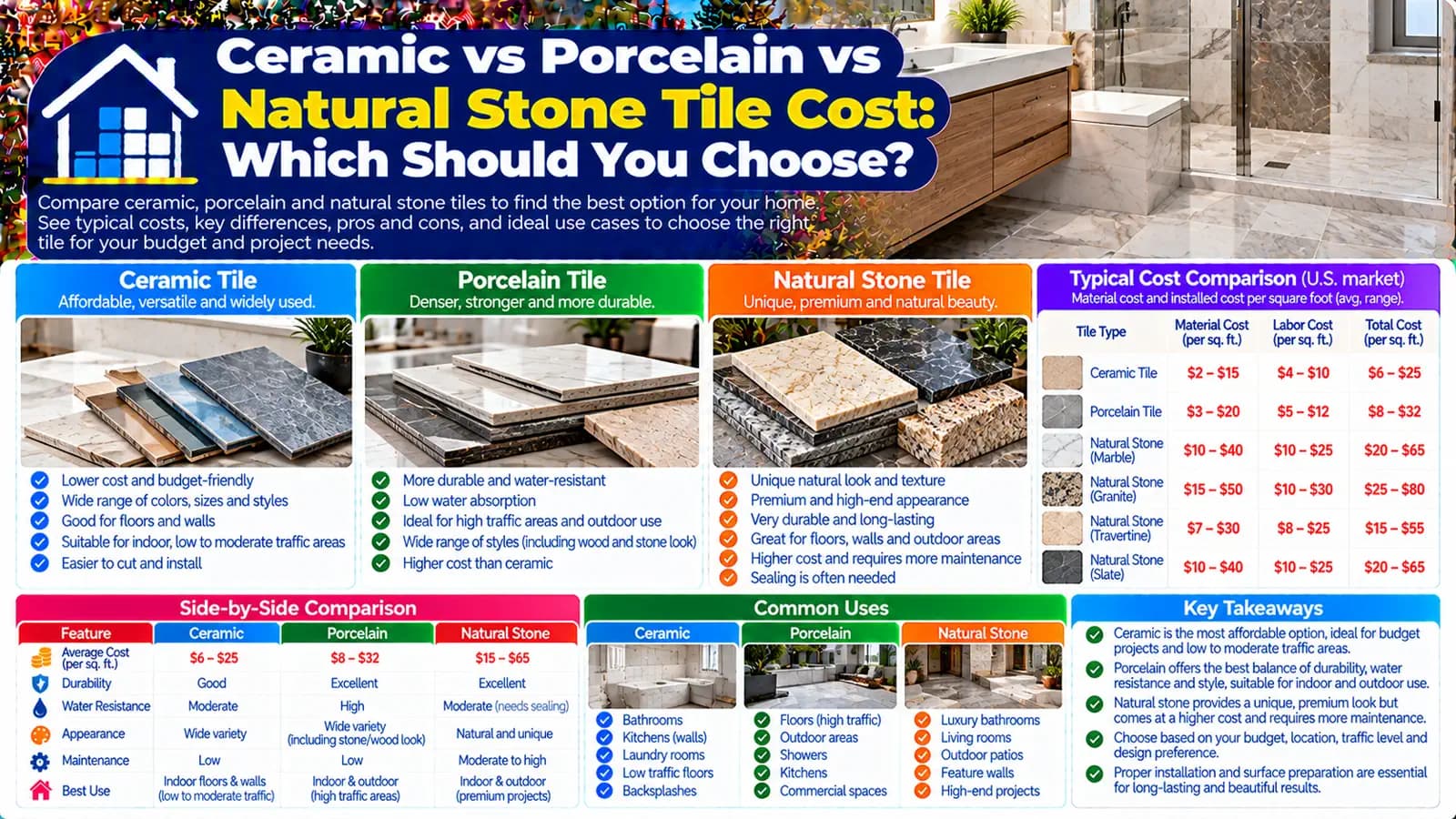
Compare material in its intended application
| Question | Ceramic | Porcelain | Natural stone |
|---|---|---|---|
| Calculator position | US/UK installed baseline | Per-area uplift from baseline | Larger per-area uplift from baseline |
| Installation planning | Confirm format, finish, cuts and substrate | Confirm product, format, cuts and substrate | Confirm exact stone, finish, handling and setting scope |
| Wet-area question | Product and assembly must suit application | Product and assembly must suit application | Stone and assembly need product-specific assessment |
| Ownership | Specify cleaning and repair expectations | Specify cleaning and repair expectations | Confirm stone-specific care and sealing advice where applicable |
Installed cost includes more than the tile
The calculator uses ceramic as its area-based installed baseline, with native US and UK adjustments for porcelain and stone. Application, pattern, surface preparation, removal, waterproofing, trim, and access can change the complete result. Do not use a tile retail price as an installed-project comparison.
Use product documentation for performance claims
Water absorption, slip, wear, frost exposure, finish, and suitable location depend on the individual product and system, not simply on the words ceramic, porcelain, or stone. Use relevant technical documentation and the installer’s specification rather than assuming any category is automatically suitable or unsuitable for wet areas.
Preparation and handling affect every material
Large format, complex patterns, walls, wet areas, irregular layouts, openings, edges, and substrate conditions can alter labour and waste. Natural stone may also need product-specific handling and finishing consideration. None of those factors can be resolved by a material label alone.
Care is material- and finish-specific
Do not assume a sealing interval, stain outcome, lifespan, or repair result from a generic category. Ask the supplier and installer for the selected product’s care requirements, compatible cleaners, sealing guidance where relevant, spare-tile strategy, and repair limitations.
Compare like-for-like tile scenarios
Keep area, application, pattern, and preparation constant while comparing ceramic, porcelain, and stone; then test the shortlist against the actual product specification.
Plan with the right calculator
Enter your project details and select the United States or United Kingdom market for Low, Typical, and High planning estimates.
Frequently asked questions
Does the tile calculator include surface preparation?+
Yes, through minor or significant preparation choices. Significant preparation already represents backer-board work in the model, so it should not be added twice. Structural floor repair remains separate.
Is tile itself a waterproofing system?+
No. Tile selection does not by itself establish a waterproof wet-area assembly. The calculator prices waterproofing or tanking as an optional scope; final system selection belongs to the installer and applicable requirements.
Why does a complex layout cost more?+
Diagonal, offset, and complex patterns can change setting-out, cuts, waste, labour, trim, and finishing. The calculator applies a complexity adjustment rather than treating every layout as identical.
Does removal include all disposal and repairs?+
Removal is an area-based planning allowance. Hidden substrate damage, structural work, mould remediation, plumbing relocation, and major demolition need separately defined scopes.
Sources & references
- Tile Council of North America Handbook · Tile Council of North America
- Tile Council of North America Standards · Tile Council of North America
- Natural Stone Institute Technical Resources · Natural Stone Institute
- The Building Regulations 2010: Sanitation, Hot Water Safety and Water Efficiency · GOV.UK
- Tile Installation Cost · Angi
- Tiling Cost Guide · Checkatrade