
Compare the same deck before comparing materials
| Decision | Wood or timber | Composite |
|---|---|---|
| Initial calculator position | Pressure-treated/softwood baseline; premium timber adds cost | Area-based premium over baseline |
| Specification | Species, treatment, grade, profile, and finish | Product line, profile, colour, span, and fastening system |
| Appearance | Natural variation and weathering | Manufactured colour and texture range |
| Care | Cleaning, inspection, and finish plan where used | Cleaning and product-specific inspection |
| Repair | Individual boards may be worked or replaced | Matching proprietary boards and fasteners may matter |
Upfront material and installation cost
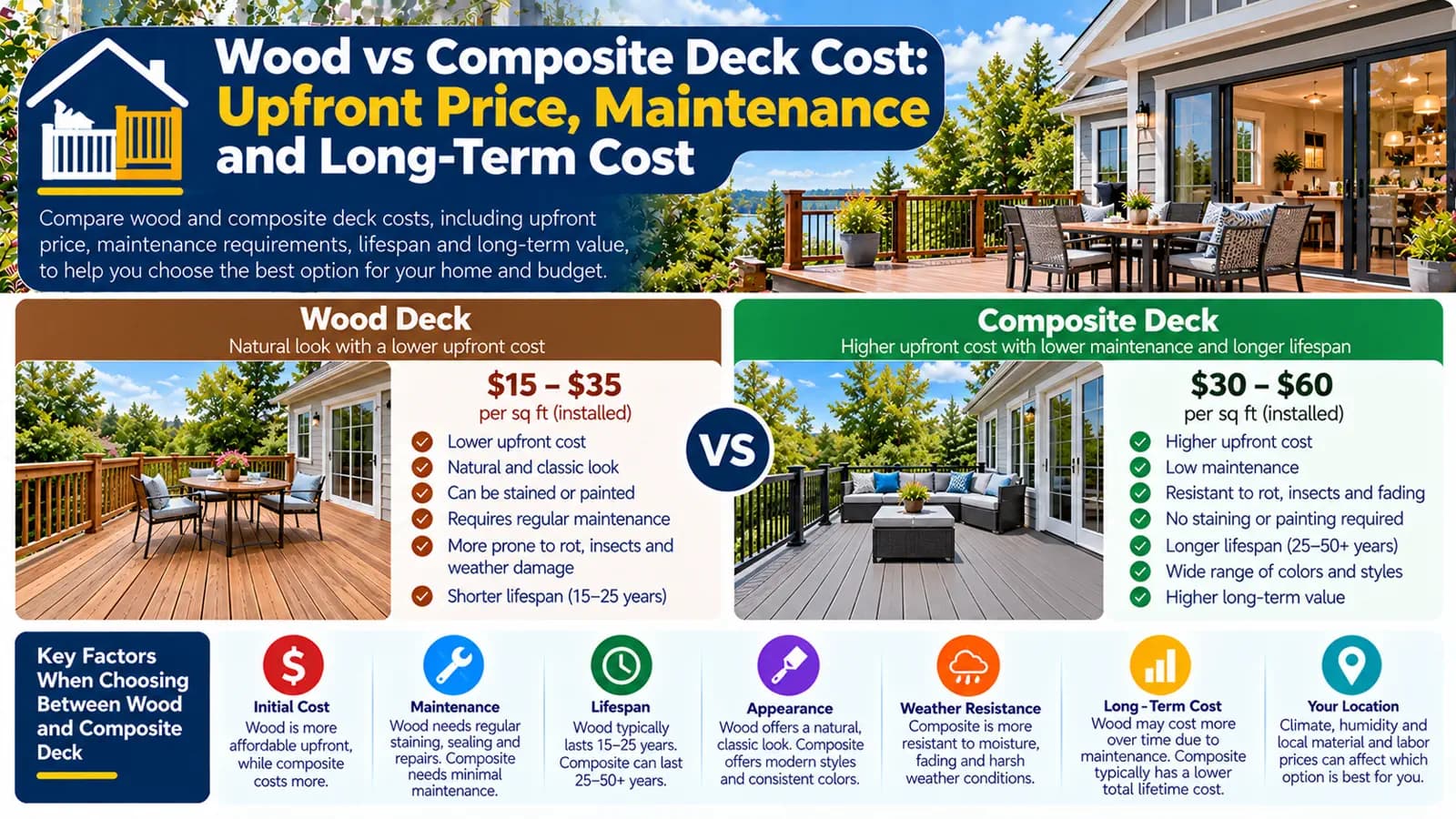
In the current US calculator, pressure-treated wood is the baseline, cedar or premium timber adds $8 to $20 per square foot, composite adds $15 to $35, and premium composite or hardwood adds $28 to $55. In the UK model, softwood is the baseline, hardwood adds £35 to £80 per square metre, and composite adds £45 to £100.
Those adjustments sit inside a complete installed estimate. Hidden-fastener systems, edge boards, fascia, colour-specific accessories, board layout, waste, delivery, and installer familiarity can change the product-level quote.
The board choice does not remove the substructure
Both material choices depend on properly designed footings, posts, beams, joists, drainage, ventilation, and connections. Board systems may have different span, support, expansion, fastening, and stair requirements. Reusing an existing frame requires inspection; a new surface cannot correct decay, movement, undersized members, or failed connections below it.
Cleaning, finishing, and routine inspection
TDCA guidance recommends keeping decking clear of dirt, algae, and leaves and carrying out more thorough periodic cleaning. Timber appearance may be left to weather or managed with a suitable finish; if a coating is chosen, preparation and reapplication should follow product guidance. Composite also needs cleaning and inspection rather than being described as maintenance-free.
Moisture, weather, and surface behaviour
Drainage, ventilation, debris, wetting, drying, direct sun, and freeze-thaw exposure affect outdoor surfaces and the structure below. Colour and sun exposure can affect how hot any walking surface feels, but performance varies by product and conditions; request manufacturer test information if surface temperature is a deciding concern.
Appearance and repairability
Wood offers species, grain, profile, stain, and natural-weathering choices. Composite offers manufactured profiles, textures, and colours. For either option, ask how scratches, stains, damaged boards, hidden fasteners, edge details, and colour matching will be repaired several years later and whether spare boards should be retained.
Model ownership cost without promising a lifespan
- Start with the same area, structure, complexity, stairs, and railing scope.
- Enter each supported material scenario in the calculator.
- Add product-specific installation, accessories, and finish allowances from comparable quotes.
- Estimate cleaning, inspection, refinishing, and repair events over a shared ownership period.
- Test a range of maintenance and replacement assumptions instead of one guaranteed service life.
A composite premium may or may not be recovered through lower finish maintenance, just as a lower-cost timber deck may or may not remain lower cost after care and repairs. The answer depends on the selected products, exposure, workmanship, maintenance behaviour, and time horizon.
US and UK material context
The calculator distinguishes pressure-treated wood, cedar/premium timber, composite, and premium composite/hardwood in USD per square foot.
The calculator distinguishes softwood, hardwood, and composite in GBP per square metre, with UK timber specification and planning context.
Choose by project priority
- Choose a product-level specification rather than relying on the words wood or composite.
- Prioritise structure, drainage, connections, access, and safe detailing before surface aesthetics.
- Compare written maintenance and repair paths alongside the initial quote.
- Use the Deck Building Cost Guide for the full project scope before isolating the board premium.
Plan with the right calculator
Enter your project details and select the United States or United Kingdom market for Low, Typical, and High planning estimates.
Frequently asked questions
Is composite decking always more expensive than wood?+
Composite carries an area-based premium in the current calculator, but actual installed cost depends on the selected product, substructure, fasteners, layout, access, and detailing.
Does composite decking require no maintenance?+
No outdoor deck is maintenance-free. Cleaning, inspection, drainage, fasteners, joints, and damage still need attention according to the manufacturer's instructions.
Can composite boards use an existing wood frame?+
Only after the frame is inspected and the proposed board system's span, fastening, ventilation, and loading requirements are confirmed. Do not assume an old frame is suitable from appearance alone.
How should I compare lifetime ownership cost?+
Compare the same deck design and ownership period, then include installation, cleaning, inspections, repairs, refinishing where applicable, and eventual component replacement without assuming a guaranteed lifespan.
Sources & references
- Deck Maintenance · Timber Decking and Cladding Association
- Decking Timber Options · Timber Decking and Cladding Association
- Wood Handbook, Chapter 15: Wood Preservation · USDA Forest Products Laboratory
- How Much Does It Cost to Build a Deck? · Angi
- Garden Decking Cost Guide · Checkatrade