
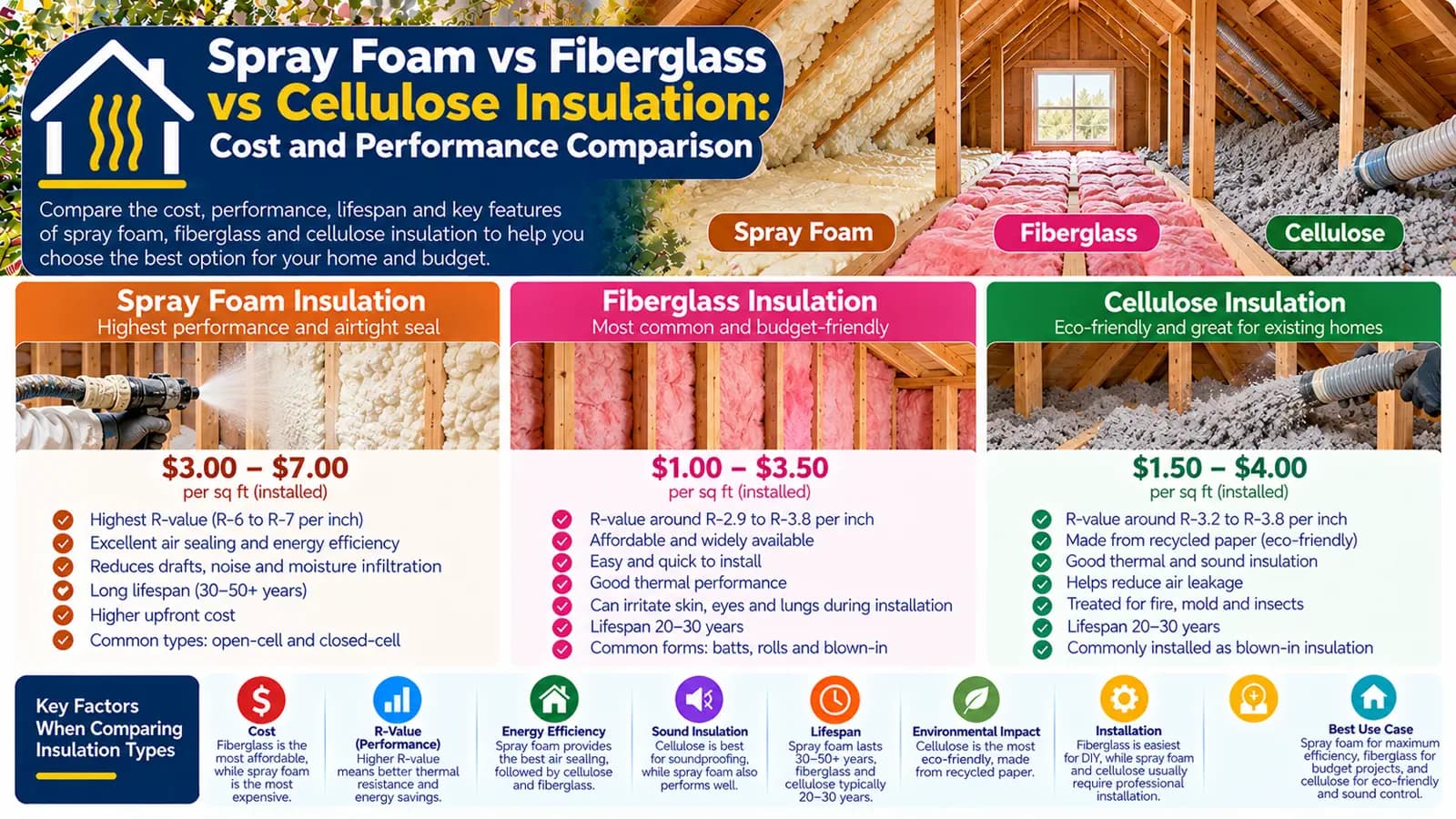
Compare assemblies, not labels
| Factor | Fiberglass | Cellulose | Spray or other foam |
|---|---|---|---|
| Common installation | Batts, rolls, or blown fibre | Loose or dense-pack fibre | Spray-applied or rigid product systems |
| Air control | Usually needs a separate continuous air-control strategy | Dense installation can limit movement but still needs assembly design | Some products can combine insulation and air-control roles |
| Access | Open framing or accessible blown applications | Useful for some irregular or enclosed cavities with equipment | Can reach irregular areas but requires product-specific access and controls |
| Key risk | Gaps, compression, wind washing or moisture | Settlement/density, dust, moisture and cavity condition | Chemical exposure during installation, moisture design and difficult removal |
How the calculator represents material cost
In the US calculator, fiberglass is the $0.30 to $1.50 per-square-foot baseline. Cellulose adds $0.30 to $1.50 per square foot. The calculator groups rigid and foam insulation together at a $2.00 to $5.25 premium, so it does not publish a spray-foam-only price. Location and removal remain separate.
The UK calculator uses loft-specific categories—quilt or mineral wool, loose fill, and PIR board—not a spray-foam/fiberglass/cellulose price menu. Use its native loft options and obtain product-specific UK quotes for anything outside that scope.
Thermal resistance is installed performance
Nominal R-value per thickness is useful, but actual performance also depends on coverage, density, compression, gaps, thermal bridging, air leakage, and moisture. UK U-value targets apply to whole elements rather than a material in isolation. The best material on paper can underperform when the assembly or workmanship is poor.
Air sealing and moisture control
Fibrous insulation does not automatically create a continuous air barrier. Some foam systems can restrict air movement, but vapour behaviour, drying potential, roof or wall condition, ventilation, and junction details still need design. Energy Saving Trust warns against using spray foam to conceal a leaking or poorly maintained roof.
Cavities, access, retrofit, and future removal
Batts need accessible framing and careful fitting. Blown fiberglass or cellulose can suit some irregular or enclosed cavities when density, obstructions, services, and moisture are controlled. Spray foam can adhere within complex spaces but may make inspection, repair, rewiring, roof work, or later removal more difficult. Include reversibility and future access in the decision.
Installation safety and fire strategy
EPA guidance identifies exposure risks from chemicals, vapours, aerosols, and dust during spray polyurethane foam work and emphasises isolation, ventilation, protective equipment, and manufacturer re-entry guidance. Fibrous products also require appropriate handling and dust controls. Fire performance depends on the specific product and complete protected assembly, not a generic material label.
England's Approved Document B addresses fire safety for building elements; other jurisdictions have their own requirements. Product data and a competent design should establish required coverings, cavity barriers, clearances, and other safeguards.
DIY boundaries
Accessible quilt or batt work may be within the capability of some homeowners when the space is dry, safe, uncomplicated, and local rules allow it. Closed cavities, electrical hazards, combustion equipment, hazardous existing materials, damp assemblies, and professional spray-foam systems require greater expertise. Saving labour is not worthwhile if the work blocks ventilation or creates concealed risk.
Choose using a documented hierarchy
- Define the thermal boundary and required assembly performance.
- Assess water, moisture, air leakage, ventilation, services, and existing materials.
- Identify which products are compatible with the cavity, access, and drying strategy.
- Compare installed quotes including preparation, safety controls, coverings, cleanup, and removal.
- Review product certification, warranty, fire strategy, and future inspection or repair access.
The Home Insulation Cost Guide covers the complete project budget. This specialist comparison deliberately does not declare one material universally best.
Plan with the right calculator
Enter your project details and select the United States or United Kingdom market for Low, Typical, and High planning estimates.
Frequently asked questions
Which insulation material has the best performance?+
There is no universal winner. Required thermal resistance, available thickness, air control, moisture behaviour, cavity access, installation quality, fire strategy, and regulations determine suitable assembly performance.
Does spray foam replace air sealing?+
Some spray-foam applications can insulate and limit air movement, but the complete air-control layer and junctions still require design. Product selection does not remove ventilation, moisture, combustion-safety, or fire requirements.
Can fiberglass or cellulose be added to existing cavities?+
Sometimes, but cavity condition, existing material, wiring, moisture, obstructions, density, and access must be assessed. Empty-looking space does not guarantee a suitable installation.
Is spray foam a DIY project?+
High-pressure two-component spray foam presents exposure and ventilation hazards and should be handled under manufacturer requirements by appropriately trained professionals. Small consumer products are not equivalent to a whole-building installation.
Why does the UK calculator not list fiberglass, cellulose, and spray foam directly?+
The UK calculator is specifically a loft-insulation model using quilt or mineral wool, loose fill, and PIR board. The article explains broader terminology without pretending those three US categories map directly to UK pricing.
Can wet insulation be covered with new material?+
The moisture source should be found and corrected first. Covering damp material or a wet assembly can conceal damage and undermine performance.
Sources & references
- Energy Renovations: Insulation · U.S. Department of Energy
- DIY Checks and Inspections · ENERGY STAR
- Safer Workplace Practices for Installing Spray Polyurethane Foam Insulation · U.S. Environmental Protection Agency
- Spray Foam Insulation Explained · Energy Saving Trust
- Approved Document B: Fire Safety · GOV.UK