
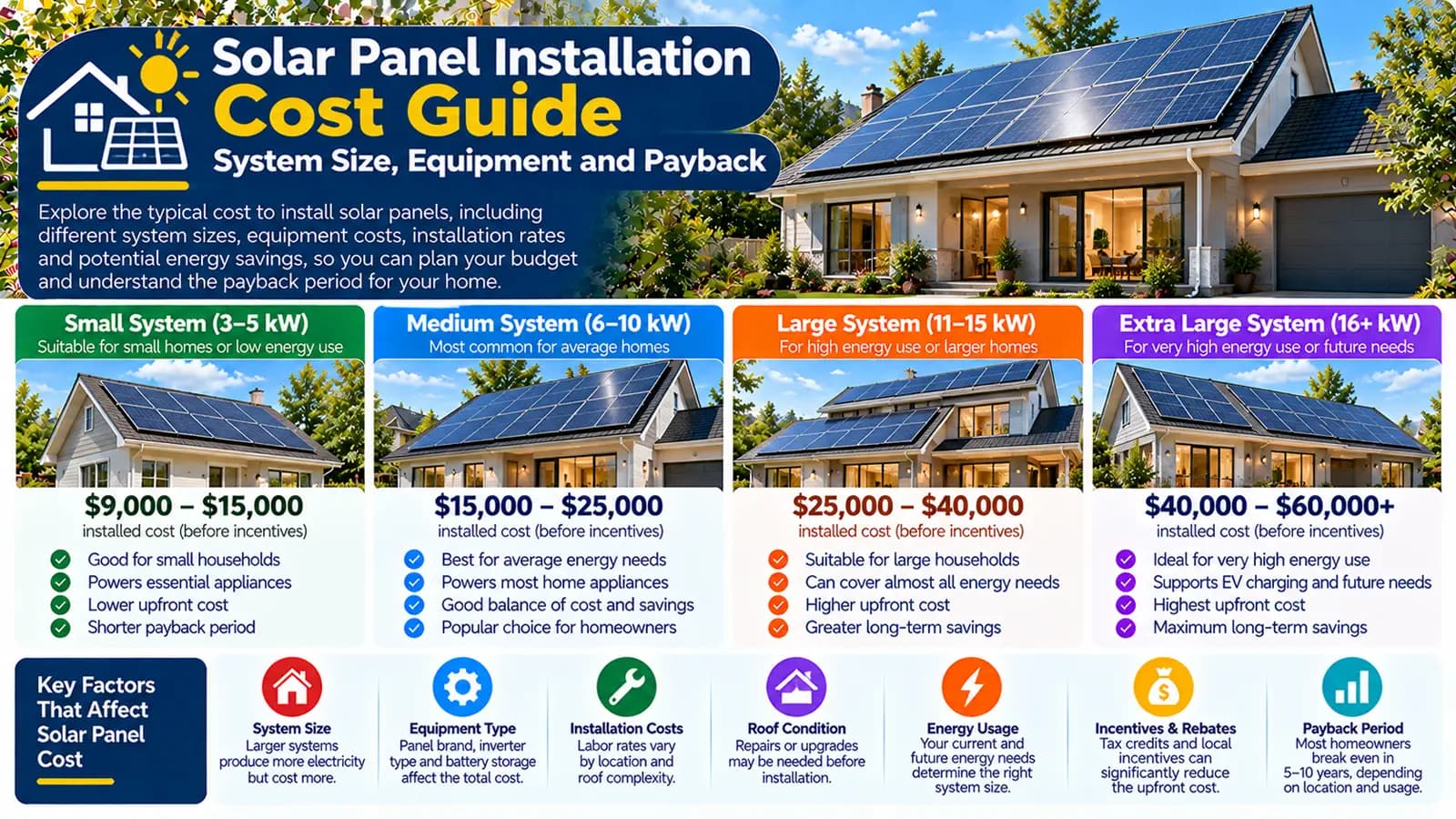
What belongs in a residential solar installation budget?
A complete proposal should identify rated system capacity, modules, inverter arrangement, mounting or racking, roof work, wiring, isolation and protection equipment, monitoring, labour, access, design, approvals, connection process, commissioning, documentation, and warranties. Battery storage is optional and should not be hidden inside a solar-only comparison.
| Component | Question for the proposal |
|---|---|
| PV array | How many modules, what rating, and what total kW? |
| Inverter | String inverter, microinverters, or another defined arrangement? |
| Mounting | What roof or ground system, attachments, and weatherproofing? |
| Electrical | What wiring, protection, meter, panel, or service work is included? |
| Process | Who handles design, permission, interconnection, commissioning, and records? |
System size starts with electricity needs—not house area alone
System capacity is expressed in kilowatts, while household consumption is measured over time in kilowatt-hours. Review recent electricity use and expected changes, then combine that demand context with roof or site constraints, local solar resource, export limits, and project goals. Floor area alone does not determine an appropriate system size.
The US Department of Energy recommends reviewing electricity needs and having an installer assess the site's solar potential. NREL's PVWatts can estimate potential production from system and location inputs, but its output is a model rather than a production guarantee.
How panel count relates to system capacity
Total array capacity is approximately the number of modules multiplied by each module's rated wattage, converted to kilowatts. The same capacity can therefore use different panel counts. Roof dimensions, setbacks, obstructions, module size, shading, electrical design, and layout can limit what fits even when household demand suggests a larger system.
Modules, inverter, mounting, and equipment tier
Modules generate direct-current electricity, while inverter equipment converts it for household and grid use. The U.S. Department of Energy distinguishes central string inverters and panel-level microinverters, among other configurations. Selection can affect design, monitoring, shading response, service strategy, and price, but no single arrangement is best for every roof.
HomeCostNest uses standard and premium equipment tiers rather than pricing individual brands. A quote should replace that broad tier with exact model numbers, ratings, warranties, compatibility, mounting system, monitoring, and included accessories.
Roof condition, orientation, shading, and access
Roof shape, slope, material, height, obstructions, attachment points, structural condition, and access affect installation. Orientation and shading affect potential production rather than simply adding or subtracting a fixed installation cost. DOE and Energy Saving Trust guidance both recommend site-specific assessment of roof suitability and solar exposure.
Electrical work, permitting, and grid connection
The installation may require wiring routes, isolation, protection, meter work, distribution-board or service assessment, and utility or network coordination. The US calculator has a fixed electrical or service-upgrade allowance. The UK model's standard per-kW range does not create a universal allowance for every network or electrical condition.
Permitting and interconnection processes vary by jurisdiction and network. In Great Britain, installers commonly coordinate Distribution Network Operator requirements; planning rules also have exceptions even where rooftop solar can be permitted development. Confirm the current process for the actual property rather than assuming a national generalisation settles it.
Battery storage is optional and separate
A battery changes the project purpose, equipment, controls, location, electrical integration, operating strategy, warranty, and cost. It does not increase the solar array's generation by itself. HomeCostNest adds battery storage only when selected: $8,000 to $18,000 in the US profile or £4,500 to £10,000 in the UK profile.
Battery capacity, usable energy, power, backup capability, chemistry, installation location, and tariff strategy require product- and site-specific assessment. Do not infer those details from the calculator's broad allowance.
How the HomeCostNest solar estimate works
The US profile uses a before-incentive installed range of $2,300 to $2,850 per kW. Premium equipment and roof complexity add per-kW adjustments; electrical or service work and battery storage are fixed optional allowances.
The UK profile uses a native £1,500 to £2,300 per-kW range, calibrated around the calculator's typical domestic reference. Premium equipment and roof complexity scale per kW, while additional scaffolding or access and battery storage are fixed allowances. Neither profile converts from the other market.
Payback is a separate model, not an installation-cost output
Simple payback divides net upfront cost by an estimated annual financial benefit, but every term requires assumptions. Production depends on location, capacity, orientation, shading, losses, and equipment. Financial benefit depends on self-consumed electricity, import price avoided, export terms, maintenance, financing, and future changes.
Ofgem's Smart Export Guarantee can pay eligible generators in Great Britain for exported electricity, but suppliers set tariffs and terms. That is not a guaranteed rate and is not included in HomeCostNest. This pillar introduces the concept only; a future specialist guide will own the detailed worth-it, savings, break-even, and ownership-economics decision.
US and UK project treatment
Use USD and kW with the US before-incentive per-kW range, equipment tier, roof complexity, optional service upgrade, and optional battery. Check local permitting, utility interconnection, and current incentive eligibility separately.
Use GBP and kW with the UK per-kW range, equipment tier, roof complexity, optional access/scaffolding, and optional battery. Check planning exceptions, DNO requirements, certification, and current export terms separately.
Compare solar proposals without relying on headline price
- Confirm the same rated kW, module and inverter models, layout, and mounting system.
- Compare roof, access, electrical, permitting, interconnection, commissioning, and monitoring scope.
- Separate batteries, financing, maintenance plans, roof work, and optional upgrades.
- Ask for site-specific production assumptions and identify shading, orientation, and loss inputs.
- Keep installation cost distinct from changing incentives, tariffs, savings, and payback scenarios.
Plan with the right calculator
Enter your project details and select the United States or United Kingdom market for Low, Typical, and High planning estimates.
Frequently asked questions
How is residential solar system size measured?+
HomeCostNest uses rated system capacity in kilowatts. Panel count depends on each module's rating and the final layout, so equal-kW systems do not always contain the same number of panels.
Does the calculator include a battery?+
Not by default. Battery storage is a separate optional fixed allowance in both US and UK calculator profiles.
Are incentives or export payments included?+
No. The calculator estimates installation before incentives and excludes export tariffs, grants, financing, savings, and utility rates. Current eligibility and terms must be checked separately.
Does a larger solar system always create better payback?+
No. Cost and potential production both change with size, while self-consumption, export terms, shading, orientation, tariffs, financing, and equipment performance affect the result.
Should an older roof be replaced before solar installation?+
Roof condition and remaining service needs should be assessed before mounting an array. Coordinating necessary roof work can avoid removing and reinstalling panels later.
Does HomeCostNest promise electricity savings?+
No. The calculator estimates project cost only. Production and savings require site-specific modelling, utility information, consumption data, and current program terms.
Sources & references
- Homeowner's Guide to Solar · U.S. Department of Energy
- Solar Integration: Inverters and Grid Services Basics · U.S. Department of Energy
- PVWatts Calculator · National Renewable Energy Laboratory
- Solar Panels: Costs, Savings and Benefits Explained · Energy Saving Trust
- Smart Export Guarantee · Ofgem
- Permitted Development Rights for Householders: Technical Guidance · GOV.UK