
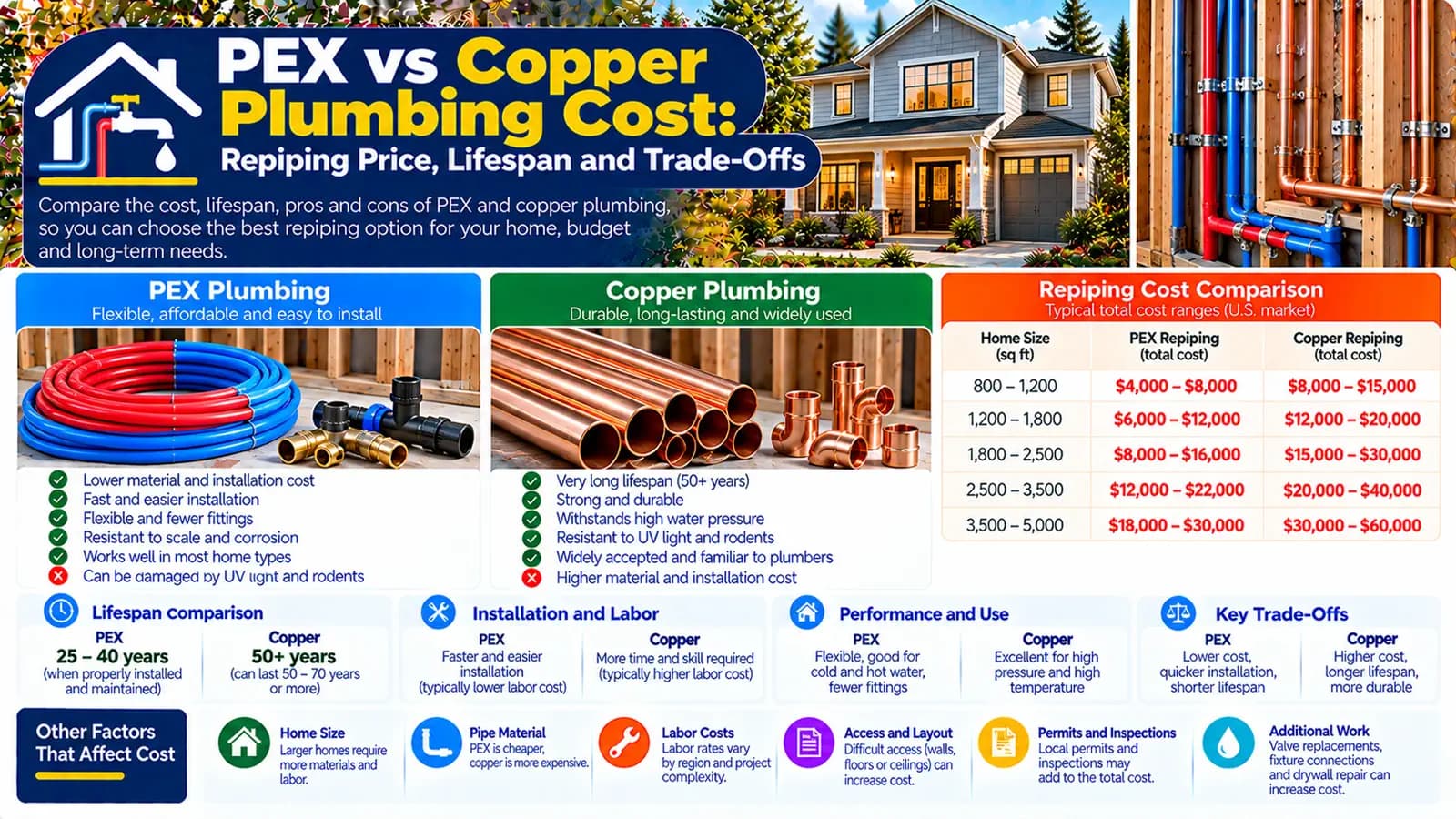
Start with the calculator's market boundary
The US profile explicitly compares PEX, CPVC, and copper, with PEX as its baseline and copper carrying a higher area-based planning adjustment. That is an installed-project model calibrated to current repiping ranges, not a retail pipe-price claim.
The UK profile instead uses Plastic / modern approved pipe system, Copper, and Mixed / complex replacement. It does not promise that a US-labelled PEX system maps directly to UK product practice. Select only a system accepted for the project and jurisdiction.
PEX and copper decision matrix
| Decision factor | PEX may fit | Copper may fit |
|---|---|---|
| Installed-cost priority | Lower US calculator baseline can suit broad repiping where the system is approved | Higher material and labour profile may be accepted for project-specific reasons |
| Restricted routes | Flexibility can reduce some directional fittings and help certain routes | Rigid lengths require planned changes of direction and working space |
| Visible or exposed work | Needs suitable support, protection, and product-approved exposure conditions | Rigid, familiar exposed routing may suit some designs, with appropriate protection |
| Connections and repairs | System-specific fittings and tools make installer and future product support important | Multiple recognized connection methods exist; accessibility and installer skill remain important |
| Water and environment | Product temperature, pressure, chemical, UV, and application limits must be respected | Water chemistry, corrosion, galvanic conditions, freezing, and environment require assessment |
| Market context | US PEX and UK approved plastic systems cannot be assumed identical | Copper standards, dimensions, joining practice, and rules still vary by market |
These are planning considerations, not design instructions or universal performance guarantees.
Installed cost combines pipe, fittings, labour, and access
PEX flexibility can reduce some fittings and installation time on suitable routes. Copper is rigid and may require more directional fittings, preparation, and labour. Yet a simple open-wall copper project can be easier to price than a difficult concealed PEX route, and premium manifolds or complex transitions can narrow a material-only difference.
Compare quotes that include the same fixture branches, valves, supports, transitions, fire or acoustic reinstatement, testing, openings, and making-good. Otherwise the cheaper material may simply be attached to a smaller scope.
Temperature, pressure, exposure, and application limits
Product markings, certification, manufacturer data, and local requirements establish where a particular pipe and fitting system can be used. Do not generalize from the terms PEX, plastic, or copper to every hot-water temperature, pressure, recirculation arrangement, external exposure, or proximity to heat.
NSF notes that many PEX products are tested for hot and cold supply applications, while potable-water suitability still depends on the certified product. UK water-fittings rules require suitable, appropriately standardized fittings and protection against conditions such as contamination, corrosion, pressure, temperature fluctuation, and freezing.
Water quality and corrosion need project evidence
Copper performance can be affected by water chemistry and system conditions; NSF specifically cautions about acidic water in consumer guidance. That does not mean copper is unsuitable everywhere or that a plastic system is automatically preferred. Local water information, existing-system evidence, and professional product selection should guide the decision.
Plastic products also require drinking-water approval and application compatibility. Taste, odour, permeation exposure, disinfectant conditions, and product-specific limitations should be handled through recognized certification and technical data rather than unsupported material-wide claims.
Repairability is system- and access-dependent
A local repair may be straightforward when the failed location is accessible, matching components remain supported, and the cause is understood. Concealed routing, proprietary fittings, mixed systems, discontinued components, or recurring environmental causes can complicate either material.
Plan accessible valves and service points through professional design, retain product and installer records, and document concealed routes. This is ownership planning—not an instruction to make connections or modify a pressurized system.
Avoid a universal lifespan promise
Published marketing numbers cannot predict one property's service life. Water chemistry, temperature, pressure cycling, installation quality, support, UV or chemical exposure, freezing, physical damage, product compatibility, and maintenance vary.
Choose by the project's constraints
- Confirm the market, applicable rules, and potable-water product approvals.
- Map hot and cold routes, fixture density, access, exposure, and water conditions.
- Obtain like-for-like installed quotations for complete pipe-and-fitting systems.
- Review transitions, future component availability, documentation, and warranty.
- Compare restoration, disruption, and serviceability alongside initial price.
Plan with the right calculator
Enter your project details and select the United States or United Kingdom market for Low, Typical, and High planning estimates.
Frequently asked questions
Is PEX always cheaper than copper?+
No universal rule applies, although the US calculator uses a lower PEX planning profile and a higher copper adjustment. Layout, access, product system, fittings, local labour, water conditions, and approval requirements shape the installed comparison.
Does the UK calculator use the same PEX categories as the US calculator?+
No. The UK profile uses Plastic / modern approved pipe system, Copper, and Mixed / complex replacement. It does not assume a particular US product or fitting practice.
Which material lasts longer?+
A credible project decision should not rely on one universal lifespan number. Product qualification, water chemistry, temperature, pressure, installation, exposure, system compatibility, and maintenance all influence service.
Can PEX and copper be combined?+
Mixed systems can be designed, but transitions, fittings, accessibility, bonding implications where relevant, and product instructions require professional specification. The article does not provide installation instructions.
How should potable-water suitability be checked?+
Use products certified or approved for their intended drinking-water application and accepted by the applicable jurisdiction. A material name alone is not proof that every pipe, fitting, or joining product is suitable.
Sources & references
- Faucets and Plumbing Products · NSF
- The Water Supply (Water Fittings) Regulations 1999 · UK Legislation
- Products Used Within a Property Boundary · Drinking Water Inspectorate
- What Does Pipe Replacement Cost? · Angi
- Plumbing Installation Costs · Checkatrade