
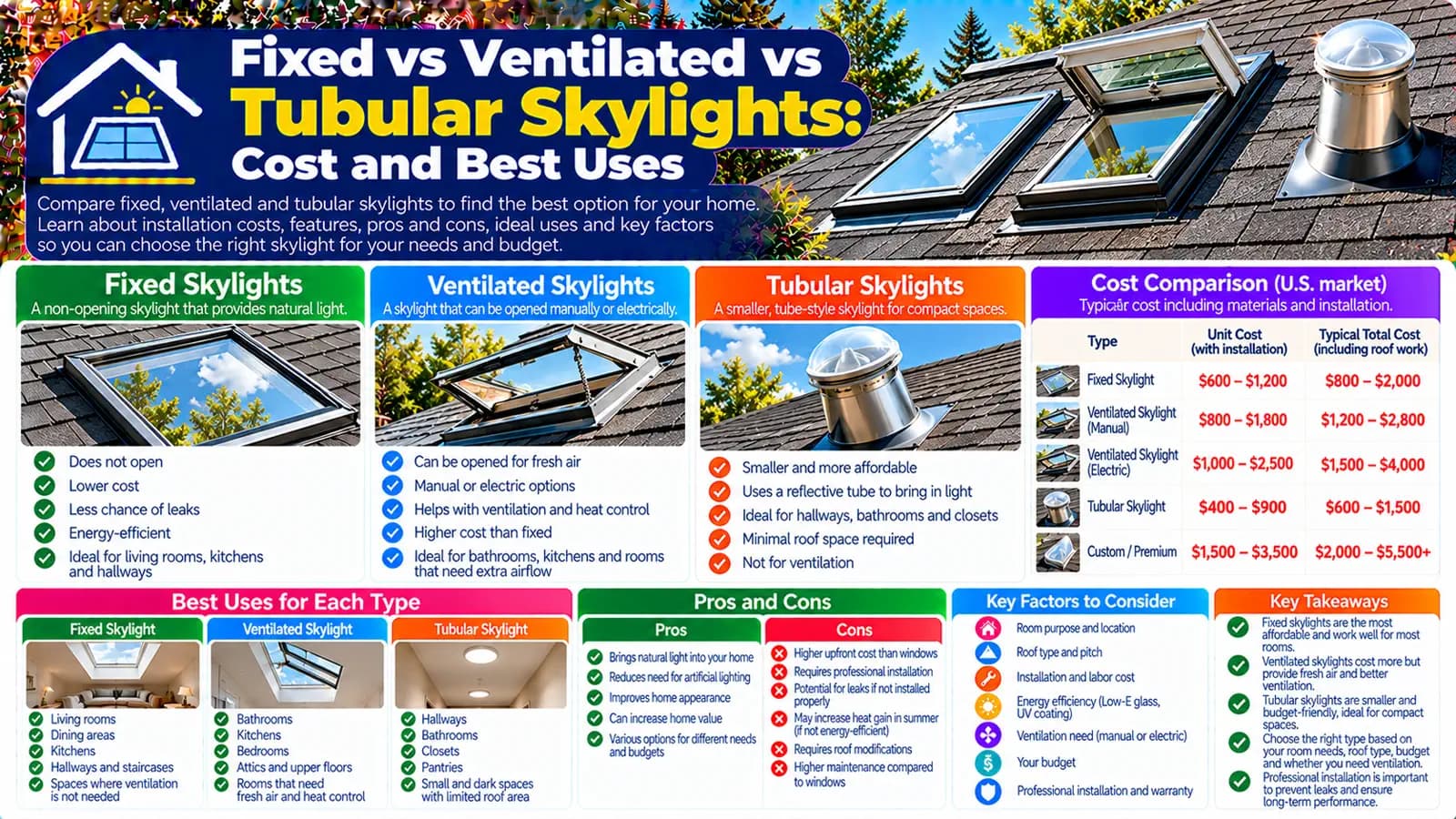
Compare three different daylighting concepts
| Decision | Fixed | Ventilated / openable | Tubular daylighting |
|---|---|---|---|
| Primary goal | Direct daylight and a view of sky without opening ventilation | Direct daylight plus an opening ventilation function | Deliver daylight through a roof collector, reflective tube, and ceiling diffuser |
| Roof/opening concept | Direct framed or curbed glazed opening | Direct glazed opening plus hinges, seals, controls, and moving hardware | Usually a smaller roof penetration with a routed tube; exact system and structure still matter |
| Controls | Optional blind or shade | Manual reach hardware or powered controls; optional sensors and shades | Product-dependent diffusers, dampers, or light kits; routing is central |
| Interior work | Shaft, light well, or finished reveals where needed | Similar shaft or reveals plus control access | Tube route through attic, loft, ceiling void, or other space and a ceiling diffuser |
| Maintenance focus | Glazing, seals, flashing, roof interfaces, interior moisture | Fixed-unit items plus opening hardware, controls, sensors, and power | Roof collector, flashing, tube joints and route, diffuser, and any accessories |
Compare installed projects, not product stickers
The US calculator names fixed, manual vented, electric or solar vented, and premium or custom tiers. The UK calculator names standard fixed or basic, opening roof window, and electric or premium tiers. Installed cost also depends on count, roof condition, opening type, framing, interior finishing, controls, blinds, and access.
Tubular daylighting is not a named choice in either live dataset. Its roof collector, flashing, tube diameter and route, bends or obstructions, ceiling diffuser, access, and interior making good require a product-specific quote.
Fixed units prioritize daylight without opening hardware
A fixed skylight can suit a room where daylight and a view are wanted but roof-level ventilation is not part of the plan. Fewer operating components can simplify the product scope, but the roof opening, glazing, structure, flashing, drainage, shaft, shades, and maintenance access still require design.
A lower named calculator tier does not establish the lowest final quote if the unit is large, custom, difficult to access, or requires a new structural opening and extensive interior work.
Openable units add ventilation and control scope
Manual or powered opening can support a ventilation strategy, but it does not by itself prove adequate ventilation for the room. Opening area, other inlets and extracts, room use, control logic, weather, security, insect screens, local rules, and building design matter.
Powered units can add wiring or power architecture, sensors, remote or wall controls, integration, commissioning, and future service. Solar-powered product features should be verified for the exact unit rather than assumed to eliminate all electrical or control work.
Tubular systems trade a direct view for routed daylight
A tubular daylighting device collects roof-level light and carries it through a reflective tube to a diffuser. It can be useful where a direct glazed shaft is impractical or where a smaller ceiling delivery point suits the room, but roof position and interior destination must be connectable through a viable route.
Structure, ducts, pipes, wiring, fire separations, insulation, attic or loft access, tube length, bends, roof form, and diffuser position can affect feasibility and light delivery. It is a daylight system, not automatically a ventilation opening or exterior view.
Start with the room and ownership goal
- Daylight quantity, distribution, glare, view, privacy, and solar-gain goals
- Whether natural ventilation is genuinely required and how it integrates with the wider ventilation plan
- Ceiling height, attic or loft depth, room layout, roof orientation, obstructions, and feasible route
- Manual reach, powered controls, sensors, blinds, cleaning, and future service access
- Noise, rain, condensation, security, weather closure, maintenance, and warranty priorities
Ratings and daylight goals are not interchangeable
DOE and ENERGY STAR identify whole-product U-factor, solar heat gain coefficient, and visible transmittance as important skylight measures in the US context, with climate affecting appropriate choices. NFRC ratings help compare rated products.
Tubular-system daylight delivery is affected by collector, tube, route, bends, length, diffuser, sun and sky conditions, and room surfaces. Do not use a fixed skylight's rating as a proxy for an unquoted tubular system or promise a universal daylight level or energy saving.
Every option needs compatible weatherproofing
Fixed, openable, and tubular products all penetrate the roof. None is leak-proof by category. Roof covering, pitch, curb or deck detail, collector or frame, compatible flashing, underlay or membrane, drainage, installation, exposure, and maintenance affect water performance.
Opening hardware adds seals and moving interfaces; tubular products add collector and tube joints; fixed units retain perimeter and glazing interfaces. These are differences to evaluate, not proof that one category always performs better.
US and UK labels need product context
The calculator uses 'skylight' and directly models fixed, manual vented, electric/solar vented, and premium/custom units in USD.
The calculator title uses 'Roof Window / Skylight' while inputs use 'roof window': standard fixed/basic, opening roof window, and electric/premium in GBP. Rooflight, skylight, and roof window should follow the proposed product's classification and use.
Tubular daylighting products may have different local names and supply patterns. Obtain native-market specifications and prices; do not currency-convert a US unit assumption.
Structure and roof access remain professional scope
Even a relatively small opening can interact with roof structure, weather layers, insulation, fire provisions, and services. HSE identifies roof work and fragile rooflights as serious hazards.
Choose the system that fits the actual building
- Define daylight, view, ventilation, privacy, control, and interior-design goals.
- Assess roof covering, pitch, orientation, structure, route, ceiling, services, weather exposure, and access.
- Compare complete fixed and opening skylight scopes using the cost guide and calculator.
- Obtain a product-specific tubular design and quote because it is not a named calculator input.
- Compare ratings, daylight delivery, controls, finishes, weatherproofing, maintenance access, warranties, and approvals without declaring a universal winner.
Plan with the right calculator
Enter your project details and select the United States or United Kingdom market for Low, Typical, and High planning estimates.
Frequently asked questions
Is a fixed skylight always the cheapest option?+
It is the lowest named unit tier in the US calculator, but total cost also depends on count, roof conditions, existing versus new opening, framing, finishing, access, controls, blinds, and the exact product. Local quotations can differ.
What is the difference between a ventilated skylight and a roof window?+
Terms overlap in everyday use but are not universally interchangeable. Product position, reach, opening method, intended use, applicable standards, and manufacturer classification can differ. Use the UK calculator's roof-window terminology and the proposed product documentation.
Are tubular skylights in the calculator?+
No. The comparison explains tubular daylighting as a separate concept, but neither live market dataset names it as a selectable unit type. Obtain a product-specific quote rather than treating a fixed-unit range as a tubular price.
Do electric or solar controls remove the need for wiring?+
Not necessarily. Product architecture, power, controls, sensors, charging, interfaces, and installation vary. The calculators expose electrical controls separately, so confirm whether the quoted unit and control work overlap.
Which type is least likely to leak?+
No type can be declared leak-free. Product and flashing compatibility, roof condition, pitch, drainage, opening and curb details, installation, exposure, and maintenance all influence water performance.
Sources & references
- Purchasing Energy-Efficient Residential Windows, Doors, and Skylights · U.S. Department of Energy
- Residential Windows, Doors, and Skylights · ENERGY STAR
- Windows, Doors and Skylights Key Product Criteria · ENERGY STAR
- Fenestration Energy-Performance Ratings · National Fenestration Rating Council
- Approved Document A: Structure · GOV.UK
- Conservation of Fuel and Power: Approved Document L · GOV.UK
- Roof Work · Health and Safety Executive