
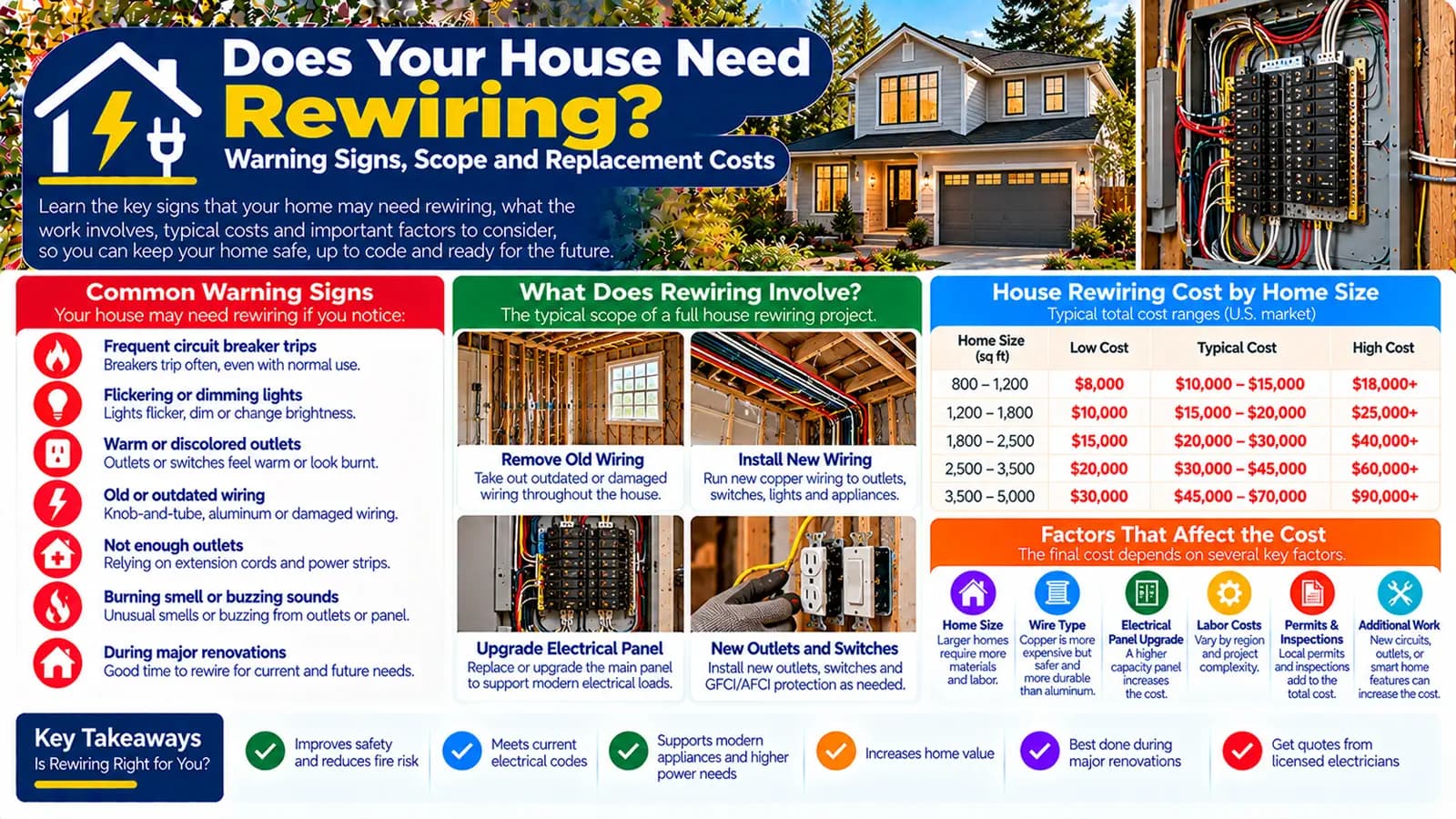
Some observations call for urgent professional help
Smoke, arcing, a burning odour, scorching, or unusually hot electrical accessories can indicate an immediate hazard. CPSC and ESFI safety guidance directs consumers to stop using affected equipment and obtain qualified electrical help rather than attempting repairs. Call emergency services when there is fire, smoke, or immediate danger.
Observation is not a guaranteed diagnosis
| Observation | Why professional evaluation may matter | Possible scope to investigate |
|---|---|---|
| Repeated tripping or blown fuses | A protective device may be responding to overload, equipment, a circuit fault, or another condition | Load/use review, appliance or circuit assessment, defined repair, or wider testing |
| Flickering, dimming, buzzing, heat, or discolouration | Connections, accessories, equipment, loading, or supply conditions may require prompt assessment | Affected equipment and circuit first; broader scope only if evidence supports it |
| Damaged sockets/receptacles, switches, covers, or visible cable | Physical damage can expose people or materials to electrical hazards | Safe isolation by a professional, local replacement, circuit testing, and cause assessment |
| Too few circuits or outlets for current use | Extension-lead dependence and concentrated loads can signal that capacity and distribution no longer suit use | New points or circuits, panel/capacity assessment, or coordinated upgrade |
| Unrecorded or apparently poor alterations | Unknown workmanship and connections can complicate safety and future renovation | Inspection and testing, opening only where professionally justified, correction of defined defects |
| Major renovation or added loads | New layout, appliances, HVAC, solar, garage, or addition work can change demand and access | Project-wide electrical design and coordination; not automatically full replacement |
Property age and component type are clues, not verdicts
A property's date, visible cable type, fuse box, electrical panel, or consumer unit may help an electrician plan an assessment. None alone establishes the condition of concealed wiring or guarantees that whole-house replacement is necessary. Conversely, a newer-looking panel does not prove every downstream circuit was replaced correctly.
Electrical Safety First's reporting guidance emphasizes a clear condition summary based on observations and test results rather than a vague instruction to rewire. Ask what evidence supports each recommendation and which circuits or components it covers.
Inspection and testing define the decision
A professional assessment can consider supply and control equipment, protective measures, earthing or grounding and bonding, circuit condition, accessories, signs of alteration, loading, and appropriate test results. The extent of inspection depends on property access and applicable practice.
In the UK, an EICR is a recognized reporting format for an existing installation. In the US, inspection, permit, and documentation routes vary by jurisdiction and project. Neither label should be treated as a remote pass/fail shortcut.
Repair, partial rewire, and whole-property rewire
- A defined repair addresses an assessed fault or damaged component without claiming the rest of the installation is renewed.
- A targeted upgrade may add capacity, protection, or new circuits for a remodel while retaining assessed existing work.
- Partial rewiring replaces a documented group of circuits or areas and requires safe coordination with retained work.
- Whole-property rewiring replaces substantial distribution and accessories under a coordinated design, testing, and certification scope.
The appropriate rung depends on findings, goals, access, and how safely old and new work can coexist. It is not determined by article checklists.
Why the decision changes cost so sharply
Small repair pricing, a partial project, and a substantial whole-property rewire have different labour, access, material, inspection, and restoration profiles. The HomeCostNest calculator is calibrated for substantial or whole-home work, so using it for one defective outlet or one additional circuit would misstate the project.
Once professional evaluation supports broader scope, the House Rewiring Cost Guide explains area, specification, panel or consumer-unit implications, access, permits, testing, wall repair, and disruption in detail.
US and UK decision language
A licensed electrical professional can assess receptacles or outlets, circuits, grounding and bonding, the service panel, capacity, permit needs, and local code requirements.
A suitably qualified electrician can assess sockets, circuits, earthing and bonding, the consumer unit, EICR findings, Part P context, notification, testing, and certification.
Information that helps without self-diagnosis
- Dates, locations, and circumstances of recurring problems
- Photographs of visible damage taken without touching or opening equipment
- Panel schedules, certificates, permits, invoices, and prior reports
- Planned appliance, renovation, solar, garage, or addition loads
- Rooms where outlet dependence or interruptions affect normal use
Do not recreate faults, overload circuits, remove covers, or probe equipment to collect evidence.
Plan with the right calculator
Enter your project details and select the United States or United Kingdom market for Low, Typical, and High planning estimates.
Frequently asked questions
Does an old house automatically need rewiring?+
No. Age is context, not a diagnosis. Inspection and testing of the actual installation, its condition, protection, loading, alterations, and intended use should determine the scope.
Does repeated breaker tripping prove the whole house needs rewiring?+
No. Repeated operation of protective devices warrants professional evaluation, but it does not identify the cause or prove that every circuit requires replacement.
Is an older fuse box or consumer unit enough to diagnose the wiring?+
No. The control equipment is one part of an installation. A professional assessment should consider circuits, earthing and bonding, accessories, protection, condition, alterations, and test results.
Can only the affected circuit be repaired?+
Possibly. The appropriate choice may be a defined repair, partial rewire, wider upgrade, or whole-property rewire. That decision depends on inspection findings and how safely new and retained work can operate together.
What should I do about burning smells, heat, smoke, or arcing?+
Treat these as urgent safety concerns. Stop using the affected equipment or area if it is safe to do so, keep clear, and contact emergency services or a qualified electrical professional as appropriate. Do not open or work on energized equipment.
Sources & references
- Home Wiring Safety Tips · Electrical Safety Foundation International
- CPSC Guide to Home Wiring Hazards · U.S. Consumer Product Safety Commission
- Electrical Safety: Approved Document P · GOV.UK
- Electrical Installation Condition Reporting: Best Practice Guide 4 · Electrical Safety First
- Cost to Rewire a House · Angi
- House Rewiring Cost Guide · Checkatrade