
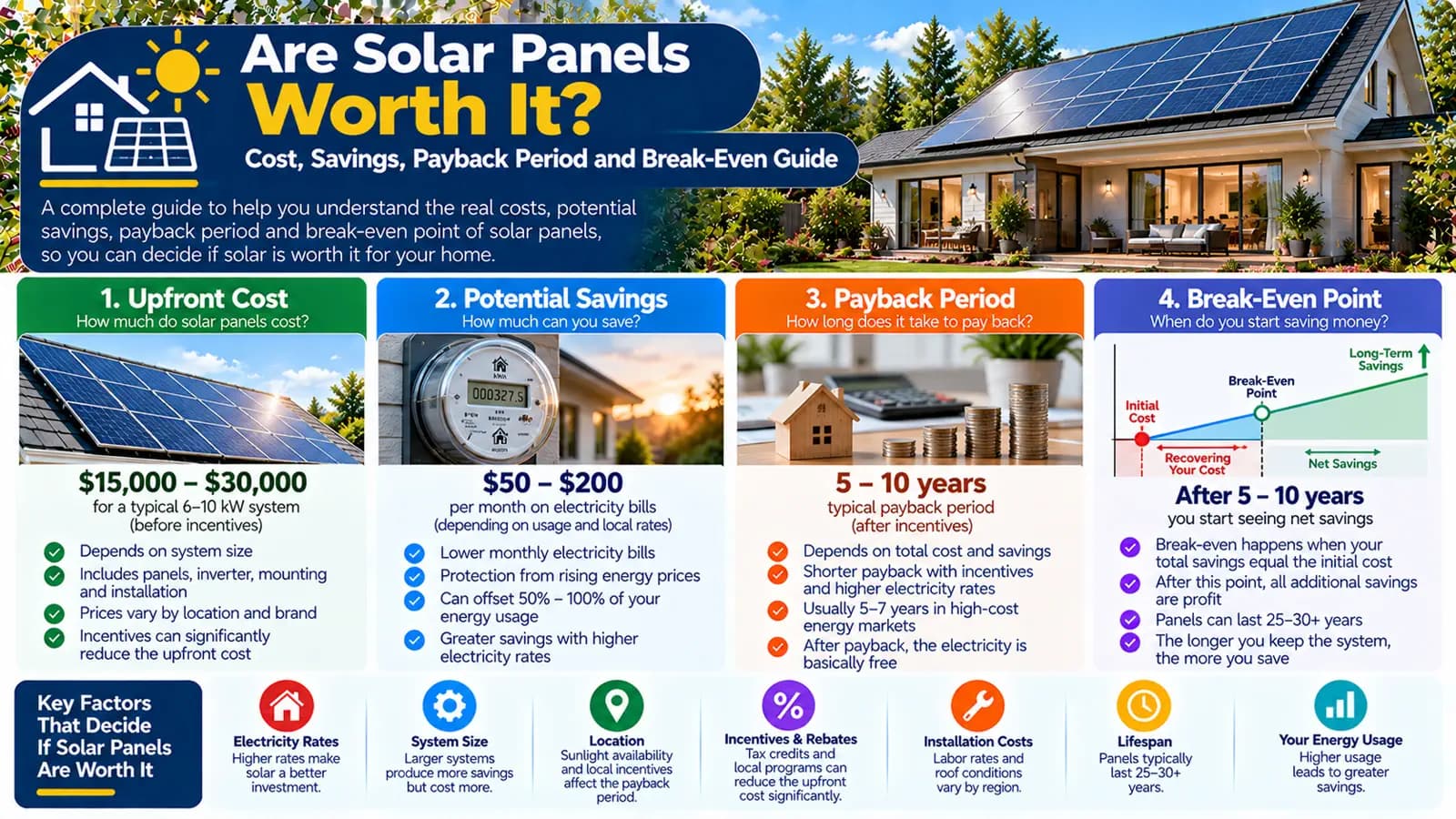
The answer is conditional
Solar may be financially attractive when a suitable site produces useful electricity, the installed cost is competitive, a meaningful share of generation offsets electricity purchases, and the ownership horizon is long enough. It may be less attractive when shading, roof work, high financing cost, low self-consumption, weak export value, or a short ownership period changes those assumptions.
| Variable | Why it matters |
|---|---|
| Net project cost | Sets the amount that must be recovered |
| Annual production | Determines the electricity available to use or export |
| Self-consumption | Values generation at avoided import cost when it offsets household use |
| Export compensation | Values surplus sent to the grid under current terms |
| Financing and ownership | Changes cash flow, total cost, risk, and time available to benefit |
Start with a complete installation cost
Use the Solar Panel Installation Cost Guide to define system size, equipment, roof complexity, electrical or access work, and optional battery storage. HomeCostNest produces a before-incentive project range, so it does not silently assume a tax provision, grant, export tariff, financing structure, or electricity price.
Estimate production separately from rated capacity
Rated capacity in kilowatts is not annual electricity production. Location, orientation, tilt, shade, layout, weather variation, equipment, and system losses affect expected kilowatt-hours. DOE recommends site assessment, while NREL PVWatts provides a modelling starting point rather than a production guarantee.
Match generation to household consumption
A household benefits differently from each generated unit depending on whether it is used on site or exported. Review interval or time-of-use data where available, not only an annual bill. Daytime loads, seasonal use, future electrification, remote work, electric vehicles, heating, and occupancy can change the match between production and demand.
Separate self-consumed and exported electricity
A simple annual benefit model can value self-consumed generation at the avoided electricity import rate and exported generation at the applicable export rate, then subtract estimated operating or maintenance costs. Tariffs, rates, and eligibility can change; do not assume either value grows at a fixed rate.
| Component | Planning calculation |
|---|---|
| Self-consumed benefit | Self-consumed kWh × applicable avoided import price |
| Export benefit | Exported kWh × current eligible export rate |
| Annual net benefit | Self-consumed benefit + export benefit − modelled annual costs |
This is a framework, not a forecast. Use current bills, contracts, and jurisdiction-specific rules.
Calculate simple payback without mistaking it for ROI
A simplified planning formula is: simple payback = net upfront project cost ÷ estimated annual net electricity benefit. If an illustrative project cost £10,000 and the assumed annual net benefit were £1,000, the arithmetic would show ten years. That example does not predict any actual system because every input is hypothetical.
Simple payback ignores the timing of cash flows, financing, opportunity cost, tax treatment, equipment replacements, degradation, tariff changes, and value after the payback point. Break-even is the point at which cumulative modelled benefits equal cumulative modelled costs; changing assumptions can move it materially.
Financing changes cash flow and total cost
Cash, loans, leases, and power-purchase arrangements allocate ownership, maintenance duties, incentives, payments, escalation terms, and transfer obligations differently. Compare total contractual payments and responsibilities, not only a monthly payment. This guide does not recommend a financial product or provide individualized financial advice.
Treat battery economics as a separate decision
A battery can shift solar electricity to another time and may support other goals, but it adds equipment cost and operating assumptions. Its financial value depends on usable capacity, efficiency, cycling, import and export tariff structure, backup configuration, warranty, and household load. Run solar-only and solar-plus-storage cases separately rather than assuming a battery improves payback.
Allow for monitoring, maintenance, and equipment service
Include inspections, cleaning where actually needed, monitoring, roof access, and possible equipment service in the ownership model. Inverter architecture and warranties differ, and future work may require labour even where equipment remains covered. Avoid inserting one universal replacement year or degradation rate without a product-level specification.
Ownership horizon and a future sale
A homeowner planning to move soon has less time to realise bill reductions. A sale can also involve warranty transfers, finance or lease obligations, system records, and buyer questions. Do not assume the installation produces a guaranteed increase in sale price; treat any resale effect as uncertain unless supported for the specific market and property.
US and UK financial context
Start with the US before-incentive calculator result and current utility rules. Verify any tax or local program independently; this article makes no federal tax-credit claim.
Start with the native UK calculator result. Ofgem's Smart Export Guarantee can compensate eligible exported electricity in Great Britain, but suppliers set rates and terms, so no tariff is assumed.
Make the decision with scenarios, not a promise
- Build a complete before-incentive installation range.
- Model site-specific annual production with documented assumptions.
- Split production into self-consumed and exported electricity.
- Apply current rates and terms, then include financing and modelled operating costs.
- Test conservative, central, and stronger cases over the expected ownership horizon.
- Record which changes would reverse the decision before signing a contract.
Plan with the right calculator
Enter your project details and select the United States or United Kingdom market for Low, Typical, and High planning estimates.
Frequently asked questions
What is a simple solar payback period?+
It is net upfront project cost divided by estimated annual net electricity benefit. It is a simplified planning measure, not a guaranteed return or a complete investment analysis.
Does a larger solar system always improve payback?+
No. Capacity affects cost and production, but household use, export compensation, shading, orientation, tariffs, and design determine how additional generation is valued.
Does adding a battery make solar more worthwhile?+
Not automatically. A battery adds cost and changes when energy can be used, but its economics depend on usable capacity, operating strategy, tariffs, efficiency, warranty, and household consumption.
Are incentives included in the HomeCostNest solar estimate?+
No. The calculator is before incentives and excludes grants, tax provisions, export tariffs, financing, savings, and utility rates.
How do shading and roof direction affect the decision?+
They can change expected production. Use a site-specific model and installer assessment rather than assuming every roof produces the same energy per installed kilowatt.
What happens if I sell the home before break-even?+
Ownership transfer, contracts, warranties, financing, and buyer preferences can affect the outcome. Do not assume a guaranteed property-value increase or that every agreement transfers easily.
Sources & references
- Homeowner's Guide to Solar · U.S. Department of Energy
- PVWatts Calculator · National Renewable Energy Laboratory
- A Consumer's Guide to Buying a House with Solar Panels · U.S. Department of Energy
- Solar Panels: Costs, Savings and Benefits Explained · Energy Saving Trust
- Smart Export Guarantee · Ofgem