
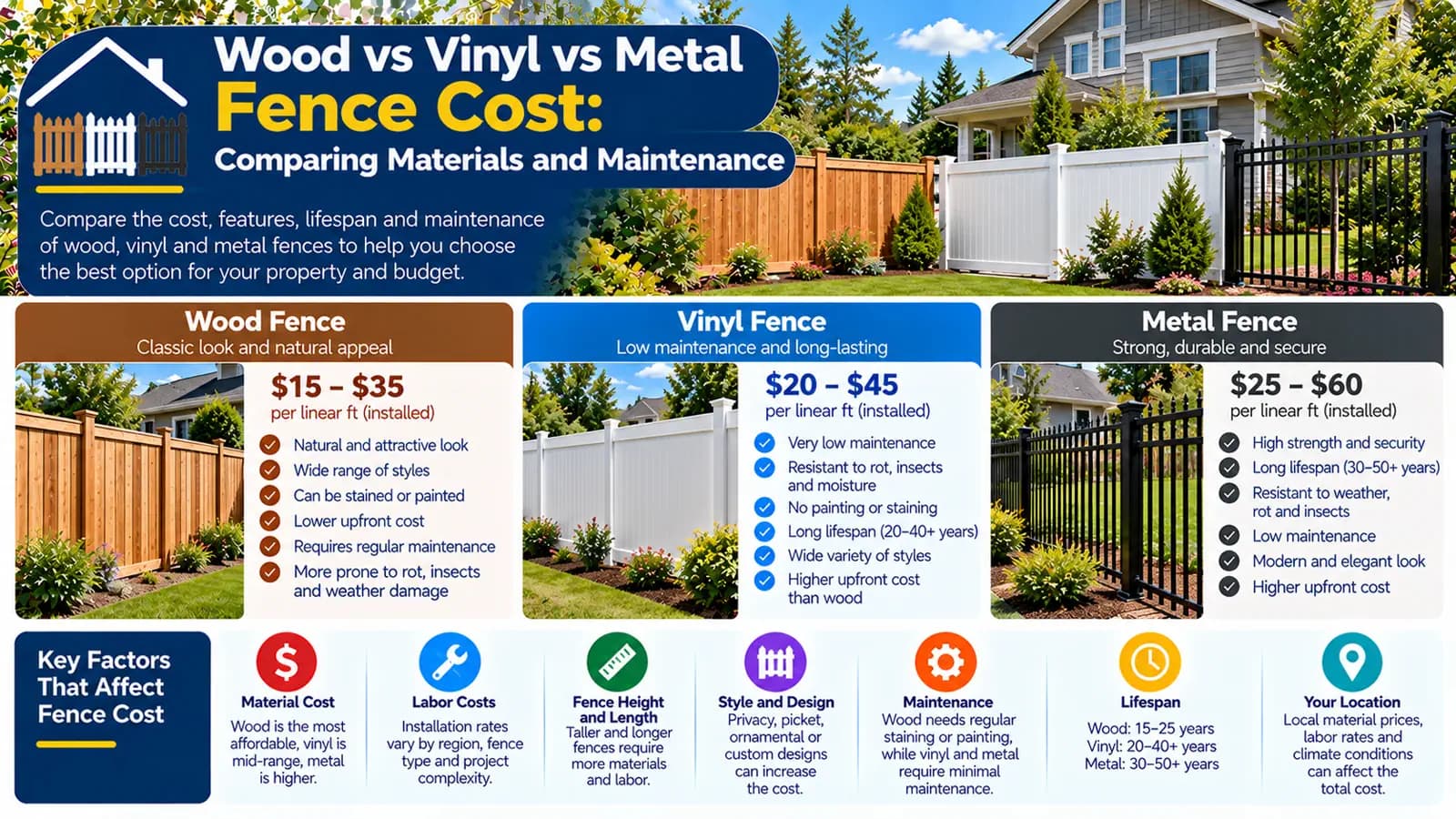
Compare material systems serving the same purpose
| Factor | Wood | Vinyl / PVC | Metal |
|---|---|---|---|
| Common role | Privacy, panels, pickets, rails | Manufactured privacy or picket systems | Chain-link, aluminium, steel, or ornamental systems |
| Cost structure | US baseline; UK panels/closeboard | US premium; not a UK calculator choice | Varies widely by metal and design |
| Maintenance | Inspect wood, finish, fixings, posts | Clean and inspect components and movement | Inspect coating, corrosion, fixings, and gates |
| Repair | Boards, rails, or panels may be replaced | Matching proprietary profiles can matter | Mesh, panels, rails, welds, or coatings differ |
| Privacy | Depends on board or panel layout | Solid systems can screen | Chain-link and ornamental systems are normally open |
How material changes the calculator estimate
The US model uses wood at $10 to $45 per linear foot as its installed baseline. Chain-link reduces the range by $2 to $8 per foot, while vinyl adds $5 to $16, aluminium adds $8 to $35, and composite adds $4 to $18. Height, removal, gate, and terrain remain separate.
The UK model does not offer vinyl as a primary material choice. It uses timber panels as the £55 to £100 per-metre baseline, closeboard adds £15 to £40, composite adds £55 to £120, and metal adds £40 to £110. Post type, height, removal, and gate scope are separate.
Wood: flexible design with an exposure-specific care plan
Wood can form solid panels, closeboard fencing, pickets, or rails and can be cut or repaired on site. Species, treatment, grade, post exposure, end cuts, fixings, drainage, and finish affect the system. USDA preservation guidance distinguishes exterior and ground-contact exposures, reinforcing why posts and boards should not be specified as though they face identical conditions.
Vinyl or PVC: a US option with product-specific details
Vinyl is an explicit US calculator choice but not a UK one. Posts, rails, panels, reinforcement, movement, gates, impact repair, colour, and compatible replacement parts vary by manufacturer. Ask how the system is detailed for wind, slopes, temperature movement, and future repairs rather than describing it only as low-maintenance.
Metal is not one fence type
Chain-link uses mesh, posts, rails, tension components, and optional coatings. Aluminium systems are commonly modular and lighter than many steel or traditional ornamental systems. Steel and ornamental metal may involve different weight, fabrication, welds, finishes, foundations, and corrosion protection. Compare the exact metal, coating, section sizes, and gate hardware.
Weather, moisture, corrosion, and terrain
Wood-decay risk, coating breakdown, corrosion, impact, UV exposure, salt, wind, soil moisture, and drainage vary by property. Slopes can favour stepped or raked systems depending on material and design. No material eliminates the need for suitable posts, foundations, clearances, drainage, and local specification.
Compare maintenance and ownership cost
- Choose equivalent height, privacy, gate, and layout requirements.
- Run each market-supported material with the same length and site options.
- Add system-specific posts, hardware, finishes, and access from written quotes.
- Model inspections, cleaning, finish renewal, corrosion repair, damaged components, and gate service as applicable.
- Use ranges instead of assuming one material has a guaranteed service life.
Match the material to the project priority
| Priority | Question to answer |
|---|---|
| Privacy | Does the quoted design provide continuous screening at the required height? |
| Open boundary | Would chain-link or ornamental metal meet appearance and security needs? |
| Easy local repair | Are compatible boards, panels, profiles, coatings, and hardware available? |
| Sloping site | Can the system rake, or will stepping create unacceptable gaps? |
| Low upkeep | What cleaning, inspection, finish, and repair work does the manufacturer require? |
Use the Fence Installation Cost Guide to define the complete project before isolating material choice. There is no universal winner when privacy, site, appearance, repair, and market availability differ.
Plan with the right calculator
Enter your project details and select the United States or United Kingdom market for Low, Typical, and High planning estimates.
Frequently asked questions
Which fence material costs the least?+
In the current US model, chain-link adjusts below the wood baseline; vinyl, aluminium, and composite adjust above it. UK material choices and market relevance differ, so compare native profiles rather than converting prices.
Is metal fencing one material category?+
No. Chain-link, aluminium, steel, and ornamental systems differ in structure, finish, privacy, corrosion protection, weight, and installation. Define the actual system before comparing quotes.
Does vinyl fencing have the same role in the UK?+
No. Vinyl or PVC is an explicit US calculator choice, while the UK profile focuses on timber panels, closeboard, composite, and metal fencing.
Which material lasts longest?+
There is no reliable universal answer without a product, exposure, installation, finish, and maintenance plan. Compare warranties and technical requirements for the exact systems being quoted.
Which material is best for privacy?+
Privacy depends on the fence design and gap pattern as much as the base material. Solid timber, vinyl, or composite systems may provide screening; open metal systems serve different goals.
Sources & references
- Planning Permission: Fences, Gates and Garden Walls · Planning Portal
- Wood Handbook, Chapter 15: Wood Preservation · USDA Forest Products Laboratory
- How Much Does Fence Installation Cost? · Angi
- Fence Panel Installation Cost Breakdown · Checkatrade